
A good patio checkers board is easy to read in shifting daylight, stays usable through a light breeze, wipes clean according to its maker's directions, and packs away indoors after the game. For most families, that means a portable tabletop board for a dry, covered patio—not equipment advertised for permanent outdoor exposure.
This guide compares board categories and fit criteria, not named products or hands-on test results. Material, weight, dimensions, cleaning directions, and moisture limits vary, so verify the current listing and manufacturer care guidance before buying.
As an Amazon Associate, The Good Chess & Checkers may earn from qualifying purchases.
Product-category guide
Start with a dry table and indoor storage
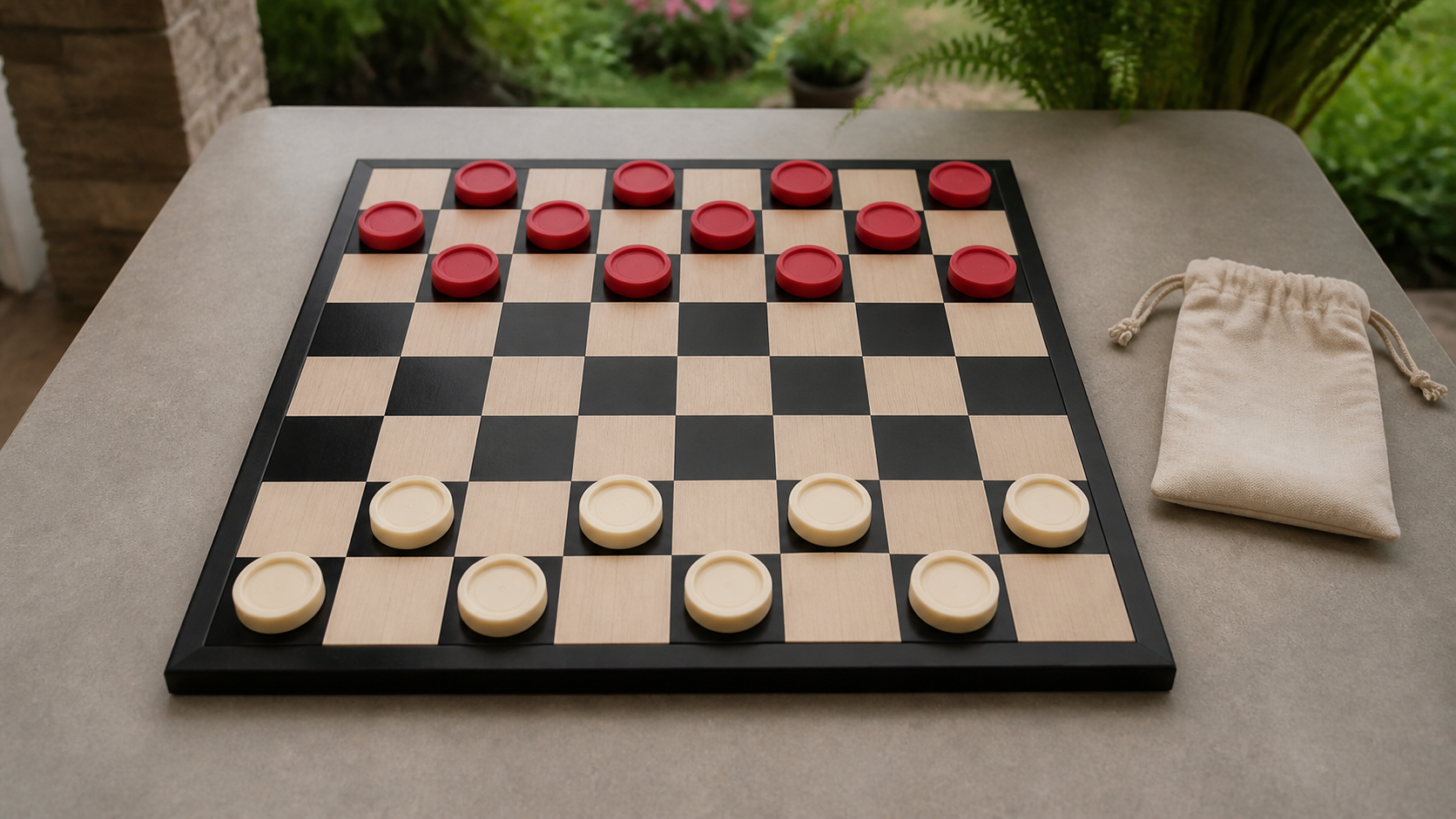
Compare matte contrast, board flatness, checker stability, complete storage, and maker-approved cleaning. An ordinary portable board can suit occasional covered-patio play without being weatherproof.
What matters on a patio
- Low-glare contrast: matte dark and light squares are usually easier to follow than glossy surfaces when daylight shifts across the table.
- Board flatness: rigid boards sit predictably on a level table; flexible boards need a clean flat surface and corners that will not curl into a breeze.
- Piece stability: broad, moderately substantial checkers are less easily nudged than tiny lightweight discs. Confirm dimensions and weight rather than assuming.
- Kinging: pieces should stack securely or provide another obvious way to mark kings.
- Complete storage: a pouch, lidded compartment, or folding case helps keep all 24 checkers together between games.
- Care limits: “wipe clean” does not mean waterproof, sunproof, or safe to leave outdoors. Follow the maker's current directions.
Best all-around: matte rigid boards with a storage pouch
A rigid board is the simplest choice for a stable covered-patio table. It needs no unrolling, and a matte surface can reduce distracting reflections. Look for an eight-by-eight grid with enough contrast to distinguish playable dark squares, plus checkers that fit comfortably inside each square.
Best for: homes where the board moves a short distance from an indoor shelf to a level patio table.
Skip it if: storage space is narrow, the board must fit in a backpack, or the table is frequently damp or uneven.
Best for compact storage: folding checkers boards
Folding boards reduce shelf width and may store the pieces inside. Before buying, check whether the opened board lies flat, whether the center seam interrupts piece movement, and whether the latch and internal compartments hold every checker securely. A wooden-looking finish is not evidence that a board tolerates moisture.
Best for: small homes, shared game shelves, and players who want board and pieces in one closing package.
Skip it if: a raised center seam bothers the players or the storage insert makes setup and cleanup fussy.
Best for easy carrying: roll-up or flexible boards
A flexible board can be light, compact, and straightforward to wipe when its care instructions allow. The patio tradeoff is wind: curled or lifted corners can disturb a game even when the pieces themselves stay put. Check the open dimensions, material, and storage method, and plan to roll rather than sharply fold a board when directed.
Best for: carrying the set between rooms, vacation rentals, or a patio table that is broad, clean, and flat.
Skip it if: the patio is breezy, the tabletop has gaps or texture, or no suitable tube or bag is available.
Best for breezy tables: magnetic travel boards
Magnetic pieces can resist small bumps and light air movement, but travel sets are often smaller. Compare checker diameter and thickness with the square size, and make sure stacked kings remain recognizable and stable. Choose the smallest board only if both players can handle and distinguish the pieces comfortably.
Best for: small covered tables, occasional breezes, and households that also want a travel set.
Skip it if: either player finds small pieces tiring, the board feels cramped, or a relaxed full-size game matters more than portability.
Quick comparison framework
- Choose rigid and matte when easy setup and readability matter most.
- Choose folding when the board and pieces need one compact closing case.
- Choose roll-up or flexible when carrying and narrow storage matter more than breeze resistance.
- Choose magnetic when piece retention matters more than generous piece size.
Pre-purchase checklist
- Measure the patio table and the indoor shelf, drawer, bag, or bin where the set will live.
- Confirm an eight-by-eight board, 12 checkers per side, and a clear method for marking kings.
- Compare checker diameter with square width; pieces should not crowd adjacent squares.
- Check open size, packed size, board material, total weight, finish, and included storage.
- Read current cleaning, moisture, heat, and sunlight guidance from the maker.
- Plan to count the pieces and return the complete dry set indoors after each game.
Who should skip a patio-specific purchase?
Skip another board if your existing checkers set is readable, easy to carry to a dry covered table, and simple to return indoors. A closing checkers storage bag or case may solve the real problem for less space than a second complete set.
Also skip ordinary tabletop categories if you need equipment that will remain outside, tolerate rain, or work directly on a lawn. Those are different requirements. Compare the giant checkers guide for large-ground formats, while still checking the maker's surface, care, and storage limits.
Bottom line
For most covered patios, a matte rigid board with readable stackable pieces and a closing storage pouch is the easiest choice. Folding boards save shelf space, flexible boards carry easily, and magnetic boards help on small or lightly breezy tables. None should be treated as permanently weatherproof without explicit current manufacturer guidance: play in dry conditions, then store the complete set indoors.