
A comfortable checkers set is easy to read at a glance, simple to pick up, and quick to put away. For an older beginner, returning player, or shared family table, those practical details usually matter more than decorative wood, travel-small dimensions, or tournament-style language.
This is a category comparison, not a ranked list of named products or a claim that one format works for every person. Start with the actual player, table, and storage routine. Ask what is easy to distinguish and handle rather than assuming age alone determines the right set.
As an Amazon Associate, The Good Chess & Checkers may earn from qualifying purchases.
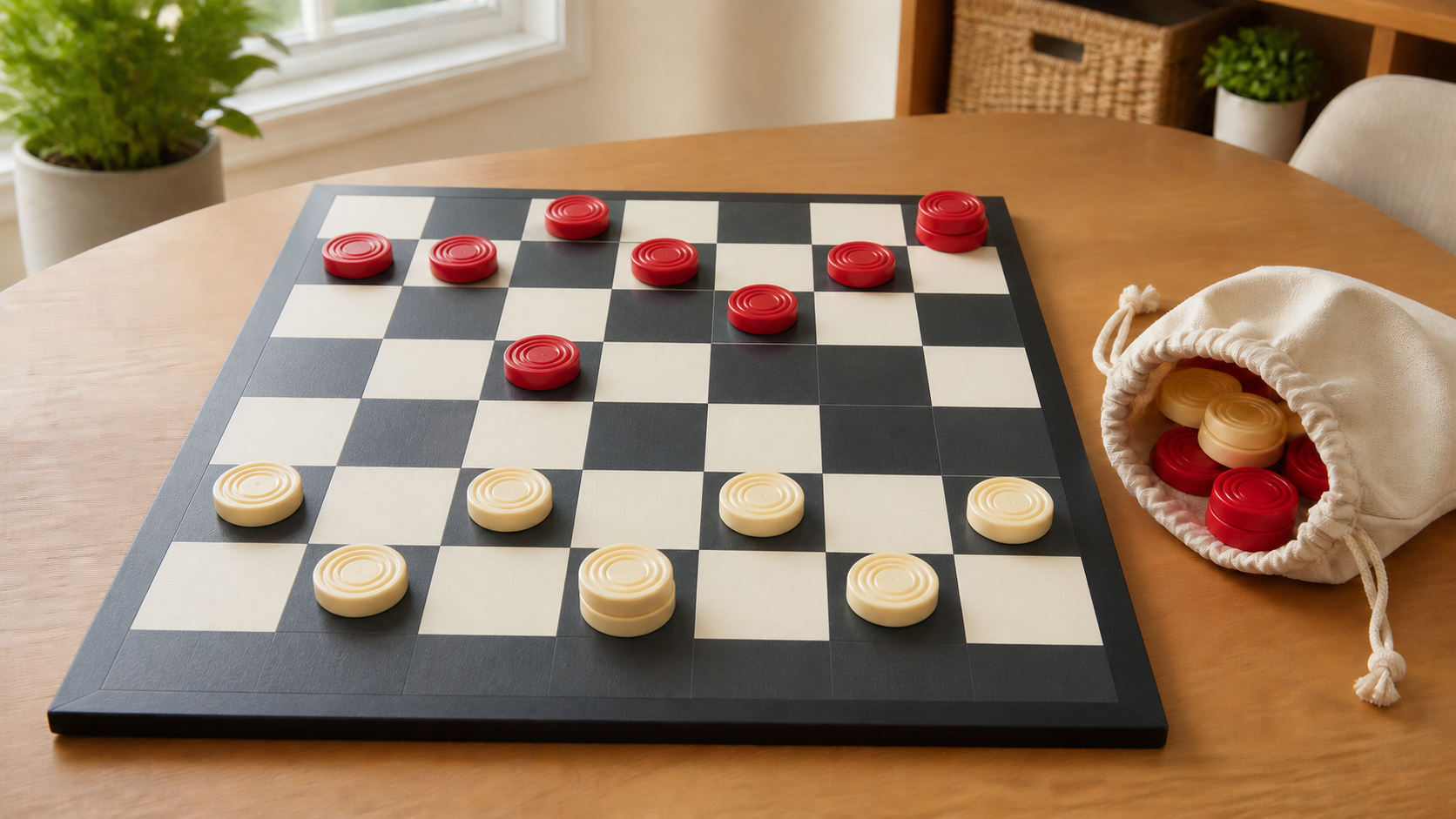
Compare the visible parts first
Browse larger, high-contrast checkers sets
Look for listings that state the board dimensions, square size, checker diameter and thickness, included piece count, and storage method. Product photos should confirm contrast and kinging, but measurements are the better fit check.
What makes a checkers set easier to use?
- Square contrast: dark and light squares should remain clearly different in the room where the set will be used, without glare erasing the boundary.
- Piece contrast: both colors should stand apart from each other and from the playable squares. Avoid two similar wood tones if they merge under warm lighting.
- Checker diameter: a wider checker gives fingers more surface, but it still needs space inside its square. Verify both measurements instead of trusting “large” in a title.
- Checker thickness and edge: thicker pieces or a defined rim may be simpler to lift from a flat board than thin, flush discs.
- Stable kings: two pieces should stack without sliding easily. If the set uses a separate king marker, make sure it is obvious and included.
- Board stability: a flat board with a nonslip or steady base is usually less frustrating than a very light board that shifts during captures.
- Storage: a single roomy pouch, lidded compartment, or simple box is easier to inventory than tight molded slots.
Best overall format: full-size high-contrast set
A full-size flat board with strongly contrasting squares and substantial checkers is the clearest starting category. It leaves room between pieces, keeps the whole position visible, and avoids the tiny components common in travel sets. Confirm the complete table footprint before buying: a readable set is not useful if it overhangs the table or must be packed away midgame.
Best for: a dining table, card table, community-room table, or permanent game corner with enough storage nearby.
Skip it if: the board is too large for the usual surface, the finish creates glare, or the pieces are wide but unusually thin and hard for the intended player to lift.
Best for easier piece handling: thick, wide checkers
Prioritize published diameter and thickness over vague labels such as jumbo or oversized. Compare the diameter with the board's square width so pieces do not crowd diagonal moves. A visible rim or shallow groove can provide a clearer edge, while rounded, polished sides may feel slippery to some players. Let the actual user choose when possible.
Best for: players who prefer a more substantial disc and families that want pieces that are easy to sort.
Skip it if: the checkers nearly fill each square, stacks wobble, or the extra size makes the set cumbersome to store.
Best for clear kinging: stable stackable pieces
In American checkers, a common family method marks a king by stacking a second checker on top. Look for flat mating surfaces or shallow rings that help two pieces stay aligned. The set also needs enough spare pieces for crowned stacks during ordinary play. Other checkers variants may mark kings differently, so match the set to the rules you use.
Best for: players who want king status visible without separate markers or memory aids.
Skip it if: the pieces are domed, stacks slide readily, or a custom kinging method is difficult to replace if a marker disappears.
Best for shared storage: folding board with simple compartments
A folding board can protect the pieces and reduce shelf space, but inspect the hinge, latch, interior depth, and setup process. Loose, open compartments or a roomy pouch are often faster than fitted slots that require every checker to be pressed into place. Check that the unfolded board lies flat.
Best for: a shared game shelf or multipurpose table that must be cleared after play.
Skip it if: the seam interrupts play, small latches are awkward for the intended user, or the closed set becomes heavier than they want to move.
Quick comparison framework
- Choose a full-size flat set when maximum visibility and an open board matter most.
- Choose thicker, wider pieces when lifting and sorting thin discs is the main frustration.
- Choose stack-friendly pieces when crowned kings must be instantly clear.
- Choose a folding set when simple all-in-one storage matters more than the flattest possible board.
- Choose a combo set only if chess will genuinely be played too; otherwise the extra pieces add inventory and storage work.
Measure before ordering
- Measure the clear tabletop area, including room for captured pieces and players' arms.
- Check the board's open dimensions and divide its playable width by eight if the listing omits square size.
- Compare checker diameter with square width; leave visible clearance rather than choosing pieces that fill each square.
- Check checker thickness, edge shape, and whether two pieces stack securely to mark kings.
- Count the included pieces by color and confirm how replacements could be matched later.
- Review closed dimensions, total weight, latch style, and storage method with the person who will move the set.
- Look at the real playing-room lighting and avoid glossy combinations that lose contrast in glare.
Who should skip these categories?
Skip an age-labeled recommendation when the intended player already has a format they enjoy. A familiar ordinary set may be better than a larger one that crowds the table. Skip travel-small boards when visibility is the priority, decorative boards when the square boundaries are unclear, and heavy folding sets when moving the case creates more friction than a flat board and separate pouch.
If the shopper only needs larger replacement discs, use the large checkers pieces guide and measure the existing squares first. If the buyer is new to the game and has no age-specific handling preference, the broader beginner checkers set guide is the simpler starting point.
Bottom line
The best checkers set for an older adult is the one that suits that person's eyes, hands, table, and storage routine—not the set with the strongest age claim. Start with high contrast and a stable full-size board, then compare checker diameter, thickness, king stacks, weight, and cleanup. When possible, show the intended player the measurements and product photos before ordering.