
A chess book stand solves a specific desk problem: it keeps a book open and readable while leaving both hands free to replay moves on a physical board. The best format is the one that safely supports your heaviest study book without taking the space your board needs.
This is a category comparison, not a named-product ranking or hands-on test. Verify current dimensions, stated capacity, materials, folded size, and return terms on the listing before buying.
As an Amazon Associate, The Good Chess & Checkers may earn from qualifying purchases.
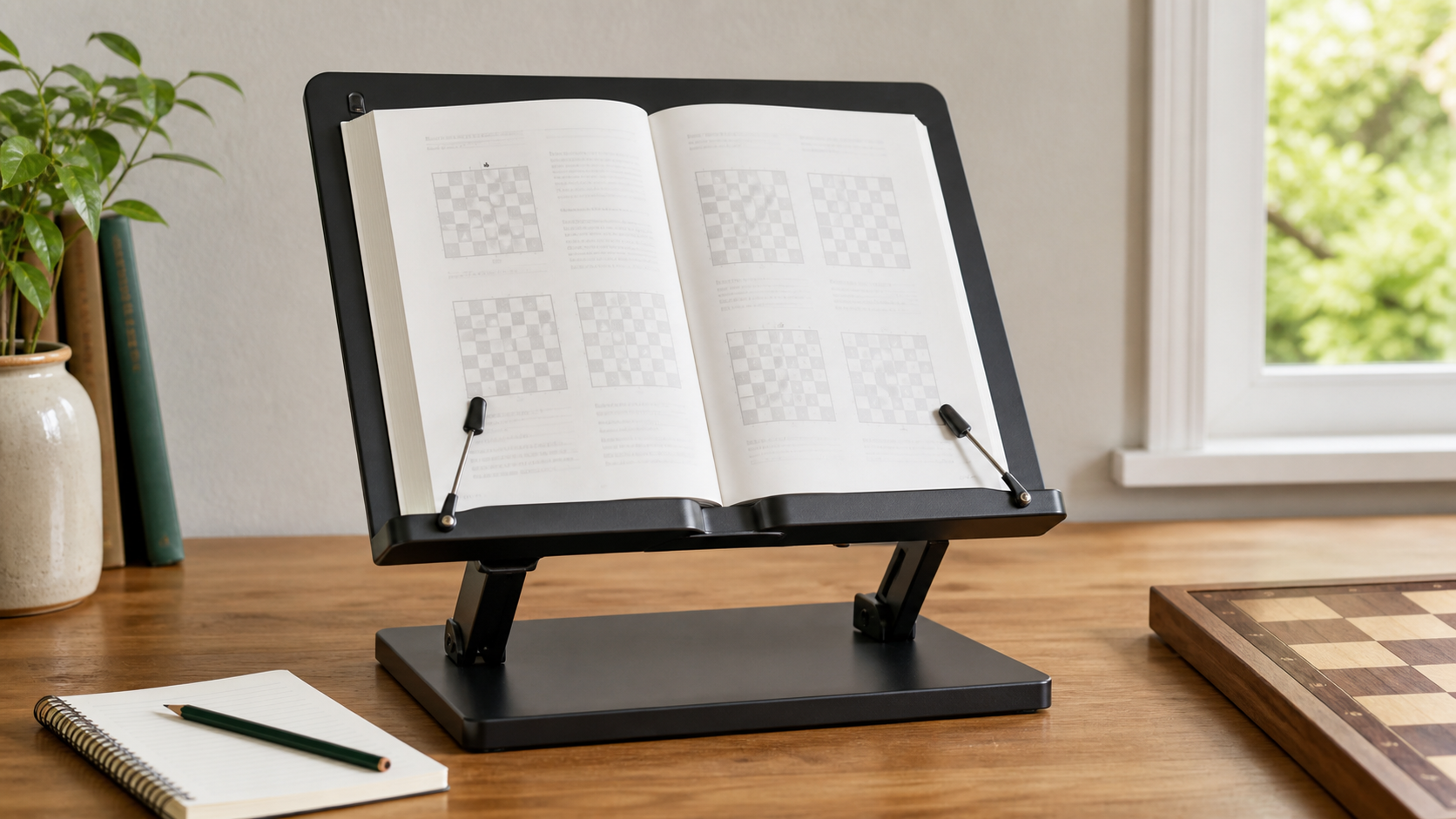
Product-category guide
Start with the book you actually study from
Measure its open width, thickness, and weight, then compare ledge depth, page clips, angle settings, base footprint, and folded storage.
Quick comparison framework
- Book fit: compare the open book's width and thickness with the stand's support panel and ledge.
- Page control: clips should hold springy pages without covering diagrams or making page turns needlessly awkward.
- Angle adjustment: several stable positions are more useful than a large range that slips under weight.
- Board-side footprint: measure the base together with the board, captured-piece area, and notebook.
- Stability: a broad base and secure hinges matter more than decorative material.
- Storage: check folded thickness if the stand must share a shelf or travel bag with books and chess gear.
Best for heavy reference books: wide rigid stands
A wide metal, wood, or reinforced-plastic stand spreads the load of a thick book and gives both covers support. Look for a ledge deep enough for the closed page block, not just a thin tablet. Confirm stated size or capacity rather than assuming a large-looking product photo proves fit.
Best for: large hardbacks, reference books, and a study space that can remain set up.
Skip it if: its base crowds the board or you mostly use slim paperbacks that need less support.
Best for changing diagrams quickly: stands with gentle page clips
Page arms help when a new book resists lying flat. The useful design lets you release and reset one side without knocking the stand or hiding the lower ranks of a diagram. Avoid relying on vague claims about page protection; inspect the clip shape and contact area yourself.
Best for: exercise books, paperbacks, and frequent page changes during a session.
Skip it if: the clips cover notation, press awkwardly on fragile pages, or require two hands every time you advance.
Best for a shared desk: folding portable stands
A folding stand can clear away with the book when work or dining resumes. Compare the folded dimensions, hinge locks, and number of loose parts. A very light stand is convenient to carry but may shift when a large book is opened unevenly.
Best for: multipurpose tables, club bags, and study setups that cannot stay assembled.
Skip it if: portability makes the base too narrow for your book or setup and folding take longer than simply laying the book flat.
Best when desk depth is tight: compact low-profile stands
A shallow stand can sit behind or beside a compact board, but check the full depth at your preferred angle. Tilting the support backward may require more desk depth than the base measurement suggests. Test the plan with paper rectangles before ordering.
Best for: compact boards and short study sessions on a small desk.
Skip it if: the stand pushes the book too far away to read or a flat book beside the board already fits.
What to measure before buying
- Open the largest chess book you expect to use and measure its width, height, thickness, and approximate weight.
- Lay out your board, book, notebook, and captured-piece space on the real desk.
- Check support-panel width, ledge depth, base depth, and the product's folded dimensions.
- Look for page holders that reach the pages without hiding the diagrams you use.
- Confirm how the angle locks and whether adjustment points remain stable under the stated load.
- Ignore unsupported learning, ergonomic, or posture claims; choose by observable fit and setup friction.
Who should skip a chess book stand?
Skip one if your books already lie open, you study mostly from a screen, or the stand would force you to use an uncomfortably small board. A heavy object improvised as a page weight may also be enough when it does not damage the book or obstruct the diagram. If the real problem is board footprint, start with the analysis-set guide before adding another accessory.
Bottom line
Choose a wide rigid stand for heavy books, effective page clips for springy pages, a folding model for shared spaces, or a low-profile format for a shallow desk. Measure the complete board-study layout first. Stable support, visible diagrams, easy page turns, and a sensible footprint matter more than premium-looking materials.