
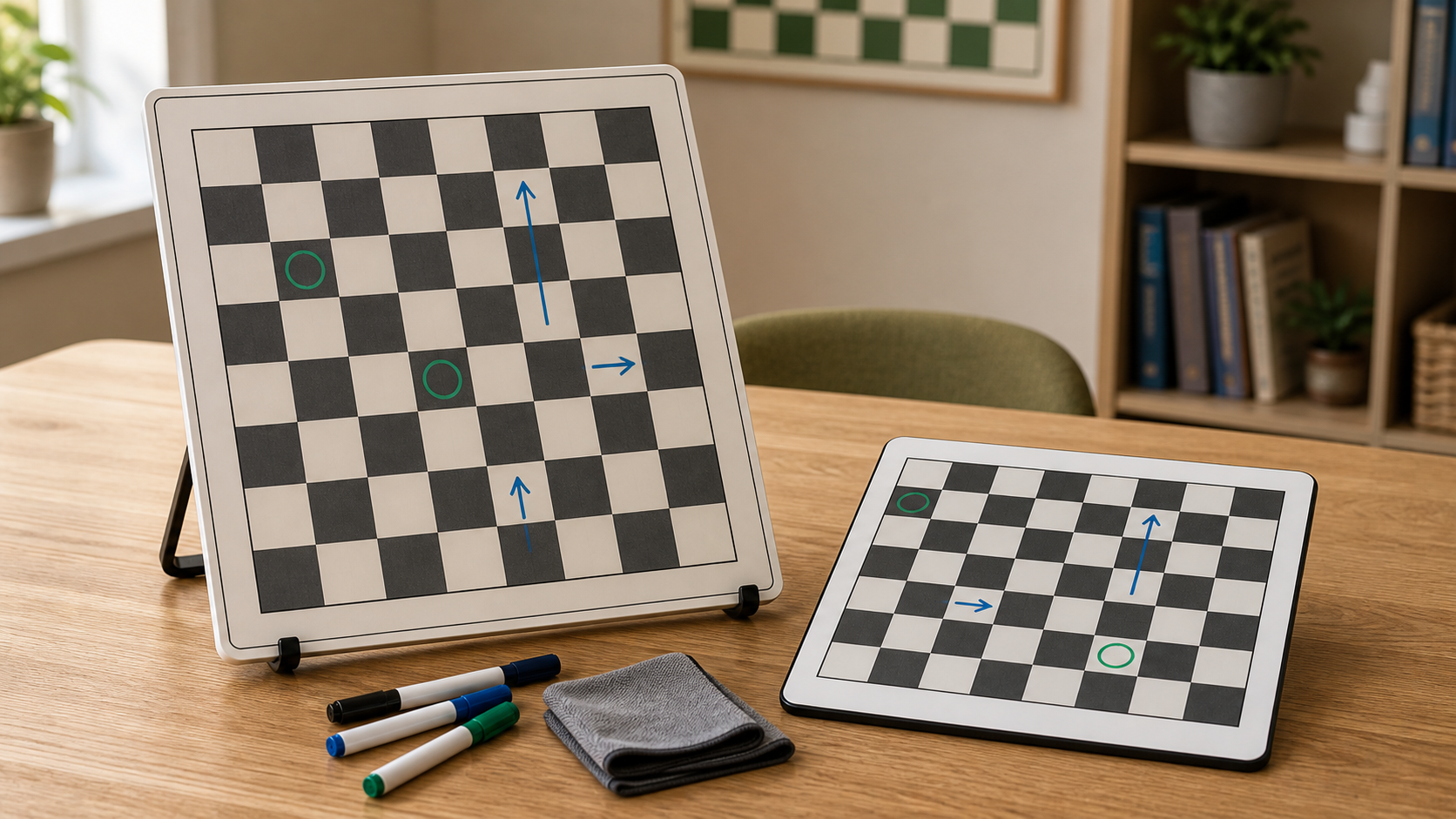
A dry-erase chess board can make a lesson easier to follow because a teacher can circle a square, draw an attack line, or mark a planned route and then clear it for the next position. The useful choice is a real 8-by-8 chess grid whose writing surface, size, and setup match the number of learners watching.
This is a product-category comparison, not a named-product ranking or hands-on test. Listings change, so confirm dimensions, included accessories, surface care, mounting method, and return terms before buying.
As an Amazon Associate, The Good Chess & Checkers may earn from qualifying purchases.
Product-category guide
Start with viewing distance and lesson style
Choose the board size first, then compare square contrast, usable writing area, compatible markers, cleaning instructions, support or mounting, and storage.
Selection criteria that matter
- A true chess grid: verify that the board has exactly 64 squares in an 8-by-8 arrangement and that the corner orientation is easy to establish.
- Grid clarity: square boundaries and any coordinates should stay visible after arrows or circles are added.
- Writing area: larger squares allow readable marks without covering the whole position; small boards suit one learner more than a room.
- Marker compatibility: follow the seller or maker's instructions for marker type. Do not assume every erasable marker is suitable for every coated surface.
- Cleanup: look for explicit care directions and a surface that can be cleared between examples without complicated supplies.
- Support: tabletop boards need a stable stand; wall boards need an appropriate mounting method. Use only the supplied or manufacturer-specified hardware.
- Storage: check whether the board folds, rolls, hangs, or stores flat and whether markers and cloths have a reliable place.
Best for one learner or a parent-and-child lesson: lap-size boards
A compact rigid board keeps the position close enough for two people to discuss. It can work flat on the table or on a small stand if the listing supports that use. Choose squares large enough for distinct arrows and circles, especially if coordinates are already printed around the grid.
Best for: home lessons, tutoring, puzzle explanations, and short review sessions.
Skip it if: several learners must see the board from across a room or the small squares turn every annotation into clutter.
Best for a small group around a table: freestanding demonstration boards
A larger board on a stable easel can face three or four learners while leaving the table available for their own chess sets. Check the stand depth, viewing angle, and whether the board can be written on without tipping. A strong visual grid is more important than a crowded set of printed labels.
Best for: family groups, tutoring tables, and small club instruction.
Skip it if: the stand consumes the playing area, wobbles under light writing pressure, or folds into an awkward package for your storage.
Best for a room-facing lesson: wall or hanging boards
A large vertical board makes the position visible to more learners and lets the teacher annotate without gathering everyone around one table. Confirm whether pieces are drawn, magnetic, pocketed, or absent; a writable grid alone may be best for explaining routes, while move-by-move positions need a dependable piece system.
Best for: recurring lessons where the board can stay in one teaching area.
Skip it if: you cannot follow the specified mounting instructions, need a board that travels often, or learners mostly practice in pairs at their own boards.
Best low-cost alternative: a reusable clear overlay
A purpose-made transparent writing layer placed over a printed chess diagram or suitable board can preserve a familiar grid while allowing temporary marks. Confirm that the overlay lies flat, is intended for compatible erasable markers, and cannot transfer residue to the board below.
Best for: occasional annotations when you already own a readable teaching board.
Skip it if: glare makes the position harder to see, the layers slide, or the underlying board surface could be marked or damaged.
Quick comparison framework
- Choose lap-size for one learner and close conversation.
- Choose freestanding tabletop for a small group sharing one example.
- Choose wall or hanging when viewing distance is the main constraint.
- Choose a clear reusable overlay when annotations are occasional and your current grid is already readable.
- Choose an ordinary board instead when learners need to move real pieces more than they need drawn explanations.
Pre-purchase checklist
- Count the learners and measure the farthest expected viewing distance.
- Verify an 8-by-8 grid, readable square boundaries, and useful coordinate orientation if coordinates are included.
- Check overall dimensions and square size rather than relying on a room-scene product photo.
- Confirm whether chess pieces, markers, eraser, stand, storage, and mounting hardware are included.
- Read the stated marker and cleaning instructions; avoid unsupported claims that a surface never stains or ghosts.
- Plan where the board and loose accessories will be stored between lessons.
- Ignore vague “professional” or “classroom approved” language unless the listed specifications fit your actual lesson.
Who should skip a dry-erase chess board?
Skip this category if the learner mainly needs hands-on piece movement, if an ordinary board plus verbal explanation is already clear, or if the board would only add another setup step. A reusable chess puzzle card may suit short individual exercises, while a piece-by-piece teaching approach may help a brand-new learner more than drawn arrows.
Bottom line
Choose a dry-erase chess board by who needs to see it and what must be marked. Lap-size boards fit one learner, freestanding boards fit a small table group, wall boards fit longer viewing distances, and overlays fit occasional annotation. A clear 8-by-8 grid, enough writing room, stated marker care, stable support, and sensible storage are the practical deciding factors.