
A wall chess board can keep one position visible while a learner studies it over several short sessions. That makes it different from a travel magnetic set, which solves movement, and a classroom demonstration board, which is mainly built for a group to see at once. At home, the useful questions are whether the board fits the room, remains readable from the usual study spot, holds every piece reliably, and can be mounted according to its maker's instructions.
This guide compares product categories and measurable fit, not named winners. It does not claim hands-on testing, current prices, ratings, availability, or that one mounting method suits every wall. Confirm the current listing, included hardware, dimensions, piece set, and manufacturer instructions before buying or installing anything.
As an Amazon Associate, The Good Chess & Checkers may earn from qualifying purchases.
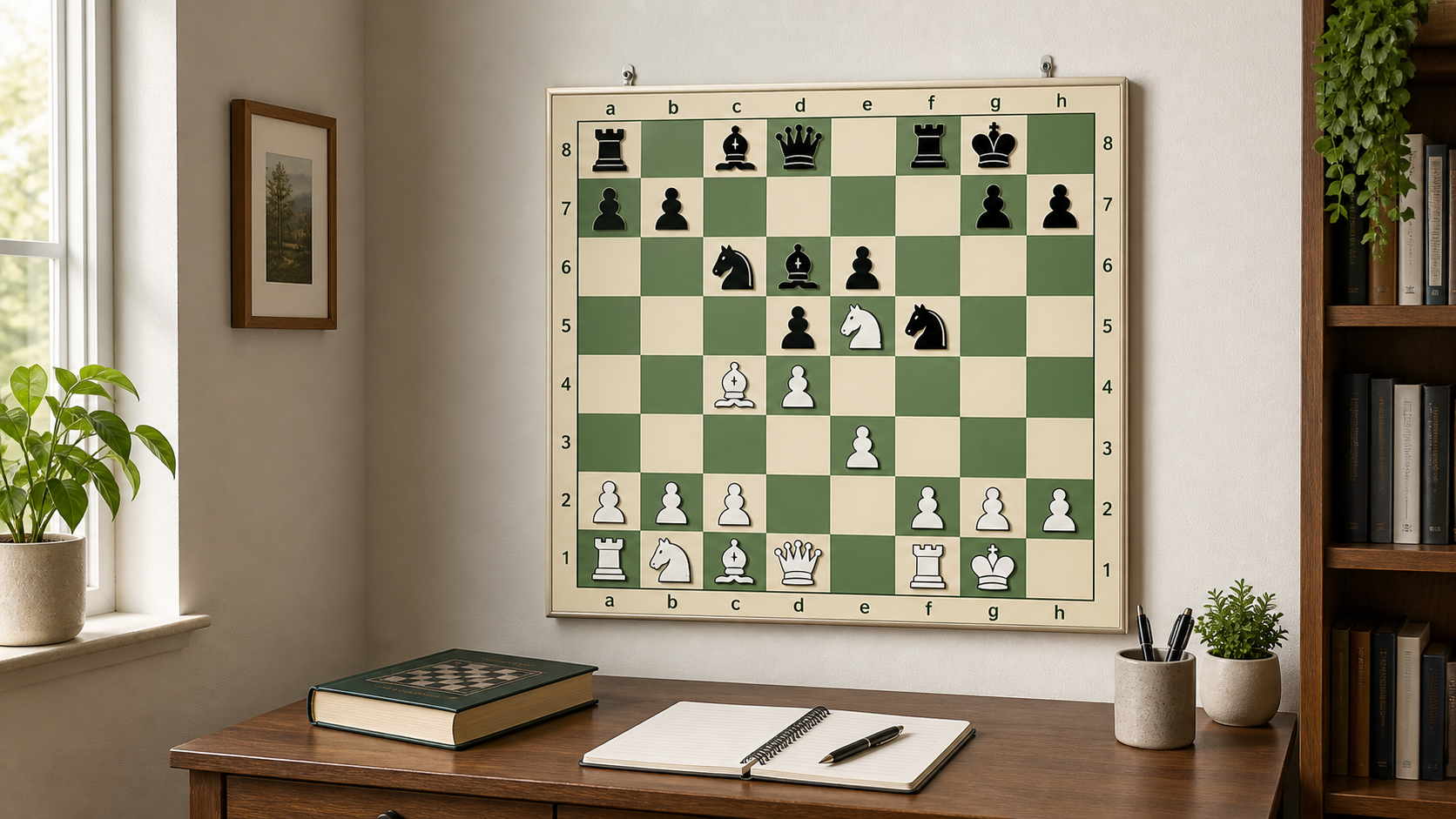
Keep a position visible between sessions
Compare magnetic wall chess boards by home-study fit
Start with the available wall area and viewing distance, then compare rigid and roll-up formats by square visibility, magnetic piece retention, coordinates, setup effort, and storage.
Start With the Room, Not the Board Label
Measure the clear wall area, the distance from the usual chair or doorway, and the space needed to reach every square comfortably. Record the board's complete outside dimensions rather than judging only the printed grid. A large border, hanging rail, pockets, or folded edge can require more room than the playing area suggests.
- Square visibility: printed pieces and coordinates should remain distinct from the normal viewing position, not only in a close listing photo.
- Piece retention: verify how the pieces attach and whether the listing includes a complete, clearly distinguishable set.
- Position access: the learner should be able to move pieces without stretching over furniture or disturbing nearby objects.
- Mounting instructions: use the manufacturer-specified support and hardware, and match installation to the actual wall construction.
- Glare and contrast: avoid a location where a window or lamp makes the dark and light squares difficult to separate.
- Reset and storage: check where captured pieces go and whether the entire board can be packed away when the room changes use.
Best Overall Format for a Dedicated Study Spot: A Rigid Magnetic Board
A rigid wall board gives the position a flat, consistent surface and can feel natural in a study nook where it will stay in place. A border with coordinates helps learners follow books or notation. The tradeoff is commitment: the board needs a suitable location, and its complete size may dominate a small room.
Best for: a learner with a stable study wall who wants to leave one game, puzzle, or variation visible.
Skip it if: the room is frequently rearranged, the approved mounting method is unsuitable for the wall, or a tabletop board already fits beside the study material.
Best for Flexible Rooms: A Roll-Up Hanging Demonstration Board
A fabric or vinyl hanging board with magnetic or fitted flat pieces can be easier to remove and store than a rigid panel. Confirm the actual attachment system: some demonstration boards use pockets or hook-and-loop pieces rather than magnets, and those formats behave differently. Check whether the board hangs flat and whether its pieces remain readable when viewed at an angle.
Best for: multipurpose rooms where the study display comes down between sessions but the position still needs to be preserved or photographed.
Skip it if: curling, swinging, or a loose hanging surface makes piece placement frustrating, or the board must remain perfectly flat for long periods.
Best for Following Books: A Board With Clear Coordinates
Files are the lettered columns and ranks are the numbered rows. Clear coordinates around the board can reduce lookup friction when a book or lesson names a square such as e4. Check that labels are correctly oriented from White's side and remain visible once the board is installed. Coordinates are a reference aid, not proof that a board meets any tournament standard.
Best for: beginners replaying notation, annotated games, or chess puzzles from a book.
Skip it if: the border labels are too small at the intended viewing distance or the learner already prefers an uncluttered grid.
Best for Shared Family Study: A High-Contrast Board With Simple Pieces
When several people use the display, familiar piece shapes and strong light-dark contrast matter more than decorative styling. Flat magnetic symbols should remain easy to distinguish in a crowded position. Check that spare queens or promotion markers are available if the board will hold complete games rather than only selected exercises.
Best for: families who leave a puzzle or game position where different players can discuss it during the week.
Skip it if: stylized pieces slow recognition, colors blend into the room's lighting, or younger learners would rather move ordinary three-dimensional pieces.
Quick Comparison Framework
- Choose rigid for a permanent, flat display in a dedicated study area.
- Choose roll-up when the board needs to come down and store with less bulk.
- Choose coordinates when lessons and books regularly identify squares by name.
- Choose high contrast and familiar symbols when several beginners will share the display.
- Choose tabletop instead when tactile play, two-sided seating, or easy relocation matters more than a persistent wall position.
Pre-Purchase Checklist
- Measure the full clear wall area and the normal viewing distance.
- Verify an 8-by-8 grid, complete piece set, readable colors, and the attachment method.
- Confirm the board's full outside dimensions, weight, and intended orientation.
- Read the current manufacturer mounting instructions and identify what hardware is included.
- Check the planned location for glare, furniture obstructions, and comfortable reach.
- Decide where captured pieces, spare pieces, and lesson notes will stay.
- Compare the wall format with a normal analysis set before giving up usable wall space.
Who Should Skip a Magnetic Wall Chess Board?
Skip a wall board if you mainly want to play full games face to face, need three-dimensional pieces for recognition practice, cannot use the maker's specified installation method, or do not have a low-glare location with comfortable reach. Renters and people in frequently changing rooms may prefer a tabletop coordinate chess board or a folding analysis set. A wall board also adds little if a digital position already fits the learner's routine better.
Bottom Line
A rigid magnetic wall board is the strongest category fit for a dedicated home study spot because it keeps a position flat and visible. A roll-up hanging board makes more sense in a multipurpose room, while clear coordinates and high-contrast pieces help book study and shared family use. Measure the complete wall space, verify the current piece and mounting details, and choose a tabletop set when active play matters more than leaving a position on display.