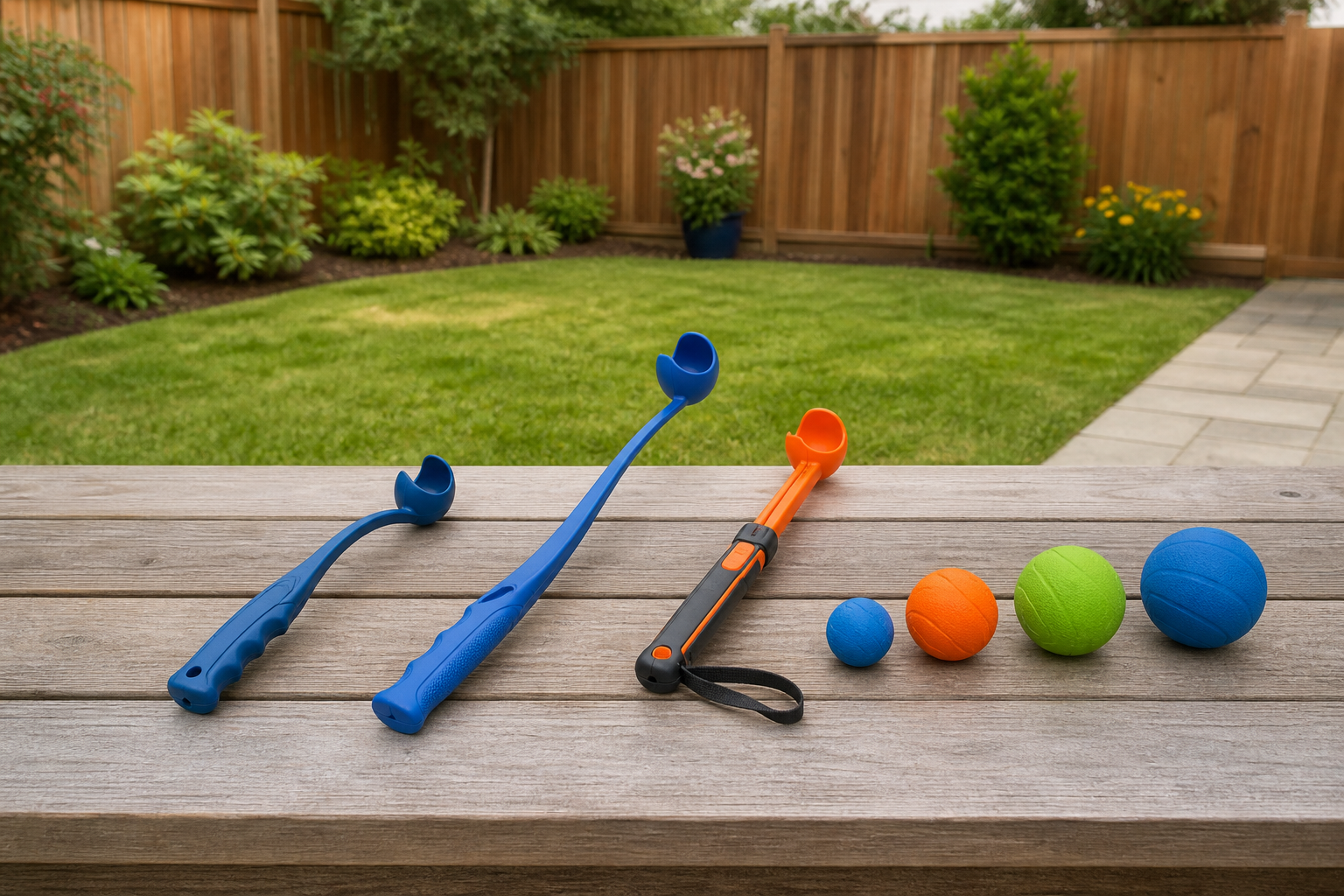
A launcher is a play convenience, not an exercise prescription or a solution for health or behavior concerns. Use it only for supervised outdoor fetch in a clear, securely bounded area. If your dog has pain, limping, breathing difficulty, exercise intolerance, mobility concerns, or a sudden change in willingness to play, stop and ask a veterinarian before continuing.
Quick Comparison: Which Format Fits a Small Yard?
Short scoop launcher: prioritize control and easy storage
A shorter handle is usually easier to store and can make a deliberately gentle toss feel more natural than using a long lever. It does not automatically limit distance: your throwing motion, the launcher’s flex, and the ball all matter. Compare actual length and make sure you can use it without striking a wall, fence, furniture, another person, or the dog.
Medium-length launcher: balance reach with boundary awareness
A medium handle can reduce bending during pickup while remaining manageable in a modest yard. Choose it only if there is clear space behind and above your throwing arm. Practice an empty, slow motion away from the dog before adding a ball, and never assume a manufacturer’s maximum-distance language describes the throw you should make.
Adjustable or compact launcher: useful when storage is tight
A folding, telescoping, or multi-grip format can fit a small shed, entry cabinet, or outing bag. Extra joints and locks also create places to inspect and clean. Confirm that every adjustable section is fully secured before play and retire the launcher if it cracks, loosens, or develops sharp edges.
Selection Criteria That Matter
- Usable yard dimensions: Measure the clear throwing lane, including stopping room before fences, steps, planting beds, patios, and gates.
- Launcher length: A longer handle changes leverage and swing clearance. Choose for deliberate control, not maximum distance.
- Ball diameter: Match the launcher cup and the dog. A ball must not be small enough to swallow or lodge in the mouth or throat; ask a veterinarian if sizing is uncertain.
- Included-ball material: Treat included balls as replaceable play items. Inspect before every session and discard damaged, split, loose, or heavily worn pieces.
- Pickup design: A secure scoop can reduce bending, but it should release predictably without requiring force near the dog’s face.
- Grip and swing room: Check handle texture and wrist comfort, then make sure the chosen motion clears people, pets, structures, and overhead obstacles.
- Cleaning: Follow the maker’s directions. Rinse off dirt and saliva when appropriate, dry completely, and check joints or cup edges for trapped debris.
- Storage: Keep the launcher and balls away from unsupervised chewing and remove them when the game ends.
A Small-Yard Comparison Framework
Start with the yard rather than the product listing. Identify one clear lane, then subtract space around hard edges, gates, garden beds, and anything the dog could collide with. If the remaining lane is very short, hand-tossed or rolled play may be the better choice.
Next, choose the smallest launcher that gives you a comfortable pickup and controlled motion. Compare compatible ball sizes only after confirming an appropriate diameter for your dog. Ignore unsupported “best distance” rankings: more range is not an advantage when the actual goal is a predictable, bounded throw.
Finally, consider the whole session. Repeated sharp turns, jumping, skidding, and hot-weather exertion can matter more than launcher style. Keep sessions brief enough for the individual dog, offer breaks and water, and stop if movement, breathing, or enthusiasm changes.
Who Should Skip a Ball Launcher?
Skip it if an ordinary hand toss or ground roll already fits the yard and your dog. Also skip it when the space has no clear lane, the launcher’s swing would be crowded, the available balls are an uncertain size, or your dog destroys or guards fetch toys. A launcher is not suitable for unsupervised use.
Dogs with pain, injury, mobility limits, breathing concerns, exercise restrictions, or abrupt changes in play should have professional guidance rather than a new throwing tool. For dogs that become frantic, fearful, possessive, or difficult to interrupt around balls, pause the game and consult a qualified trainer or veterinary professional rather than using the launcher to intensify play.
Safer, Quieter Alternatives for Limited Space
A slow ground roll, short hand toss, sniffing game, or appropriately chosen puzzle can be easier to fit into a tight setup. Our guide to choosing supervised puzzle toys covers difficulty, cleaning, and frustration, while the beginner dog puzzle-toy guide compares product formats for calmer indoor enrichment.
The Bottom Line
For a small yard, choose a short launcher for compact control, a medium-length launcher when pickup reach and swing clearance both fit, or an adjustable format when storage matters. Measure the space, verify ball diameter and launcher compatibility, supervise every session, and value a controlled throw over maximum range. If a hand toss or roll fits better, skip the launcher.