We have not hands-on tested or ranked every tool in this category. A pet-hair squeegee is a convenience tool for gathering visible surface fur; it does not deep-clean carpet, remove stains, collect fine dust, or address why a pet may be shedding more than usual.
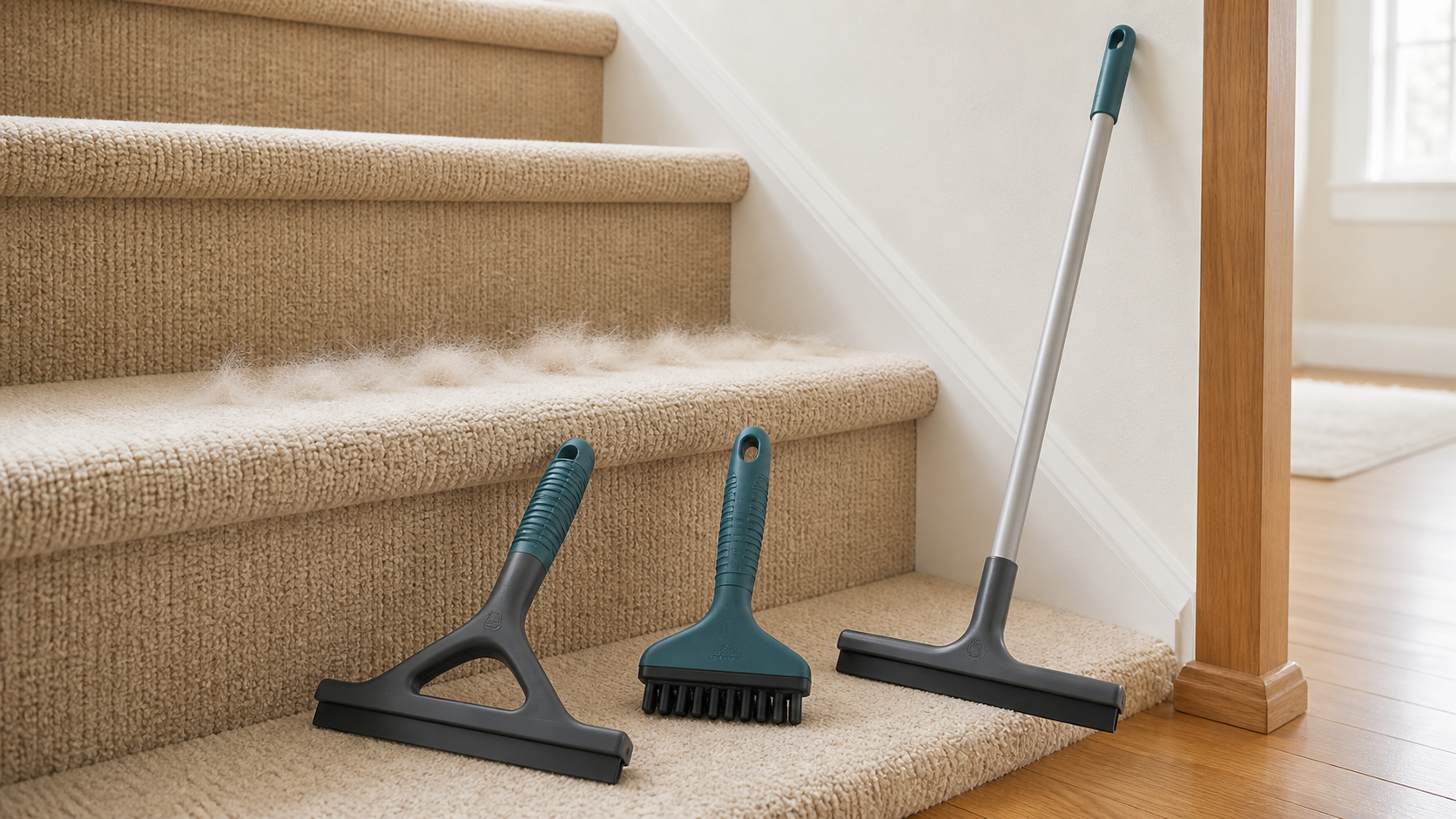
Best Variety for Open Treads: A Handheld Rubber Blade
A compact straight or slightly curved rubber edge gives direct control on the flat center of a tread. Look for a handle that keeps your knuckles clear of the carpet and a blade narrow enough to pull from the back of the tread toward the nosing without striking the wall or balusters.
The tradeoff is bending. A handheld tool may be precise, but cleaning a full staircase can be uncomfortable if you cannot kneel or crouch easily. It also reaches riser corners less effectively than a small bristle head.
Best Variety for Risers and Corners: A Rubber-Bristle Detail Brush
Short rubber nubs or bristles can work around the junction between tread and riser, along a wall edge, and over curved stair nosing. Compare the complete head width with the narrowest area you need to reach. A dense, oversized brush can be just as awkward as a broom.
Use light passes first. Looped, delicate, handmade, loosely attached, or already fraying carpet needs extra caution, and a manufacturer may exclude some surfaces. Stop if the tool snags yarn, lifts an edge, or changes the carpet texture.
Best Variety for Less Bending: A Long-Handled Narrow Squeegee
A long handle can reduce repeated crouching on the middle of each tread, provided the head remains narrow and the handle angle works with your staircase. Compare fixed and telescoping handles, joint stability, assembled weight, and where the tool will be stored.
A handle does not eliminate every awkward reach. Risers, tight turns, and the first few inches beside a wall may still require a compact detail tool. Do not overreach from the top or bottom of a staircase; keep a stable position and work only where you can control the tool.
Selection Criteria That Matter
- Carpet construction: Check the maker's surface guidance and test gently away from view, especially on looped or delicate carpet.
- Head width: Measure the narrowest tread area, inside corner, and distance between a wall and baluster.
- Blade or bristle shape: A blade gathers fur on flatter areas; short bristles usually navigate seams and curves more easily.
- Grip and wrist angle: The handle should stay secure during short pulling passes without forcing the wrist into an uncomfortable bend.
- Handle length: Compare usable reach, adjustment locks, weight, and whether the angle still lets the head contact the carpet.
- Tool cleaning: Fur should peel or rinse away without complicated disassembly. Follow the maker's washing and drying directions.
- Storage: Check hanging holes, blade covers, and assembled dimensions. Keep rubber tools where pets cannot chew them.
- Damage checks: Replace a split blade, loose handle, sharp edge, or shedding bristle section.
Quick Comparison Framework
Measure one tread from wall to open edge, its usable depth, the riser height, and the tightest corner. Then compare each tool on four questions: can the head reach those spaces, is the listed carpet type compatible, can you maintain a stable posture, and can the head be cleaned and dried easily?
Choose a handheld blade when open tread surfaces are the main job, a detail brush when seams and risers hold the most fur, or a long-handled narrow head when bending is the limiting factor. Many households need only one variety because a vacuum already covers the remaining areas.
Who Should Skip a Pet Hair Squeegee
Skip this category when the carpet is delicate, deeply piled, loose, or prone to snagging; when fine dust and grit matter as much as hair; or when manual stair work is uncomfortable or unstable. A compact vacuum with a manufacturer-approved carpet tool may be a better fit. Compare that route in our guide to handheld vacuums for pet hair on stairs.
For broad rugs and hard floors, a full-width tool is faster; see our rubber broom comparison. For sofas, bedding, and car seats, use the surface-based framework in our pet hair remover buying guide.
Stair Cleanup Without Overclaiming
Work from a stable position and use short, controlled pulls rather than forceful scraping. Gather the loosened hair with a dustpan or vacuum, clean the tool, and let it dry before storage. Keep pets away while you clean stairs so the tool, loose fur, and your movement do not create extra clutter on the route.
If shedding increases suddenly or appears with bald patches, irritated skin, persistent scratching, or another concerning change, contact a licensed veterinarian. A cleanup tool cannot identify or treat the cause.
The Bottom Line
The best pet hair squeegee for carpeted stairs is the variety that fits both the stair geometry and your body. Start with a compact rubber blade for open treads, a rubber-bristle detail brush for risers and corners, or a narrow long-handled head when reach matters most. Verify surface compatibility, test gently, and choose a vacuum instead when deeper debris or delicate carpet makes suction the more practical route.