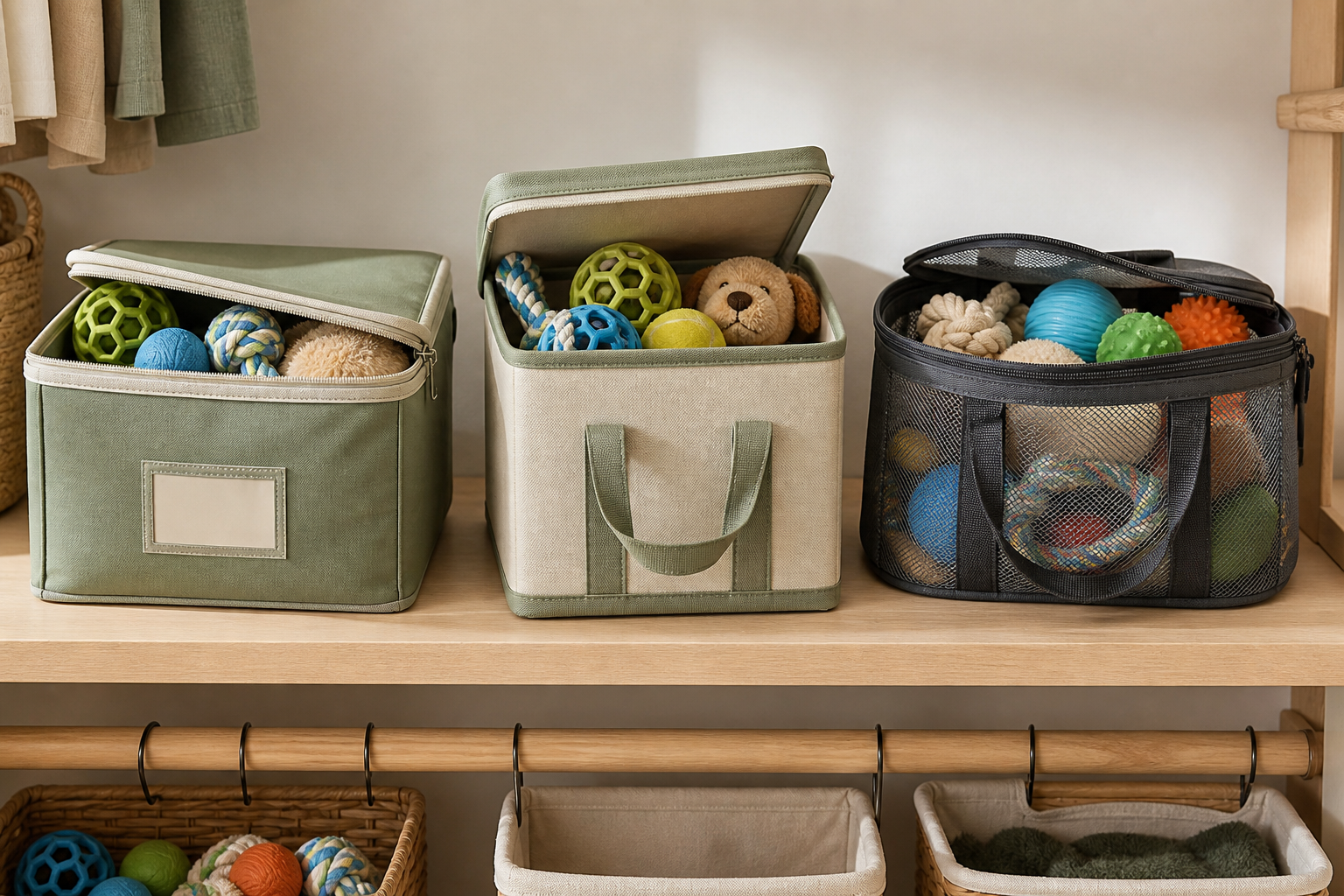
This guide compares storage varieties and buying criteria; it does not rank named products or claim hands-on testing. A closed rotation bag is for clean, dry toys that are temporarily out of use. It is not a place for pet food, medication, grooming chemicals, batteries, damaged toys, or damp items.
Quick Comparison: Which Format Fits?
Zippered fabric bags: best for soft, compressible toys
A rectangular zip bag can hold plush toys, rope toys, and other light items while using the depth of a closet shelf. Flexible sides help it fit around contents, but overfilling makes the bag harder to close, carry, and stack. Look for a zipper that opens across enough of the top to inspect everything without emptying the bag.
Structured lidded cubes: best for orderly shelf storage
A cube keeps a predictable outline and is easier to pull forward by a front handle. It suits owners who want separate rotations labeled by type or play routine. The tradeoff is fixed volume: stiff panels take up their full footprint even when the cube is half empty, and inserts or covered boards may limit washing.
Mesh-sided zip totes: best for seeing fully dry contents
Mesh panels make it easier to identify the next toy group and allow more air movement than solid fabric. That does not make a tote appropriate for damp toys; wash and dry toys completely first. Fine mesh may snag on rough rope ends, hook-and-loop tabs, or damaged toy edges, so inspect both the bag and toys during each rotation.
Selection Criteria That Matter
- External dimensions: Measure shelf width, depth, and height, including the clearance needed to lift a lid or pull the bag past a door frame.
- Opening: A wide top or three-sided zipper makes it easier to inspect every toy and remove one without digging.
- Closure: Use a full closure when pets can reach the shelf, but do not treat an ordinary zipper as pet-proof or child-proof.
- Handles and load: Check where handles attach and avoid packing the bag heavier than you can carry comfortably. Dense rubber toys may need smaller groups.
- Material and structure: Solid fabric hides clutter; structured panels preserve shape; mesh shows contents. Check current material and care information rather than assuming washability.
- Cleaning and drying: Choose smooth interiors and care instructions that match likely dust, fur, and toy residue. Dry every part before refilling.
- Toy separation: Keep clean plush and rope toys apart from outdoor, food-stuffed, or still-damp items when their cleaning routines differ.
- Pet access: Store bags where a pet cannot climb, pull them down, chew handles, or become tangled in straps or loose fabric.
A Simple Comparison Framework
First, measure the shelf and the path from closet to play area. Second, sort only intact toys into small groups that make sense for your routine—for example, quiet indoor toys, supervised fetch toys, or washable fabric toys. Third, compare closure, opening, carrying effort, cleanability, and whether you can see or label the contents. Finally, choose the smallest number of bags that keeps groups distinct without creating forgotten inventory.
This is different from an open living-room toy bin, which prioritizes quick daily access and room footprint. It also differs from under-bed pet supply storage, which can hold clean backup linens alongside selected toys. Closet rotation bags are portable, closed groups meant to move in and out of active use.
Build a Rotation You Will Actually Maintain
Keep one manageable group available and store the others only after checking that each toy is clean, completely dry, and intact. On rotation day, inspect seams, stuffing, cords, squeakers, edges, and small pieces according to the toy maker's guidance. Remove damaged toys rather than returning them to storage.
A rotation is optional enrichment organization, not a behavior treatment or a promise that every pet will show renewed interest. Our simple toy rotation guide explains how to start with toys you already own. Supervise play as appropriate for the toy and your pet, and ask a veterinarian or qualified behavior professional about sudden changes in play, appetite, mobility, or behavior.
Who Should Skip a Closet Rotation Bag?
Skip this setup if the closet is damp, prone to pests, difficult to reach safely, or accessible to a pet that chews fabric and straps. An open daily-use bin may be simpler if you own only a few toys, while a rigid washable container may suit toys that regularly bring in dirt or moisture.
Also skip large bags if lifting them from the shelf is awkward or if they encourage you to store more toys than you can inspect. Avoid storing treat-filled toys with food residue, battery-powered toys with damaged compartments, or anything that has not dried fully after cleaning.
The Bottom Line
Choose a zippered fabric bag for light compressible toys, a structured lidded cube for orderly shelf groups, or a mesh-sided tote when visibility matters. Measure first, keep rotations small, store only clean and dry intact toys, and use a shelf location that is easy for you—but not your pet—to access.