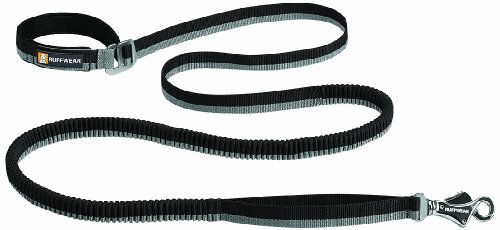
 Ruffwear Crag EX Leash
 Ruffwear Crag Leash
This is a product-selection guide, not a hands-on test and not a promise that reflective material will make a dog visible in every condition. Performance changes with the angle, distance, strength, and source of light, and dirt or wear can reduce reflection. Use a route and schedule you can manage comfortably, stay alert around vehicles and other path users, and follow local leash rules.
Why the Ruffwear Roamer Is the Starting Pick
The Roamer puts reflective trim on a recognizable everyday leash design and can be carried by hand or around the waist. That makes it a sensible first comparison for an owner who wants low-light detailing without buying a single-purpose accessory. The hand-held option is especially useful when you want a simpler grip near crossings or crowded stretches.
Its elastic section is a real tradeoff rather than an automatic benefit. It may soften small pace changes, but it also changes feedback and can feel less predictable than static webbing. Choose a Crag EX-style non-bungee construction if consistent feedback matters more than stretch.
Selection Criteria That Matter
- Reflective placement: Long strips or woven reflective threads along both sides of the leash generally present more surface than one small logo near the handle.
- Ordinary leash fit: Reflection comes second to a length, width, grip, and attachment that suit the dog, route, and handler.
- Length: A predictable four-to-six-foot style often suits neighborhood walking; avoid excess line that trails, loops near feet, or reaches traffic.
- Webbing width: Wider webbing may feel easier to grip but adds bulk. Follow maker sizing guidance instead of assuming width alone indicates strength.
- Handles: Check padding, seam placement, and whether a traffic handle is reachable while you remain upright.
- Hardware: Inspect the clip, rings, stitching, and adjusters before each walk. Reflective material does not compensate for worn hardware.
- Cleaning: Mud and road grime can cover reflective threads. Follow the maker's care directions and dry the leash fully before storage.
- Color: Bright color may improve daytime contrast, while reflection depends on incoming light. Neither guarantees that another person will notice the leash.
Comparison Framework
- Fixed-length reflective leash: Best default variety for owners who want predictable distance and conventional hand control.
- Reflective leash with a traffic handle: Useful for brief close positioning on a familiar route, provided both handles fit your reach.
- Convertible reflective leash: Fits owners who value hand-held and waist-worn options and can manage the extra adjuster or loop.
- Reflective bungee leash: Fits a manageable dog and an owner who likes some stretch; skip it when fixed feedback is the priority.
- Reflective rope leash: Can feel comfortable in the hand, but check how much of the circumference reflects and whether the rope becomes bulky when wet.
Do You Still Need a Separate Light?
Reflective material only returns light that reaches it. A small walking light or a pet light may help you see the path or make the walking setup more noticeable in some conditions, but placement, battery charge, weather resistance, and local rules still matter. Do not point a bright or flashing light into a dog's eyes, and stop using an accessory if it causes distress or creates a snag point.
Plan the whole outing rather than relying on one leash feature. A dog walking bag can keep a charged light and cleanup supplies together, while an everyday outing kit helps with longer errands.
Fit, Use, and Care
Choose a leash according to the maker's guidance for the dog and inspect the connection point on the dog's harness or collar. Practise any convertible or secondary handle in a bright, quiet place first. Keep the leash out of bicycle paths, wheels, doors, and feet, and never wrap a conventional leash around your hand or fingers.
Wipe off grit after damp walks and follow the label for washing. Check reflective threads in ordinary light for peeling, broken stitching, or abrasion, then use a flashlight from several angles to see whether the material still reflects. Replace the leash when clips stick, webbing thins, seams open, or other structural wear appears.
Who Should Skip a Reflective Leash
Skip buying one if your current leash already fits well and a separate light or brighter route solves the practical problem. Also skip a reflective model that compromises the length, grip, hardware, or handling style you need just to add a visibility feature.
A different walking plan may be more appropriate if the dog lunges, bolts, panics, redirects, or pulls hard enough to affect balance. Reflective gear does not change those risks. Ask a certified trainer or qualified behavior professional for individual handling help, and contact a veterinarian about pain, coughing, breathing trouble, limping, or sudden behavior changes.
The Bottom Line
Start with a reflective fixed-length leash for the simplest everyday setup, or compare the Ruffwear Roamer when convertible carry and some stretch suit a dog who is already manageable on routine walks. Prioritize reflective coverage, normal leash fit, handle access, hardware, and cleanability.
Treat reflection as one layer in a low-light routine—not a guarantee. Attentive handling, a sensible route, appropriate lighting, and equipment in good condition matter more than any reflective label.