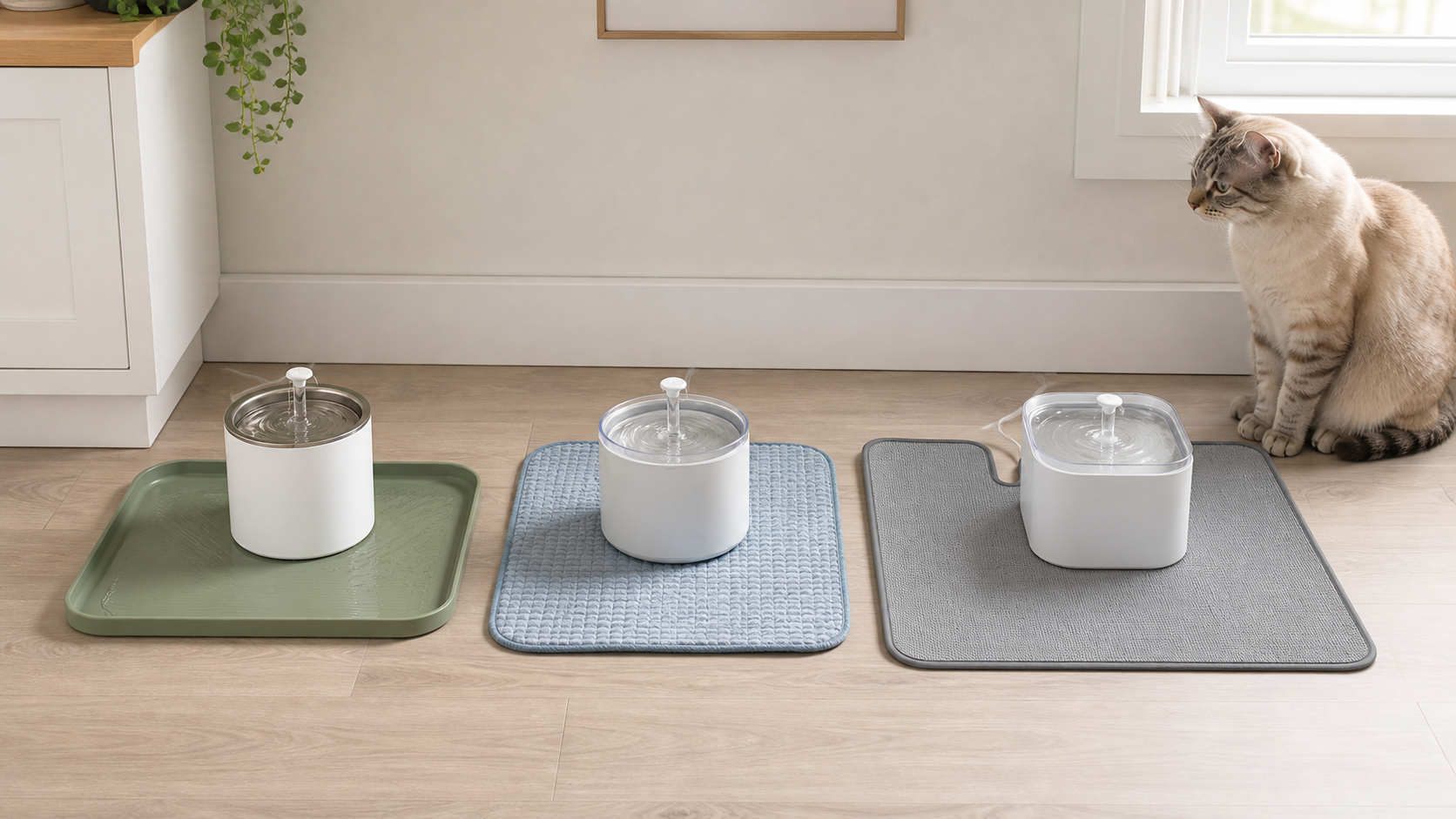
This guide compares mat formats, not current named products, and does not claim that a mat makes an electrical fountain spillproof. Follow the fountain maker's placement, cord, cleaning, filter, and pump directions. Keep plugs and connections dry, stop using damaged cords, and unplug the fountain before moving or cleaning it.
Quick Comparison: Match the Mat to the Mess
Raised-edge silicone: simplest to wipe
A flexible silicone mat with a shallow lip can contain ordinary drips long enough for you to wipe them up. It is a practical fit when the fountain itself is easy to lift and the mat can be rinsed in your sink. Measure the flat area inside the lip—not just the outside dimensions—so all fountain feet sit level.
The lip should not pinch the power cord or force it through standing water. Look for a clear rear exit or enough flat clearance to route the cord directly toward the wall without crossing a walkway.
Absorbent washable fabric: best for scattered droplets
An absorbent mat can make small droplets less likely to spread across a hard floor, especially around cats that lift their head while drinking. It needs a realistic laundry rotation: inspect the backing, wash it as directed, and dry it fully before returning it beneath an electrical appliance.
Choose a light or medium color if you want damp areas and debris to remain visible. A surface that disguises moisture may stay wet longer than you realize, while thick foam or rubber backing can take longer to dry.
Large machine-washable mat: widest setup area
A larger mat adds landing space around a broad fountain or multi-cat setup. It can also make fountain removal easier because there is room to place the pump cover, top, or reservoir briefly during a planned clean—provided the maker permits that handling and every part remains away from the plug.
Extra size creates tradeoffs. Check whether the mat fits your washer, where it will air-dry, whether doors or cabinets clear its edges, and whether a raised corner becomes a trip point.
Selection Criteria That Matter
- Usable footprint: Measure the fountain base, then add reachable splash space on every open side. Confirm all feet sit on one level surface.
- Cord route: Keep the cord out of pooled water, away from chewing, and clear of walking paths. A notch is useful only if its location matches your fountain.
- Cleaning access: Make sure you can lift the fountain without dragging it across a lip and can reach the pump, reservoir, and nearby floor.
- Moisture handling: Silicone holds drips for wiping; fabric absorbs them and therefore needs prompt washing and full drying.
- Backing and grip: Check how the backing behaves on your exact floor finish. Test in a small area and follow flooring-care guidance.
- Edge profile: Avoid curled corners, thick borders in a traffic path, and lips that prevent the fountain from sitting flat.
- Care instructions: Confirm washer, dryer, detergent, and temperature limits rather than assuming every fabric or silicone mat has the same care routine.
- Pet access: Skip exposed foam, loose fibers, or tempting raised edges if your cat chews, shreds, or pulls mats.
A Practical Fountain-Mat Setup Framework
- Measure the fountain base and the available floor area, including cabinet, door, and walking clearance.
- Map the shortest safe cord route to the outlet before choosing a mat shape or notch location.
- Choose wiping or laundering based on the actual splash pattern and the cleaning routine you will maintain.
- Place the fountain level, verify that no foot sits on a lip or seam, and keep the plug and connection dry.
- Check beneath the mat regularly for trapped moisture, floor changes, debris, or backing transfer.
If the fountain itself is difficult to take apart, a new mat will not solve that maintenance problem. Use our guide to choosing an easy-clean pet fountain, then compare fountain formats built around cleaning access. For a broader meal-area setup, see the low-mess feeding station guide.
Who Should Skip a Separate Fountain Mat
Skip a separate mat if the fountain maker requires a specific base, tray, clearance, or surface that the mat would change. Also skip one if your cat chews silicone, foam, backing, or fabric edges; if the only available placement puts a cord across a walkway; or if you cannot dry an absorbent mat fully between washes.
A shallow washable tray you already own may be enough when it holds the fountain level, preserves airflow and pump access, and does not conflict with the fountain instructions. If water reaches electrical connections, the cord is damaged, or the fountain behaves unusually, unplug it safely and follow the manufacturer guidance rather than relying on a mat.
The Bottom Line
Choose raised-edge silicone for quick wiping, absorbent fabric for scattered droplets and a dependable laundry rotation, or a larger machine-washable mat for more surrounding coverage. The right mat fits the fountain feet, leaves a direct dry cord path, stays flat on your floor, and is easy enough to clean that you will check beneath it regularly.