Shared-Room LED Sign Guide
Best dimmable LED signs for shared rooms.
A lighted sign in a shared living room, bedroom, office, or multipurpose space has two audiences: the person who wants the glow and everyone else who uses the room. The best fit is not simply the brightest design. It is a sign with understandable controls, a useful low setting, a measured footprint, and a placement that keeps direct light and cords out of other people's working, relaxing, or walking zones.
Disclosure: As an Amazon Associate, we may earn from qualifying purchases and approved partner referrals.
Category route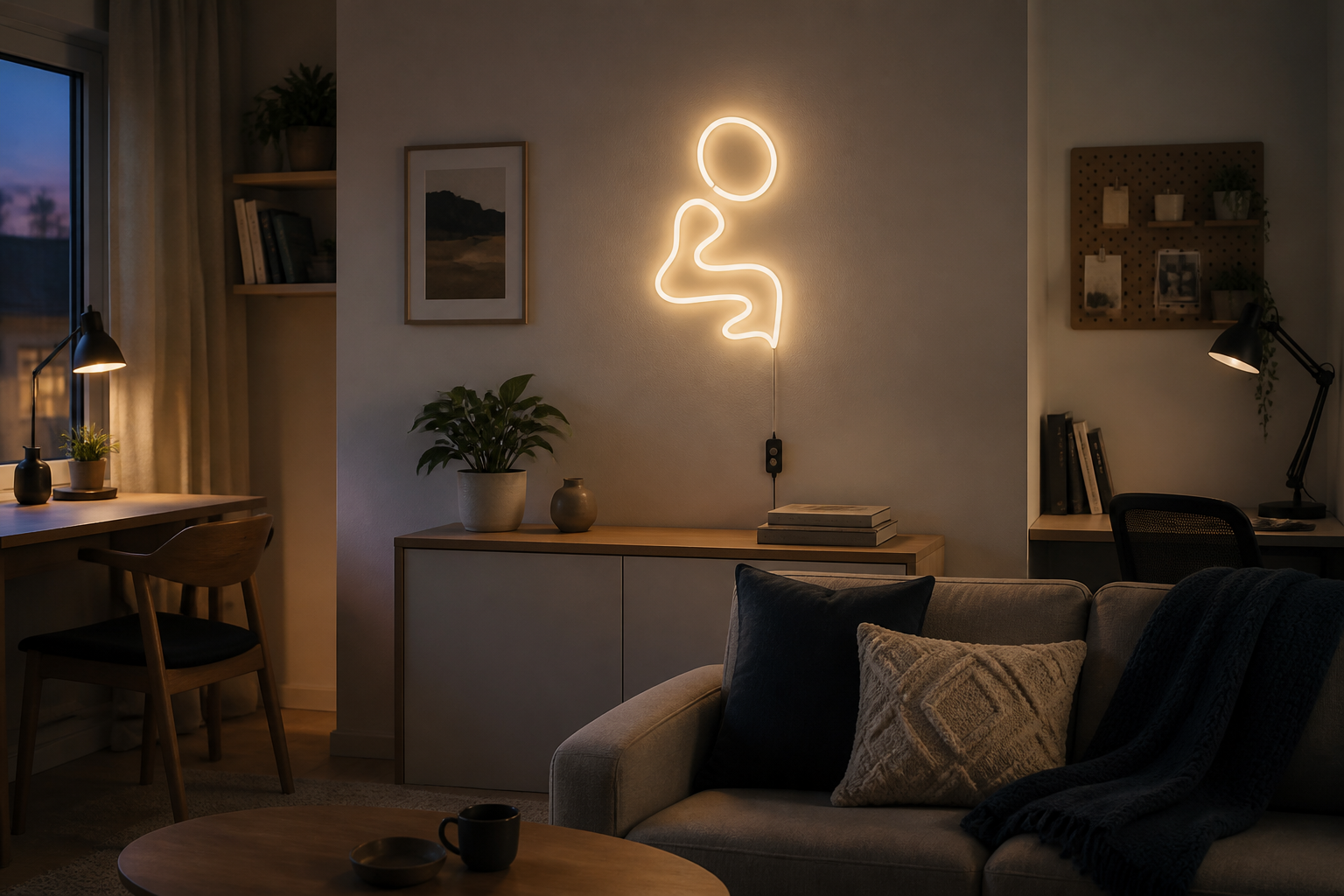
Best starting route
Compare the sign, dimmer, and complete room setup together.
Use the current listing to verify the control method, described brightness settings, overall dimensions, power components, cable length, mounting parts, and instructions. A product photo cannot show whether its lowest setting or controller will suit your room, so treat those as details to confirm rather than universal category features.
Plan the room first: use the room decor sign guide for wall scale and finish, then compare plug-in and battery-powered signs if the outlet route is still undecided.
How we compare dimmable LED signs for shared rooms
This is a category buying framework, not hands-on testing or a ranking of current named products. Compare each candidate using its current listing and instructions, then check the proposed setup with the people who share the space.
- Low-setting usefulness: look for a clearly described dimming function, then verify how the seller explains the available settings. “Dimmable” alone does not tell you how low the sign goes.
- Control access: decide whether an inline button, remote, or other listed control will be easiest to reach from the normal seat or doorway.
- Light spill: map who will face the illuminated tubes or panel, plus any screens, mirrors, or glossy artwork that may reflect the glow.
- State after power changes: if remembering the previous brightness matters, check whether the current listing or instructions explicitly describe that behavior.
- Complete footprint: use the listed outer dimensions, backing shape, controller, adapter, and cable—not a cropped product photo—to plan the wall.
- Power and mounting route: identify the specified power setup and included hanging method, then follow the maker's instructions for the sign and your wall surface.
- Shared-use agreement: settle the color, message, location, brightness, animation preference, and off-hours before buying.
Best control format by shared-room routine
Category route
Inline control: best when the cable stays reachable
An inline control can be simple to find without another loose accessory. It works only if the controller lands somewhere reachable after the complete cord is routed; verify its position and cable details in the current listing.
Browse category: Compare inline-dimmer LED signs
Category route
Remote control: best for an out-of-reach wall position
A remote can make sense above a sofa or cabinet where an inline button would hang awkwardly. Confirm the actual control functions, required power source, and what happens if the remote is misplaced; do not assume every remote includes the same modes.
Browse category: Compare remote-dimmer LED signs
Category route
Single-color dimming: best for a visually quiet room
A fixed warm or neutral color can reduce the number of choices everyone must negotiate. Compare message readability and the described brightness control rather than paying for effects the household does not want.
Browse category: Compare single-color dimmable signs
Match the sign to the room's competing activities
- Living room: check the sign from every main seat and through the television screen. Side-wall placement may create less competition than a glowing focal point beside the screen.
- Shared home office: view the sign through each webcam and monitor. The dimmer should be reachable without crossing the other person's desk or cable zone.
- Shared bedroom: agree on off-hours and keep the sign out of direct sightlines from both beds. For a bedroom-specific style comparison, use the adult neon-style sign guide.
- Family or multipurpose room: choose a short, broadly acceptable message and a control that regular users can understand. A calm fixed color is often easier to integrate than changing effects.
- Dorm room: room rules, limited space, move-out, and roommate approval add separate constraints; use the dorm-room LED sign guide for that narrower decision.
Test size, glow, and cord path before ordering
Mark the listed outer dimensions with paper or low-tack tape. Then add a temporary line for the cable, controller, adapter, and route to the intended power source. Check the mockup from each chair, desk, doorway, and screen. A good shared-room position gives the sign a clear boundary without placing the light source in another person's direct view.
You cannot reproduce the exact glow with a paper template, but you can catch scale and routing problems. Look for reflections in televisions, monitors, framed glass, and glossy cabinets. If the room already has several lamps or screens, a smaller sign or an unlit option may create a cleaner result.
Use only the power components and setup described by the maker, and follow the product instructions. Do not modify wiring or conceal controllers and adapters where they cannot be checked. If a cord would cross a walkway or be pinched by furniture, change the location or choose a different display format.
Questions to verify in the current listing
- What control type is included, and which functions does the seller explicitly describe?
- Are the sign's full outer dimensions, mounting points, and backing shape shown?
- What power components and cable details are listed?
- Does the seller explain the brightness settings or behavior after power is switched off?
- Which mounting parts are included, and what surface instructions does the maker provide?
- Is the color fixed, selectable, or animated, and can unwanted effects be left off?
- Are the message and artwork readable at the room's real viewing distance?
Who should skip a dimmable LED sign?
- Skip it when the household cannot agree on the message, color, location, or off-hours.
- Skip a powered wall sign when every practical cord route crosses a walkway, moving chair, door, or frequently used work surface.
- Skip a remote-dependent design if keeping track of a separate controller will be a recurring frustration.
- Skip complex animation when the room needs a calm background for conversation, screen use, work, or video calls.
- Skip the category if the glow will reflect in the main screen or face a regular seat even at the proposed location.
- Skip a generic ready-made phrase when the exact name, message, or artwork is the reason for the project; a custom route may fit better.
- Skip decor signs for emergency, accessibility, regulated wayfinding, or other code-sensitive communication.
When a custom sign is the better shared-room fit
Custom work can be worthwhile when a short household phrase, family name, club mark, or original line drawing is the whole point. Write a compact brief with the wall dimensions, normal viewing distance, preferred color, intended placement, power location, and need for brightness control. Ask the maker to confirm the artwork, finished dimensions, mounting approach, power requirements, controls, and project terms instead of assuming a feature from a reference photo.
For a compact custom sign or light-box idea, share the project brief with DaNite Sign Company. If the format is still undecided, compare a custom light box with a ready-made LED sign.
The practical bottom line
Start with a restrained message, measured wall position, clearly described dimming control, and a complete cord route. Compare the current listing rather than assuming all “dimmable” signs share the same settings or behavior. Most importantly, make the placement and off-hours a shared decision before the sign arrives.
If light itself is optional, an unlit acrylic wall sign or another option from the room decor sign guide can provide the message without adding a second lighting source.
 The Good Sign Company