Reusable Schedule Sign Guide
Best dry-erase signs for frequently updated schedules.
The best dry-erase schedule is not necessarily the largest board. It gives each update enough writing room, stays readable from the decision point, fits the available wall or counter, and makes erasing, rewriting, and marker storage easy enough that people will actually maintain it.
Disclosure: As an Amazon Associate, we may earn from qualifying purchases and approved partner referrals.
Category route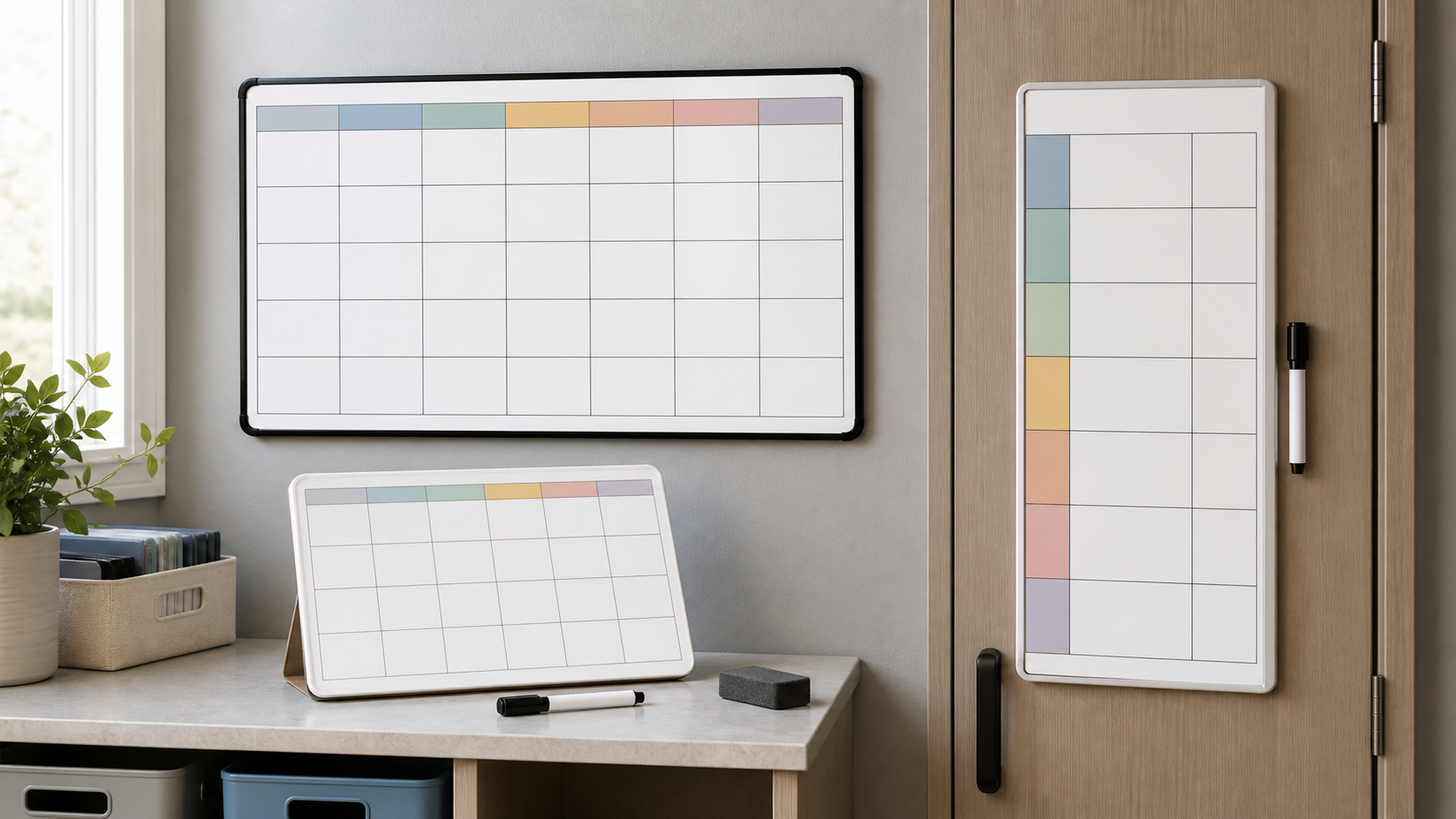
Best overall starting route
Start with the schedule layout, then choose the board format.
Write the longest realistic entry on a paper mockup before shopping. Compare the usable writing area—not only the outside dimensions—plus grid spacing, mounting method, marker storage, supplied care guidance, and the distance from which the schedule must be read.
Related: compare changeable letter boards when the message is short and presentation matters more than detailed scheduling, or use the small-business sign planning guide for broader visibility decisions.
How we compare dry-erase schedule signs
This is a product-category comparison and buying framework, not hands-on testing or a ranking of current named products. Compare candidates in this order:
- Schedule structure: daily columns suit appointments, while rows may work better for rooms, staff, tasks, or equipment.
- Usable writing area: measure the smallest cell and test the longest common entry with the marker tip size you expect to use.
- Reading distance: check whether dates, names, and status marks remain understandable from the doorway, counter, or desk.
- Update routine: decide who rewrites the board, when old entries are cleared, and where markers and an eraser will live.
- Surface and care: follow the maker's marker and cleaning instructions; do not assume every coated surface uses the same cleaner.
- Placement: compare complete dimensions, mounting points, writing height, reflections, door movement, and nearby storage.
Best format by update setting
Build the comparison around real entries
List the information that must appear every time: a date or day, time, name, location, status, and any brief note. If a cell cannot fit a normal entry without abbreviations nobody understands, the layout is too dense. A larger blank board with a simple hand-drawn structure may be more useful than a preprinted grid with tiny cells.
Test a paper version in the proposed location for several update cycles. This shows whether people can reach the top row, whether a door blocks the view, whether window light creates reflections, and whether the update process interrupts counter or desk work.
Plan markers, erasing, and ownership
- Use only marker types and cleaning methods the board maker identifies as compatible.
- Keep markers and the eraser at the board so updates do not depend on finding supplies elsewhere.
- Assign one clear update time and owner when an outdated schedule could confuse staff, guests, or family members.
- Use a small legend for repeated status marks instead of filling cells with long notes.
- Photograph important information before a full reset if the schedule also serves as a working record.
Surface-cleaning results depend on the board, marker, time between erasing, and care method. Treat seller claims as product-specific evidence and follow the supplied instructions rather than assuming a board will always erase perfectly.
Who should skip a dry-erase schedule?
- Skip it when people need remote access, automatic reminders, history, or simultaneous updates; a shared digital calendar may fit better.
- Skip a preprinted grid when the schedule structure changes often or entries regularly overflow its smallest cells.
- Skip a glossy board opposite a bright window when reflections will obscure the writing from the main viewing position.
- Skip a tabletop board when counter depth is scarce or normal customer and work activity could knock it over.
- Skip door mounting when hardware, board thickness, or marker storage could interfere with the door, handle, trim, or safe movement.
- Skip handwriting when the message must look polished from a distance; a changeable letter board or printed insert may communicate a shorter message more clearly.
The practical bottom line
Choose the simplest format that gives normal entries enough space. Mock up the smallest cell, test the viewing position, decide who updates the schedule, and make marker storage part of the setup. For most shared weekly schedules, a wall grid is the clearest starting point; use a tabletop board when portability matters or a slim panel when the available surface is narrow. Continue with the small-business sign planning pillar for visibility and placement, or Browse category: compare dry-erase schedule board categories on Amazon.
 The Good Sign Company