Mobile-Business Sign Guide
Best portable signs for mobile service businesses: arrive, identify, and pack cleanly.
A portable sign should help a customer recognize the service point without turning every appointment into a complicated setup. For many mobile detailers, groomers, photographers, tutors, and appointment-based providers, a folding A-frame is the best starting category when there is a clear, approved place to set it. Tabletop signs and replaceable-insert holders work better when the message belongs at a check-in surface.
Disclosure: As an Amazon Associate, we may earn from qualifying purchases and approved partner referrals.
Category route
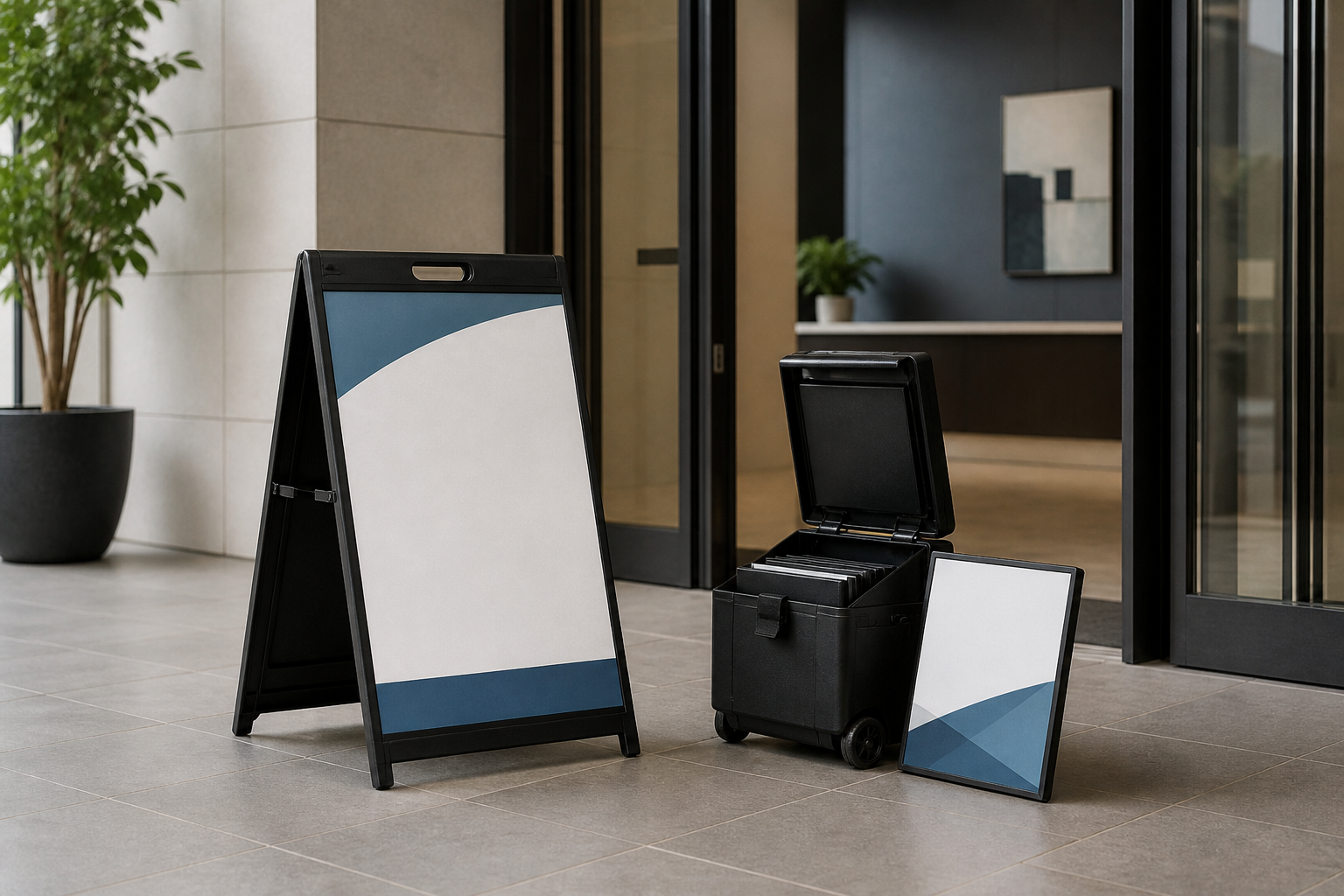
Best overall starting format
Use a folding A-frame when the sign must be seen before check-in.
An A-frame can provide a useful eye-level message and fold for transport. Compare the open footprint, packed dimensions, listed weight, handle, panel or insert format, and maker instructions—not just the face size.
Planning first? Use the small-business sign planning guide to define the audience, message, position, and next action.
How we compare portable service signs
This is a category comparison and buying framework, not hands-on testing or a ranking of current named products. Score each candidate against the same job:
- Message job: decide whether the sign identifies the provider, marks check-in, points to an entrance, or gives one short next step.
- Approach distance: make the important words readable from the actual customer path; move details to a closer-view surface.
- Open footprint: measure the fully deployed base, not only the printed panel, and preserve a clear route around it.
- Packed dimensions: confirm that the sign fits the vehicle, cart, case, closet, or shelf used between appointments.
- Setup routine: count the pieces, inserts, fasteners, and steps required at every stop.
- Placement fit: get the property, venue, or client’s approval and follow the sign maker’s use guidance for the actual setting.
Best portable format by setup
Category route
Folding A-frame: best for arrival identification
Choose this when visitors need to spot the service point before reaching a desk. Check the open footprint, fold, handle, insert method, listed setting, and storage dimensions.
Browse category: Compare portable A-frame signs
Category route
Tabletop holder: best for a check-in surface
Use a compact holder for one close-range action such as check in, wait here, or scan. Verify the base depth, orientation, glare, insert access, and packed protection.
Browse category: Compare tabletop sign holders
Category route
Replaceable-insert stand: best for changing locations
An insert format can keep the stand consistent while the room, arrow, or appointment message changes. Compare insert size, change access, panel protection, and how spares travel.
Browse category: Compare folding insert signs
Use one message at each distance
The farthest-view sign should usually identify the business or arrival point. A closer tabletop sign can explain the next action. Putting a service list, phone number, social handle, booking instructions, and directional arrow on one portable panel weakens the first-glance message.
Draft the longest message that will actually recur, then print it at scale. View it from the customer approach under the expected lighting. The business-sign message-length guide helps separate first-glance copy from details that belong elsewhere.
Plan transport and storage as part of the purchase
- Vehicle fit: compare the packed measurements with the exact cargo space left after normal equipment is loaded.
- Carry route: account for stairs, elevators, doorways, and the distance from parking to setup.
- Loose pieces: give inserts, markers, clips, and small hardware a labeled pouch or rigid compartment.
- Face protection: keep printed or clear faces from rubbing against tools, liquids, cords, or case hardware.
- Reset routine: remove outdated location details and pack the sign in the same order after every appointment.
If the sign will always sit on a booth or counter, the vendor-booth tabletop sign guide offers a more focused comparison of close-range display formats.
Stability and placement need a site check
Do not assume a portable sign may be placed on any sidewalk, lobby, hallway, curb, or shared entrance. Ask the property owner, venue, or client where temporary signs may go. Keep doors, accessible routes, stairs, queues, and working areas clear, and use the product only in settings covered by its instructions.
Wind, uneven ground, vehicle movement, and wet conditions create a different project from an indoor or covered setup. If the intended location exposes the sign to those conditions, confirm the permitted location and obtain a format recommended for that site rather than extending this indoor category framework.
Who should skip a portable sign?
- Skip it when the client or venue already provides clear arrival and check-in signs.
- Skip a floor sign when no approved position preserves a clear route around the open base.
- Skip an A-frame when the message is only read at arm’s length on a staffed table.
- Skip a tabletop sign when customers need guidance before they can see the counter.
- Skip replaceable inserts when the message never changes and the added parts only complicate packing.
- Skip illumination when the venue light is sufficient and power routing would add setup work or a cord path.
The practical bottom line
Start with a folding A-frame when customers need to identify the mobile service point from the approach and there is an approved, clear place to deploy it. Choose a tabletop holder for check-in instructions at a staffed surface, or a replaceable-insert stand when the location message changes. Measure both the open and packed form, limit each sign to one job, test readability at the real distance, and make placement approval part of the setup checklist.
Continue with the small-business sign planning pillar, or Browse category: browse portable A-frame sign formats on Amazon.
 The Good Sign Company