Small-Event Sign Guide
Best reserved table signs for small events.
A reserved sign has one job: help the right guests identify a table before they sit down. For most small receptions, parties, and community gatherings, a reusable insert holder or sturdy tent card works better than an elaborate decoration because the message stays readable and the setup remains easy to pack.
Disclosure: As an Amazon Associate, we may earn from qualifying purchases and approved partner referrals.
Category route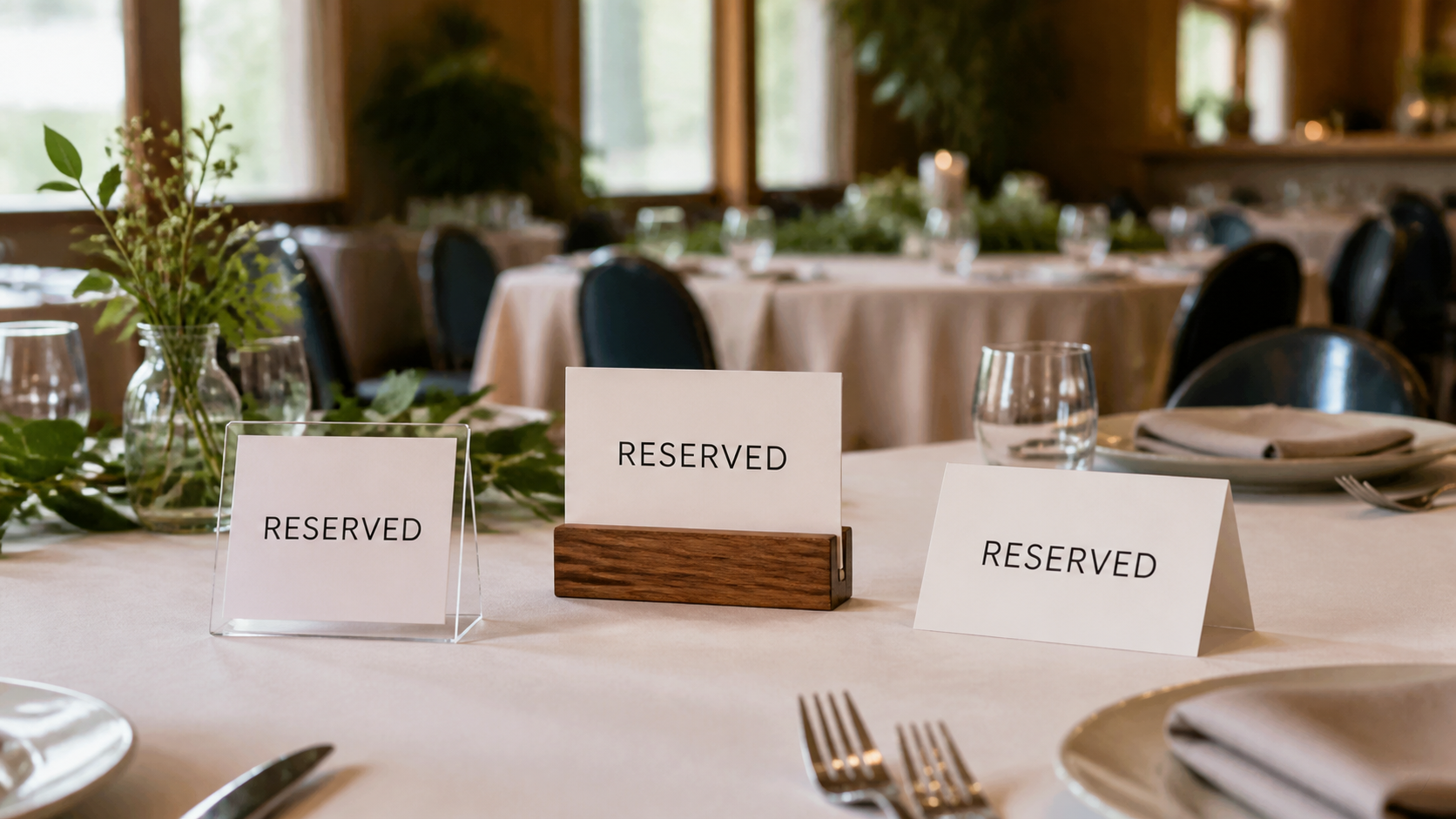
Best starting route
Start with reusable holders and a message you can print again.
Replaceable inserts let you adjust the table number, group name, or reservation wording without replacing the display. Compare the complete setup by visible card area, base footprint, viewing angle, stability, glare, and packed size.
Related: use the tabletop sign-stand guide when you already own the printed sign, or the small-event directional sign guide for room-to-room wayfinding.
How we compare reserved table signs
This is a category comparison and buying framework, not hands-on testing or a ranking of current named products. Check candidates in this order:
- Message job: decide whether the sign reserves a whole table, a few seats, or a named group. “Reserved” alone is clearest only when guests already know which table applies to them.
- Approach sightline: test a paper mockup from the aisle guests will actually use. A low tent card can disappear behind glasses and centerpieces.
- Base footprint: measure around plates, serving pieces, flowers, favors, and shared dishes rather than treating the table as empty.
- Stability: compare base width and weight with the card size. Tall, top-heavy holders are easier to bump during seating and service.
- Surface and contrast: favor plain lettering and a low-reflection face. Decorative script, pale colors, and glossy covers can slow recognition.
- Pack and reuse: count the signs, cards, bases, and storage space needed, then check how quickly each insert can be changed.
Best format by event setup
Category routeAcrylic insert holder: best for clear, repeatable setups
Use a replaceable insert when group names or table assignments may change. Check the actual visible insert size, portrait or landscape orientation, loading edge, face reflections, and complete base dimensions.
Browse category: Compare acrylic table sign holders
Category routeWood block holder: best for a compact warm look
A slot-style base can hold a printed card without a reflective cover. Confirm slot width and depth, card thickness, base weight, edge finish, and whether the sign stays upright when the table is bumped.
Browse category: Compare wood place-card holders
Category routeTent card: best for simple one-time or low-storage needs
A folded card is inexpensive to store and easy to print, but it sits low and can move when the table is disturbed. Use heavier stock, test both viewing sides, and keep it clear of spills and serving paths.
Browse category: Compare reserved table tent cards
Choose the wording before the holder
Write the shortest message that prevents the likely mistake. “Reserved” works when a host or seating chart supplies the missing context. “Reserved for volunteers” or “Reserved for speakers” helps at a community event, while a family or group name may be more useful at a reception. Avoid putting phone numbers, private schedules, sensitive affiliations, or unnecessary guest details on a public table.
Print the message at full size and set it among the planned table items. Stand at the aisle, then walk toward the table at a normal pace. If you must stop and lean in, increase the letter size or raise the sign rather than adding more words.
Build a fair comparison before buying
- Count every table and add only the spares your setup can reasonably use.
- Measure the clear table area after place settings and centerpieces are positioned.
- Record the minimum visible card size and the maximum base depth.
- Decide who prints, inserts, places, collects, and stores the signs.
- Check whether both sides need the message for two-way aisle traffic.
- Test one paper mockup under the venue lighting for glare and contrast.
For a larger welcome message at the entrance, use the small-reception welcome sign guide. Reserved table markers should not be stretched into entrance, emergency, accessibility, or required venue signage; confirm event and venue requirements with the responsible organizer.
Who should skip these reserved signs?
- Skip a separate sign when assigned table numbers and a staffed seating check already make the reservation unambiguous.
- Skip low tent cards when centerpieces, glassware, or seated guests hide them from the aisle.
- Skip clear glossy holders when venue lights reflect across the message in your mockup test.
- Skip personalized one-event pieces when the host needs a neutral set that can be reused.
- Skip tall holders when the narrow table, serving pattern, or guest conversation makes them an obstruction.
- Skip commodity holders when the event needs a coordinated custom keepsake; define the final message, quantity, dimensions, and display location before requesting custom work.
The practical bottom line
For most small events, choose a reusable insert holder with a matte, high-contrast card and a base that fits between the planned table items. Test one full-size mockup from the actual aisle, then standardize the wording and placement across the room. Start by Browse category: comparing reusable reserved table signs on Amazon, and keep directional or welcome messages on separate signs built for those viewing moments.
 The Good Sign Company