 The Good Sign Company
Custom business sign planning
Brief the sign before asking it to solve everything.
A custom business sign conversation goes more smoothly when you can explain the sign's one main job, where people will see it, how much space is actually available, and what artwork already exists. This brief helps you organize those facts without trying to design the finished sign yourself.
Disclosure: As an Amazon Associate, we may earn from qualifying purchases and approved partner referrals.
Start with one job and one audience
Write a sentence that names who sees the sign, where they are standing or moving, what they must understand first, and what they should do next. “Help first-time visitors identify our reception desk from the entrance” is more useful than “make our lobby look professional.” It identifies a location, a viewer, and a result that can guide scale and layout.
If the sign must identify the brand and give directions, decide which message comes first. A separate directional sign may be clearer than adding an arrow, hours, services, phone number, and tagline to the main identity sign.
Measure the usable area, not the whole wall
- Usable width and height: subtract doors, switches, trim, shelves, monitors, and furniture that interrupt the wall.
- Position from fixed edges: note the distance from the floor, ceiling, nearest corner, and reception desk so the intended center is unambiguous.
- Viewing distance and approach: measure from the point where a visitor first needs to recognize the message, then photograph that view.
- Surface: identify what you know about the wall or mounting location without guessing. Include close photos if the finish or construction is uncertain.
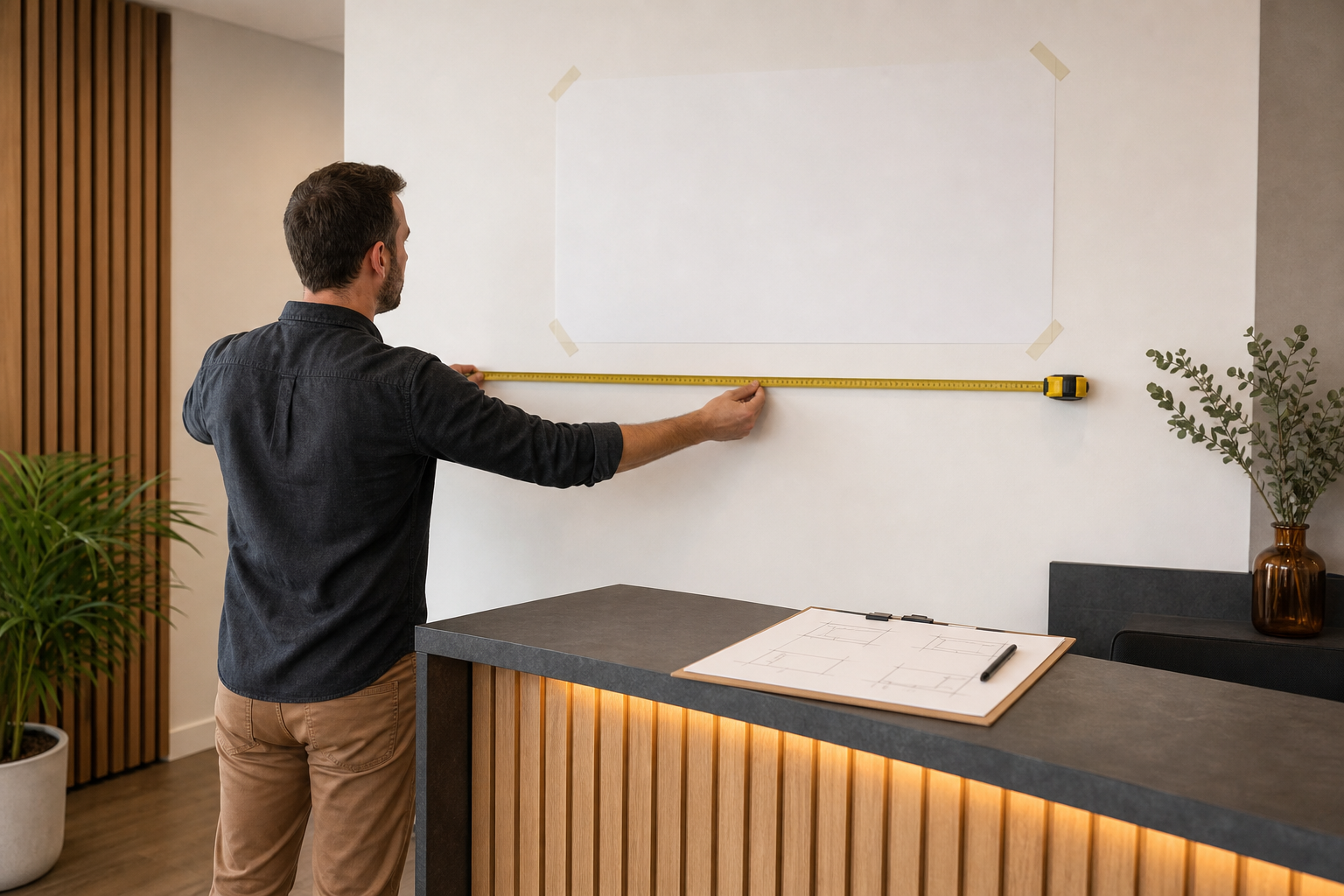
Tape up a blank paper or painter's-tape rectangle in the proposed size. View it from the entrance, counter, waiting area, and camera position if the sign will appear in video. This tests visual scale; it does not determine the final mounting method.
Send wide, straight-on, and detail photos
One close photo rarely explains a site. Send a wide view showing how people approach, a straight-on view of the proposed sign area, and detail photos of nearby obstacles or known power locations. Add one familiar-size reference or written measurements rather than expecting a sign company to estimate dimensions from the image.
For a reception wall specifically, the reception-area wall sign guide helps compare visitor sightlines, brand hierarchy, contrast, glare, and update needs.
Prepare artwork without redrawing the logo
Send the best original logo files available, plus the brand colors and typefaces if they are documented. Do not convert a low-resolution screenshot into a larger image and call it production-ready. If you only have a web image, say so; the sign company can explain what artwork work may be needed.
Also provide a plain-text copy of every required word. That gives the project team a clean reference for spelling, capitalization, and punctuation even when the artwork is difficult to inspect.
State the practical constraints early
- Indoor or outdoor placement, and the actual exposure conditions you know
- Permanent wall display, movable counter piece, temporary event use, or another setup
- Known mounting restrictions from the property owner or wall location
- Whether illumination is being considered and where power is currently available
- The date the sign is needed, presented as a request to confirm rather than an assumed production promise
- Who must review the design and who can approve it
For exterior, electrical, accessibility-related, landlord-controlled, or permitted signs, identify the relevant property contacts and local requirements for the sign professional to review. This article is a project-preparation guide, not compliance or installation advice.
Know which decisions to leave open
A strong brief defines the problem without prescribing every production detail. Bring preferences for visual tone, illumination, and finish, but leave room for the sign company to recommend construction and installation choices for the actual location. DaNite Sign Company currently describes custom sign design, fabrication, installation, and repair for Columbus businesses, including interior and exterior business signs. Confirm the fit and project details directly.
Skip custom production when the message is standard
A custom sign may be unnecessary when a standard open, pickup, reserved, or temporary directional message is available in a readable size and suitable format. It may also be too early to order when the logo is changing, the location is not final, the lease or property review is unresolved, or the message changes frequently. In those cases, use a temporary or changeable format until the decision stabilizes.
For changeable close-view information, compare changeable letter boards. For a standard open message, use the small-business open sign guide. If the buying route itself is still unclear, return to the small-business sign planning pillar.
Use this short brief checklist
- One main audience, message, location, and desired next action
- Usable width and height plus placement measurements
- Wide, straight-on, and detail photos
- Best available logo files, brand references, and exact text
- Viewing distance, lighting observations, and known surface details
- Mounting, power, property, review, and timing constraints to confirm
- A list of what must stay fixed and what can change