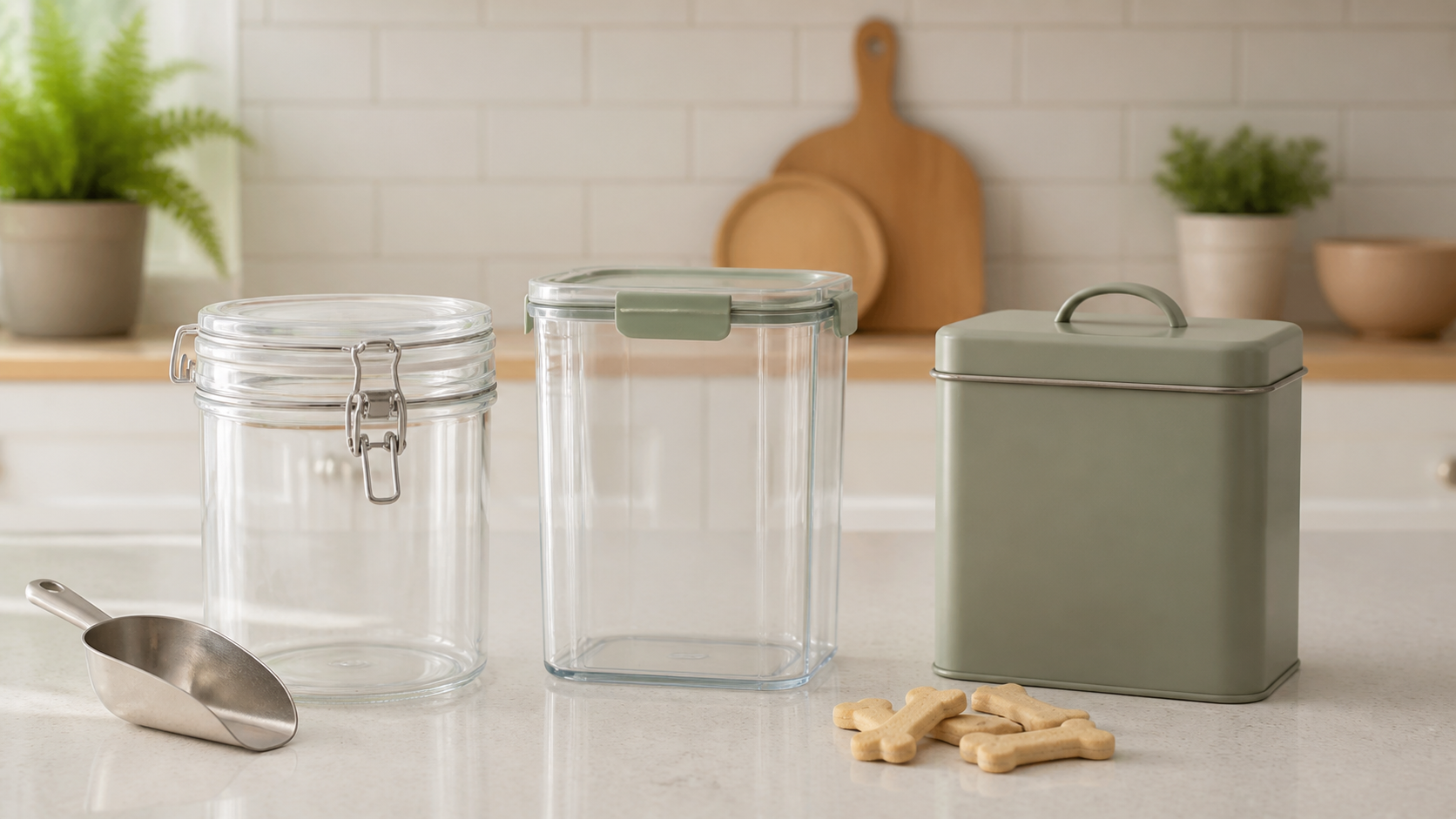
This is a category comparison, not a named-product ranking or a report of hands-on testing. “Airtight” is listing language that should be checked against the current product details; it does not override the treat maker's storage instructions or use-by guidance. Keep the original package or its full label and lot information.
Quick Comparison: Which Format Fits?
Clamp-lid canisters: best for a wide, visible opening
A clear canister makes the remaining amount easy to see, while a swing-top closure gives you a gasket and clasp you can inspect. It suits dry treats that are easy to scoop or grasp through a broad opening. The tradeoff is clearance: the hinge, lid, and clasp need room to move, and the gasket may require separate washing and thorough drying.
Press-seal containers: best for compact quick access
A rectangular container can use counter depth efficiently and may fit neatly beside another daily-use item. Look for a lid that can be removed without tipping the container and a seal that comes out for cleaning if the maker permits it. Deep corners and multi-part lids can add washing time.
Fitted-lid tins: best for opaque storage
A small tin hides visual clutter and may be easy to lift from a shelf when it has a secure handle. Because you cannot see the contents, labeling and a consistent refill routine matter more. Confirm that the interior and finish are intended for the stated use, then follow the maker's cleaning and drying instructions to avoid trapped moisture or finish damage.
Selection Criteria That Matter
- Daily-use capacity: Choose space for a modest working amount, not the largest container that fits. Frequent full emptying makes crumbs and residue easier to notice.
- Opening: Measure whether your hand or scoop fits without scraping the rim or spilling treats.
- Closure: Inspect how the lid seats, where the gasket sits, and whether every sealing surface can be reached for cleaning and drying.
- Counter footprint: Measure width, depth, and open-lid height. Leave room away from the sink, stove, direct sun, and counter edges.
- Material information: Use the current maker's documented food-contact and care claims rather than assuming every plastic, glass, or metal container has the same use limits.
- Cleaning: Check whether the lid, gasket, and container have different hand-wash or dishwasher directions. Refill only when every part is clean and fully dry.
- Label retention: Keep the treat name, ingredient and feeding information, lot code, and use-by details from the original package.
- Pet and child access: A closed lid is not a secure cabinet. Store the container beyond reach if a pet or child could pull it down, open it, or chew it.
Use a Small Working Amount, Not a Mystery Refill
Keep most treats in their original package according to its directions, then transfer only the amount that fits your near-term routine if the label permits. Empty and clean the countertop container before adding a new batch rather than continually topping old crumbs with new treats. Do not mix different products in an unlabeled container.
Discard treats according to the package directions if you notice an unexpected odor, texture, moisture, pests, damaged packaging, or another sign that concerns you. If your pet becomes unwell or you suspect contaminated food, stop offering it and contact a veterinarian; a storage container is a convenience item, not a health solution.
A Simple Comparison Framework
First, measure the counter space and the height available with the lid fully open. Second, estimate only the working quantity you plan to keep there. Third, compare opening width, closure effort, gasket removal, label space, and every cleaning step. Finally, check whether an existing washable jar or the resealable original package already does the job.
This narrow daily-access use differs from the larger containers in the small-kitchen pet food storage guide. For bowls, mats, and placement around the same counter, use the low-mess feeding station guide. New owners can place both choices in context with the practical starter pet supplies guide.
Who Should Skip a Countertop Treat Container?
Skip one if the original package already opens easily and fits the storage area, you cannot preserve the label and lot details, the container would sit within reach of a persistent pet or child, or the counter is exposed to heat, sun, steam, sink splashes, or frequent spills. Also skip a small opening if the treats are large, soft, oily, or likely to crumble against the rim.
A countertop container is also a poor fit when several people could mistake pet treats for human food. In that case, use clearly labeled closed storage away from ordinary snacks. If your pet follows a veterinarian-directed diet or has a health condition affected by treats, ask the veterinarian which treats and storage routine fit that plan.
The Bottom Line
Choose a clamp-lid canister for a wide visible opening, a press-seal container for a compact quick-access footprint, or a fitted-lid tin for opaque storage. Whichever format you choose, keep the original product information, store only a manageable working amount, clean and dry every part between batches, and follow the treat maker's directions.