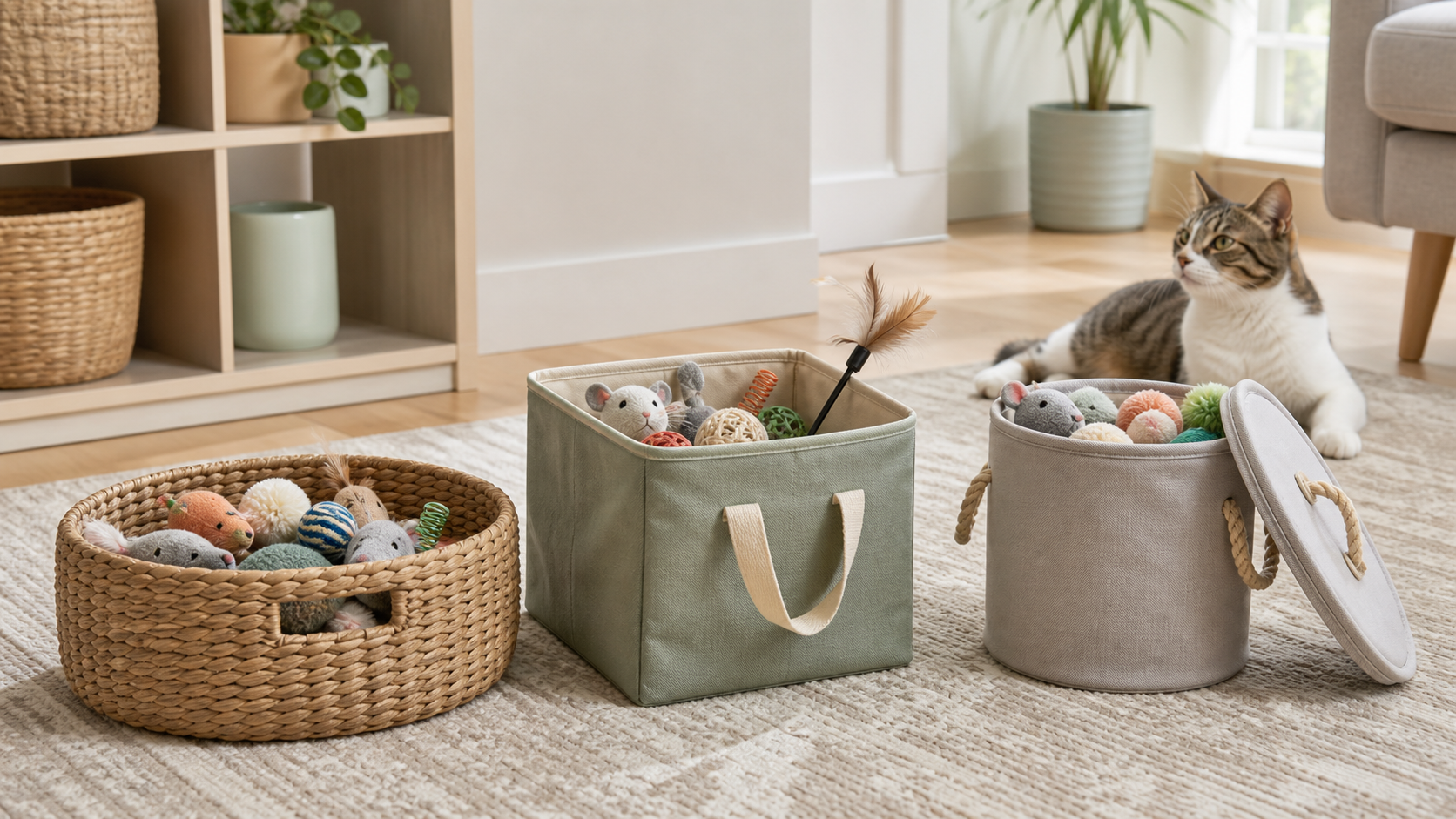
This guide compares storage formats, not current named products, and it does not assume that every toy shown is suitable for every cat. Follow each toy maker's sizing and supervision directions. Discard damaged toys, and keep string, ribbon, feather attachments, springs, and other small items secured whenever your cat should not have access.
Quick Comparison: Match the Basket to Access
Low open basket: simplest for approved everyday toys
A shallow open basket makes larger plush toys and sturdy balls visible. It can work when your cat may safely choose from a small approved set and the basket itself is not a chewing, clawing, or climbing target. A low rim is easier to reach into than a deep hamper, but small springs and mice can disappear beneath larger toys unless you add a removable divider or pouch.
Check woven baskets for rough edges, loose fibers, handles that can trap a paw, and gaps where small toys can lodge. Smooth, stable sides are more practical than decorative loops.
Handled fabric cube: easiest to move between shelf and play area
A soft-sided cube is useful when you bring out one rotation for a supervised session and return it to a shelf afterward. Look for a reinforced base so the cube does not fold around tiny items, plus handles that lie flat rather than forming tempting loops. A removable liner or documented cleaning method matters because fabric collects fur and toy debris.
Measure the shelf opening as well as the cube. Handles, bowed sides, and toys above the rim can make the usable footprint larger than the stated base dimensions.
Lidded basket: strongest fit for owner-managed small items
A lidded basket gives springs, soft mice, wand attachments, and reserve toys a defined place out of routine reach. A fully removable lightweight lid is often simpler than a heavy hinged lid around curious paws. The container should live in a closed cabinet or on a stable high shelf if your cat investigates lids or pulls at fabric.
A lid is organization, not a safety guarantee. If your cat can open, tip, shred, or climb onto the container, move the contents to genuinely inaccessible storage.
Selection Criteria That Matter
- Access plan: Decide which toys may stay out, which require supervision, and which should be inaccessible between sessions.
- Compartments: Use a divider or small inner pouch to keep springs and mice from vanishing beneath plush toys. Do not leave removable organizers where they become toys themselves.
- String containment: Store wands, ribbons, elastic cords, and feather attachments in a closed section your cat cannot reach.
- Dimensions: Measure shelf width, depth, and height. Also check whether the smallest toys can slip through woven gaps.
- Material and edges: Inspect seams, staples, fibers, wire frames, handles, and decorative trim for damage or tempting loose parts.
- Cleaning: Prefer a documented wipe-clean or washable construction, and dry the basket fully before returning toys.
- Stability: A floor basket should resist tipping when nudged. Shelf storage should not overhang or sit where it can fall.
- Inventory visibility: A shallow basket or simple labels help you notice missing, dirty, or damaged toys without overfilling the container.
A Simple Cat Toy Rotation Setup
Keep the system small: one accessible set of owner-approved toys, one stored reserve, and one contained group of supervised-only toys. During a reset, inspect each item, clean it according to its directions, discard damaged pieces, and swap only a few toys. Rotation can make organization easier, but it does not guarantee interest or solve a behavior concern.
For the broader routine, use our simple pet toy rotation guide. If you are still choosing what belongs in the basket, compare cat toy variety types or read how to choose supervised enrichment toys.
Who Should Skip a Floor Basket
Skip an accessible floor basket if your cat chews fabric or wicker, swallows toy pieces, pulls on handles, climbs into containers, guards toys, or repeatedly opens lids. Closed cabinet storage may be a better choice. Also skip buying a new basket if a sturdy container you already own fits the measured space and can separate supervised items safely.
If your cat has swallowed a toy part, string, ribbon, or another foreign object—or suddenly shows appetite, vomiting, pain, or behavior changes—contact a veterinarian promptly. A storage product is not a substitute for veterinary advice.
The Bottom Line
Choose a low open basket for a small set of safe everyday toys, a handled fabric cube for shelf-to-play-area rotation, or a lidded basket for owner-managed small items. The best format is the one that fits the shelf, cleans easily, keeps string-like toys inaccessible, and makes routine damage checks simple.