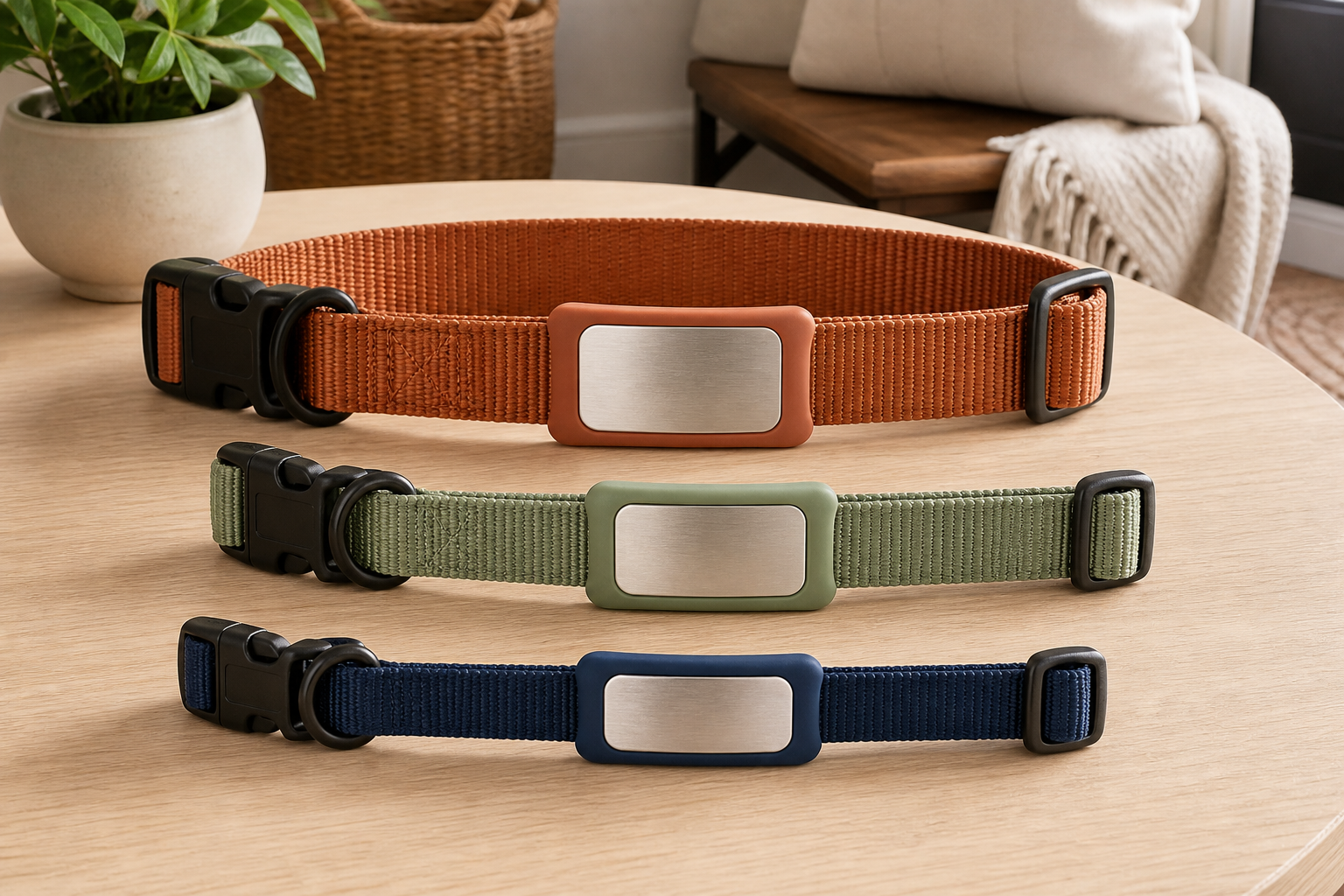
 Slide-on holders
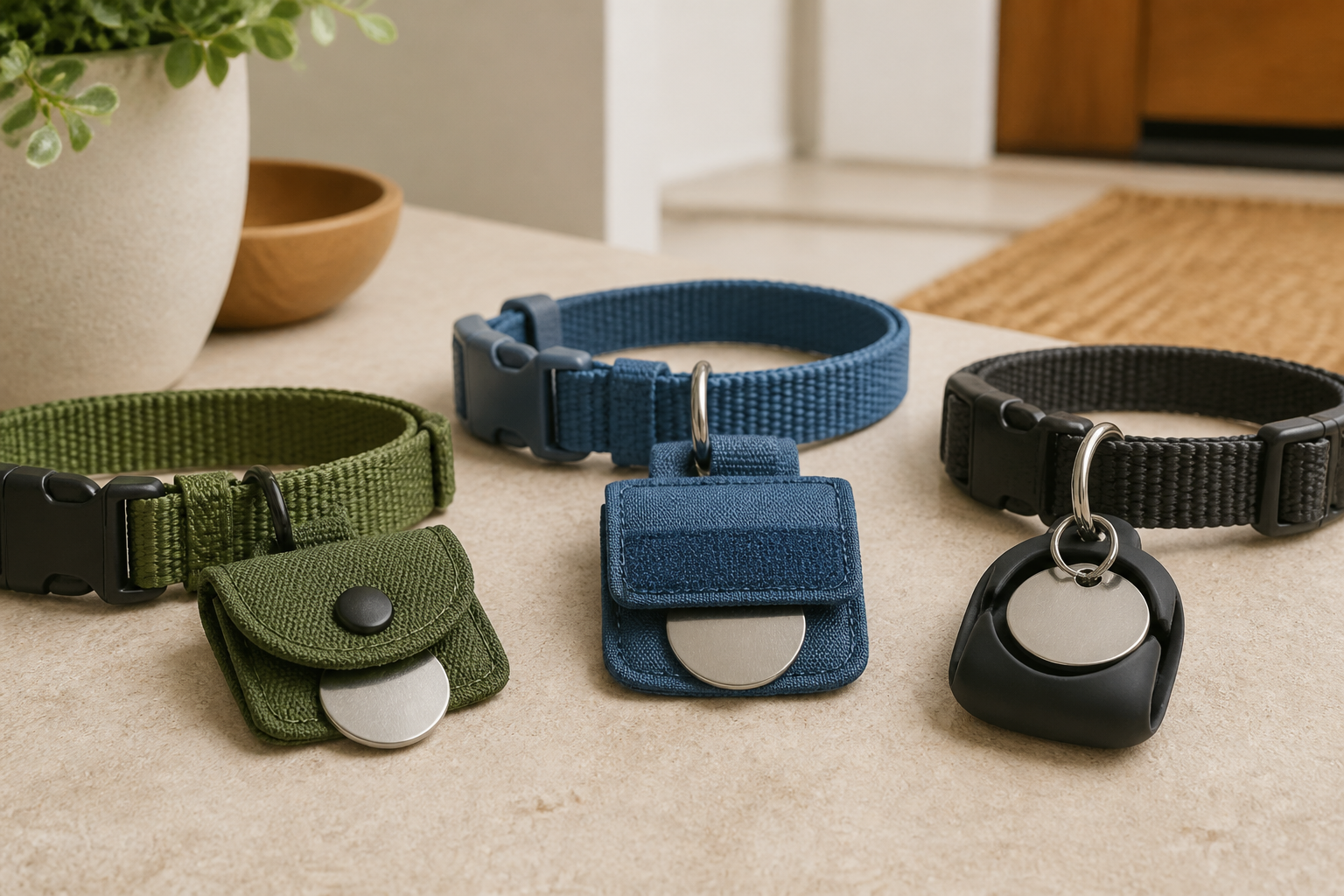 Enclosed tag pouches
A silencer or holder is a noise and attachment accessory. It does not guarantee that identification stays attached, remains readable, prevents snagging, makes a collar safe, or ensures a lost pet is returned. Keep identification current, inspect the complete collar setup regularly, and follow local identification requirements.
Choose the format by compatibility
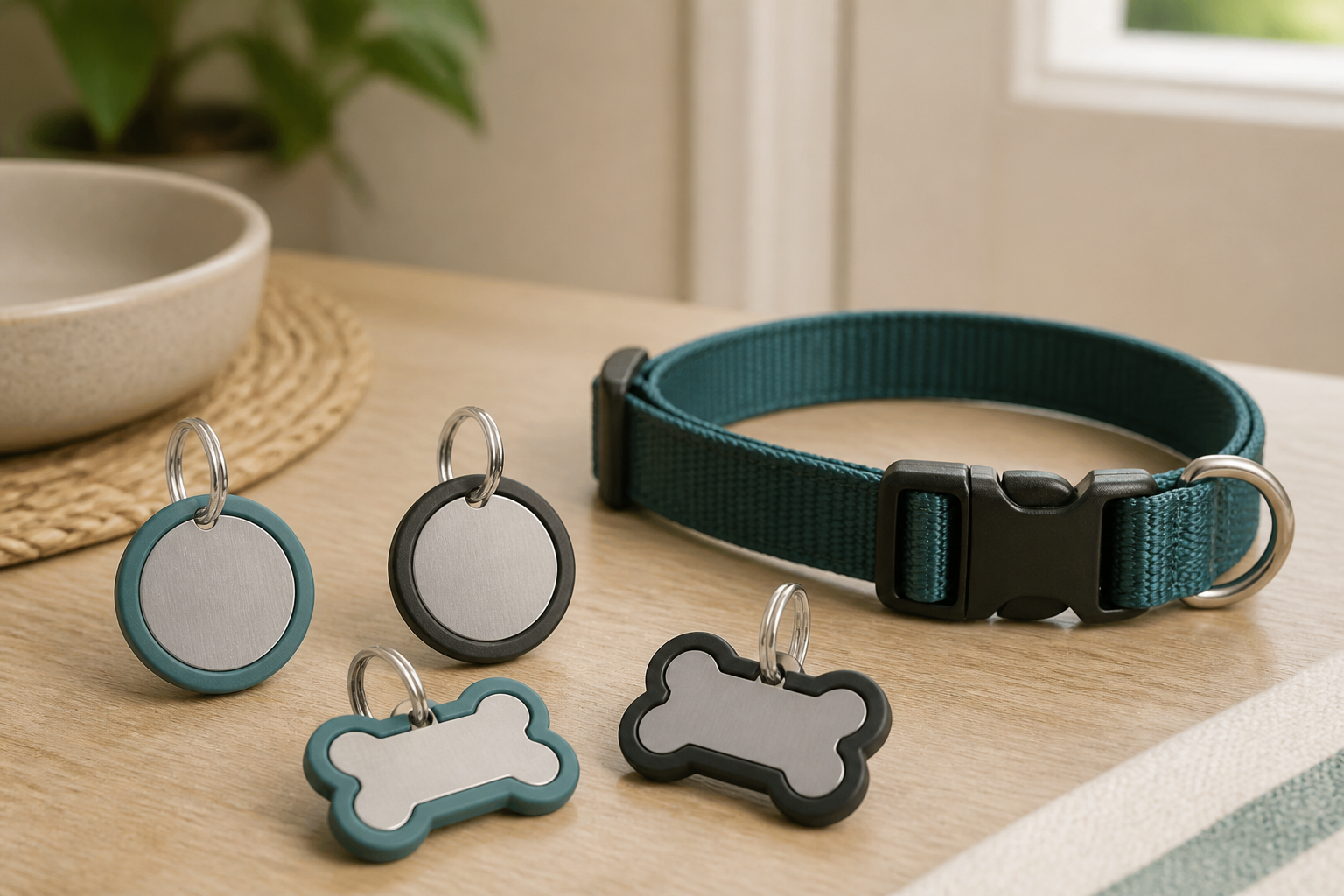
Silicone edge silencers preserve the usual split-ring attachment and fit around a tag perimeter. They work only when the profile matches closely. Round, bone-shaped, and rectangular tags need different bumpers, and even similarly named sizes may have different thicknesses or hole locations.
Slide-on holders reduce dangling because the collar passes through slots behind the plate or frame. That makes collar width, thickness, and construction decisive. Many slide-on designs do not work with rolled collars, very thick padded collars, fixed loops, wide buckle sections, or collars that cannot pass through the slots.
Enclosed pouches contain one or more compatible hanging tags behind a flap or flexible pocket. They can add bulk and make information less immediately visible, so check how the tag is accessed and whether your local rules require information to remain visible.
Quick comparison framework
- Silicone edge silencer: Start here when you want to keep an ordinary hanging tag and can verify a close shape-and-size match.
- Slide-on holder: Choose when a flat collar can pass through the stated slots and you want less movement.
- Enclosed pouch: Consider when several compatible tags need containment and the closure and information remain easy to inspect.
- Fresh split ring only: Skip the extra holder when the main issue is simply a worn or distorted attachment ring.
- No collar-mounted accessory: Ask a veterinarian or qualified professional about alternatives if a collar or dangling accessory is unsuitable for your pet or routine.
Selection criteria that matter
- Tag dimensions: Measure width, height, thickness, edge shape, and the distance from the attachment hole to the edge.
- Collar dimensions: For slide-on formats, measure the webbing width and thickness rather than relying on small, medium, or large labels.
- Attachment compatibility: Check slot shape, split-ring diameter, tag-hole size, and whether the holder can pass existing buckles or loops.
- Information access: The holder should not permanently conceal, rub away, or make it difficult to update essential identification.
- Material: Look for a clearly described flexible material or tightly finished fabric without sharp edges, loose threads, or brittle sections.
- Cleaning: Choose a format you can remove, wash or wipe as directed, dry completely, and reinstall without stretching it out of shape.
- Bulk and movement: Check that the completed setup does not crowd the buckle, leash ring, or other tags.
- Wear inspection: Replace stretched silicone, torn slots, opening seams, weak closures, sharp tag edges, and bent or spreading rings.
Fit the holder without hiding the important part
Lay the collar flat and photograph the current arrangement before removing anything. Measure the actual tag and the clear collar section available for the holder. After installation, confirm the buckle closes normally, the leash attachment remains unobstructed, and the identification is readable or readily accessible as intended.
Check the setup again while the pet is calmly supervised. Remove it if the pet mouths it, paws at it, or if the holder twists, slides into hardware, opens, stretches, or develops a loose piece. A small accessory that does not fit securely is not worth keeping for noise reduction.
Cleaning and replacement routine
Follow the listed care instructions. Remove ordinary dirt with the compatible method, rinse away residue when appropriate, and let every component dry fully before reassembly. Moisture trapped against metal can make engraving harder to inspect and may affect some finishes.
Read the tag at each cleaning and confirm the contact details are current. Inspect the collar, tag hole, ring, holder slots, seams, and closure as one system. Replace the worn component rather than assuming a new silencer will compensate for a weak ring or damaged tag.
Who should skip a tag silencer or holder
Skip one when you cannot verify the tag or collar dimensions, when local rules require visible information that a pouch would cover, or when the accessory crowds the buckle or leash attachment. Also skip it for pets that chew, swallow, or persistently manipulate small collar accessories.
Do not use a silencer to mask a collar setup that is damaged, poorly fitted, or unsuitable for the pet. If you are uncertain about collar use, snag risk, or identification options for a particular animal or environment, ask a veterinarian or other qualified professional for individual guidance.
The bottom line
For a standard hanging tag, a precisely fitted silicone edge silencer is the simplest first comparison. A slide-on holder can reduce dangling when collar dimensions match, while an enclosed pouch can contain compatible tags if access and inspection stay easy. Whatever the format, prioritize readable information, measured compatibility, intact attachment hardware, and regular wear checks over quietness alone.