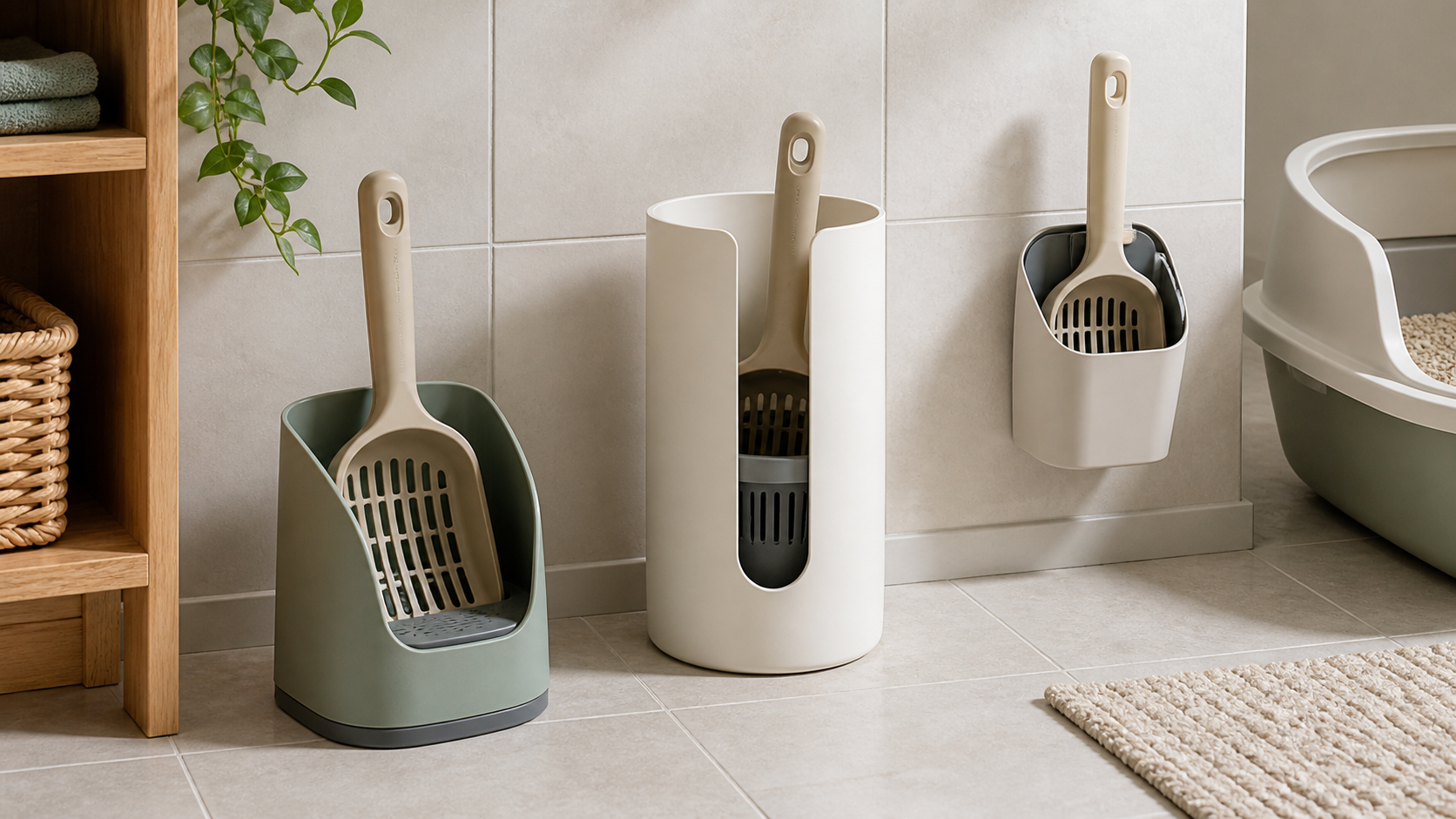
A holder is a convenience item, not a sanitary shortcut. Empty the scoop, clean it according to its material and maker directions, and let it dry before storage. A product cannot address sudden litter-box avoidance, straining, pain, blood, or abrupt urine or stool changes; contact a licensed veterinarian promptly about those signs.
Best for Simple Cleaning Access: An Open Caddy
An open caddy makes it easy to see loose granules and reach the inside during cleaning. A broad base can resist tipping when the scoop is lifted at an angle, while a removable inner cup can make routine washing easier.
The tradeoff is visibility and exposure. Check that the basket sits fully inside without the handle forcing the holder to lean. Keep the set where pets and children cannot knock it over or treat it as a toy.
Best for Visual Containment: An Enclosed Canister
A taller shell hides more of the scoop basket and may contain stray dry grains. The useful feature is not simply a narrow opening: look for a removable liner or a canister wide enough for your hand and cleaning tool to reach the bottom.
Do not put a damp scoop into a tight, unventilated enclosure. Moisture and residue can collect where they are difficult to inspect. Choose removable, washable parts and allow every piece to dry completely before reassembly.
Best for Floor Clearance: A Wall-Mounted Dock
A mounted holder keeps the floor open for sweeping and can suit a very narrow litter nook. Measure the scoop basket and handle as well as the wall area, then check that the installation will not interfere with the litter-box rim, lid removal, doorway, or nearby storage.
Adhesive mounts depend on the specified surface and preparation; screw mounting creates holes and requires suitable wall material and hardware. Follow the maker's mounting limits, check the attachment regularly, and skip this format if the surface cannot support it reliably.
Selection Criteria That Matter
- Scoop fit: Verify basket width, depth, and handle angle. A generic holder can still be too narrow or shallow for the included or preferred scoop.
- Stability: For floor models, compare base width, weight distribution, and whether removing the scoop pulls the holder forward.
- Cleaning access: Favor a removable insert or smooth interior that you can reach without hidden seams and channels.
- Drying: Open sides or adequate clearance help a washed scoop and holder dry; storage should begin only after both are clean and dry.
- Material: Check the maker's care directions. Plastic can scratch or crack; coated or metal parts can corrode if their finish is damaged or left damp.
- Footprint and clearance: Measure beside the box, including room to lift the scoop and remove the holder for floor cleaning.
- Mounting: For wall docks, confirm compatible surfaces, included hardware, removal implications, and the specified installation method.
- Pet access: Place the set away from curious paws, chewing, food, water, children's items, and high-traffic paths.
A Quick Comparison Framework
First, measure the available floor or wall area and the scoop you want to store. Eliminate holders that cannot contain the basket without tipping, scraping, or leaving the scoop awkwardly exposed. Next, imagine cleaning the holder after litter settles at its lowest point: if you cannot remove an insert or reach that area, choose a simpler format.
Then compare the daily motion. An open caddy prioritizes fast access, an enclosed canister prioritizes visual containment, and a wall dock prioritizes floor clearance. None is automatically cleaner; the better choice is the one you can empty, wash, dry, inspect, and return to a secure location without fuss.
Who Should Skip a Scoop-and-Holder Set
Skip a new set if your current scoop fits a washable container you already own and that setup is stable, easy to clean, and stored securely. A simple hook may also work when the scoop has a suitable hanging hole and cannot drip or shed litter onto nearby items.
Skip an enclosed holder if you routinely need to store the scoop before it can dry. Skip a floor caddy in a tight path where it will be kicked or moved. Skip adhesive or drilled mounting when you cannot verify surface compatibility, placement, or secure installation.
Connect the Holder to the Rest of the Litter Routine
The holder cannot compensate for a scoop whose slots, edge, and basket do not suit the litter and box. Use the full-size litter scoop guide to compare those working parts first. For trips, a holder may be too bulky; our travel scoop guide focuses on packed size and washable cases.
A litter mat can help catch granules outside the box, while a litter disposal system addresses a separate waste-storage decision. Keep each product focused on its job rather than expecting one accessory to fix the whole litter area.
The Bottom Line
Choose an open caddy for simple access, an enclosed canister for visual containment, or a wall-mounted dock for floor clearance. The best scoop-and-holder set is sized for the actual scoop, stable in its location, fully reachable for cleaning, able to dry, and easy to keep away from pets, children, food, and walking paths.