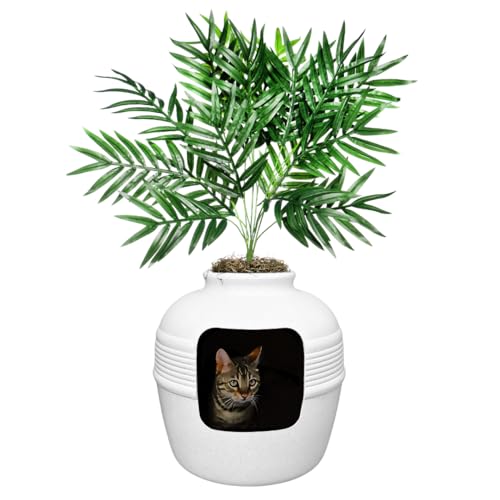
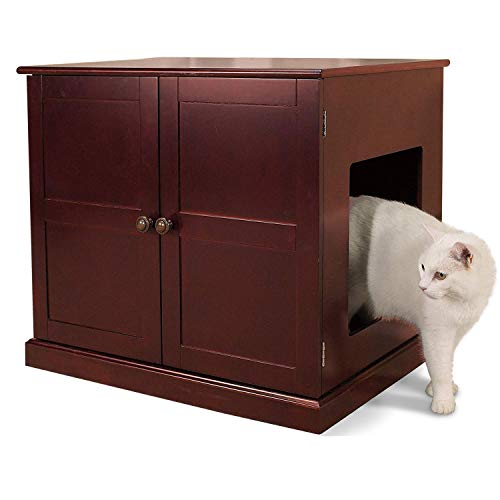
 Meow Town Concord Cat Litter Cabinet
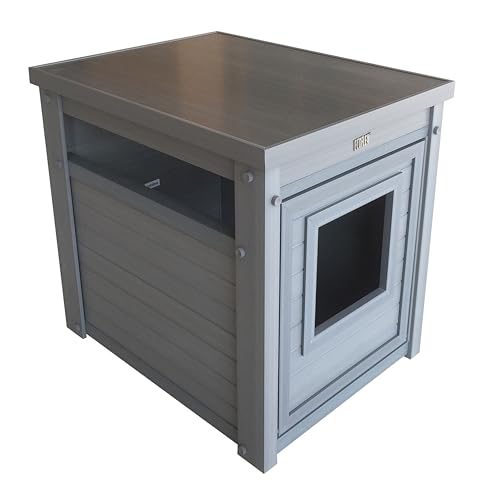 New Age Pet ecoFLEX Litter Loo
This is a format and setup comparison, not a hands-on test or a promise that one box will change a cat's behavior. Product exterior measurements can be misleading: the space beneath a curved lid or inside a tapered enclosure may be much smaller than the footprint suggests.
The Quick Difference
Choose a covered litter box when your cat willingly enters it, the interior is genuinely roomy, and partial scatter containment matters enough to justify removing or opening the lid for cleaning.
Choose an open litter box when you want maximum headroom, a clear approach, quick visual checks, and the simplest possible scooping and full-box wash routine.
For either style, put cat access and cleaning ahead of appearance. A box that looks tidy but is cramped, awkward to scoop, or routinely avoided is not a practical fit.
Option A: Covered Litter Box
A covered box places a hood, lid, dome, or furniture-like shell over the litter pan. Some have a swinging door or filter slot; others leave the entry fully open. Those details change the experience, so compare the actual entrance and interior rather than treating every covered box as the same.
Who a Covered Box Fits
- Cats already comfortable with enclosed boxes: acceptance matters more than privacy claims made for the product.
- Homes managing side scatter: taller covered walls can catch some litter kicked sideways, though litter can still leave through the entrance.
- Owners with a workable cleaning position: the hood should lift or open without moving furniture or spilling litter.
- Rooms where the footprint works: allow space above and around the box to remove the cover and carry the pan for washing.
Covered-Box Tradeoffs
A cover can reduce your view of the litter surface and add a step to every scoop. Odor can also be less noticeable to the person standing outside while remaining inside the enclosure, so a hood is not a reason to scoop less often. Curved roofs, filters, door flaps, seams, and textured plastic add surfaces to wash and dry.
Usable space is the biggest fit question. Check the interior floor, widest turning area, roof height, and opening—not only the overall product dimensions. A large cat, a cat with limited mobility, or a cat that stands high while eliminating may find a seemingly large covered box restrictive.
Option B: Open Litter Box
An open box is a pan without a roof. Wall height ranges from shallow trays to high-sided designs with a lowered entrance, so open does not necessarily mean low or unable to contain scatter.
Who an Open Box Fits
- Cats that prefer an unobstructed approach: the cat can see and move around the box without passing through a hood or flap.
- Large or tall cats: a wide pan with no roof preserves headroom and turning space.
- Kittens, older cats, or cats with mobility limits: an appropriately low entry can make access simpler; ask a veterinarian about new mobility changes.
- Owners prioritizing maintenance: waste, litter level, and wet or soiled areas are easier to see and scoop promptly.
Open-Box Tradeoffs
There is no roof to intercept litter kicked upward or sideways, and the pan remains visible in the room. A larger open box may also consume more apparent floor space than a compact-looking enclosure. High-sided versions can help with scatter, but their entrance still needs to suit the cat using it.
Setup and Maintenance Issues to Check
- Measure usable space: compare the interior floor and turning area with your cat's body length and posture. Exterior dimensions include walls, lips, hinges, and decorative shapes.
- Check entry height: the lowest step-in point matters for kittens and cats with limited mobility. Do not assume a top opening or tall doorway suits every cat.
- Plan the scoop route: confirm that you can reach every corner without awkward twisting. A covered box should open fully where it sits.
- Wash every component: lids, flaps, seams, filters, handles, and textured areas need care in addition to the pan. Follow the maker's directions and dry the box fully.
- Protect the exit path: place a suitably sized litter mat where the cat actually steps out instead of expecting the box style to stop all tracking.
- Keep ventilation practical: do not block openings or wedge a covered box into a tight, damp recess. A cover is not a substitute for routine scooping.
- Watch door clearance: make sure room doors, cabinet doors, and the litter-box lid can all open without trapping or startling the cat.
Room-by-Room Decision Guide
For an easy-to-clean utility area, start with open. Fast access and a clear view make routine scooping straightforward, especially when appearance is not the main constraint.
For a living space, consider covered only after measuring. A visually contained format may suit the room, but it still needs enough interior space, ventilation, and lid-removal clearance. Our litter box furniture guide covers enclosure-specific fit and assembly issues.
For a cat that kicks litter, compare high sides before adding a roof. A roomy open pan with high sides and an accessible entrance may address some scatter without changing to a fully enclosed format.
For a multi-cat home, prioritize access and routine. Cats may not share preferences, and one format should not be assumed to suit every cat. Keep boxes accessible and ask your veterinarian or a qualified cat behavior professional about persistent conflict or avoidance.
Who Should Skip Each Style?
Skip a covered box if your cat hesitates at the entrance, cannot turn or stand naturally inside, has trouble stepping in, or you cannot remove the hood easily for frequent scooping and washing. Also skip models whose current listings do not provide enough dimensions to judge the usable interior.
Skip a low-sided open box when litter is routinely kicked or urine goes over the wall and a higher-sided accessible pan would better contain the mess. Skip any open pan whose footprint is too small merely because it fits a narrow corner.
Skip changing the box as a quick behavior fix. A product swap cannot diagnose pain, urinary trouble, digestive problems, stress, or conflict between cats.
When to Contact a Veterinarian
Seek prompt veterinary advice for straining, repeated trips with little output, crying, blood, pain, vomiting, marked lethargy, or sudden urination or defecation changes. Sudden litter-box avoidance can have medical or environmental causes; do not wait for a new box to solve it. For persistent non-medical setup problems, a qualified cat behavior professional can help assess placement, access, household conflict, and gradual changes.
Useful Next Steps
After choosing the box format, compare clumping and non-clumping litter by cleanup routine and cat acceptance. Then match the daily tool with our litter scoop guide.
If carrying scoop waste outside after every cleaning is impractical, review litter disposal systems for small homes. These are convenience products, not substitutes for timely scooping or veterinary attention when box habits suddenly change.
Bottom Line
A covered box may suit a cat that accepts the enclosure and a household willing to manage the extra surfaces and lid access. An open box is usually simpler to inspect, scoop, size generously, and approach. Choose the format that gives your cat enough usable room and gives you the easiest reliable cleaning routine.