Glass-Door Hours Sign Guide
Best business hours signs for glass doors.
The best hours sign makes the weekly schedule easy to find before a customer reaches for the handle, while keeping exceptions simple to update. Start with the reading distance, glass reflections, frequency of schedule changes, and whether the back of the sign will be visible from inside.
Disclosure: As an Amazon Associate, we may earn from qualifying purchases and approved partner referrals.
Category route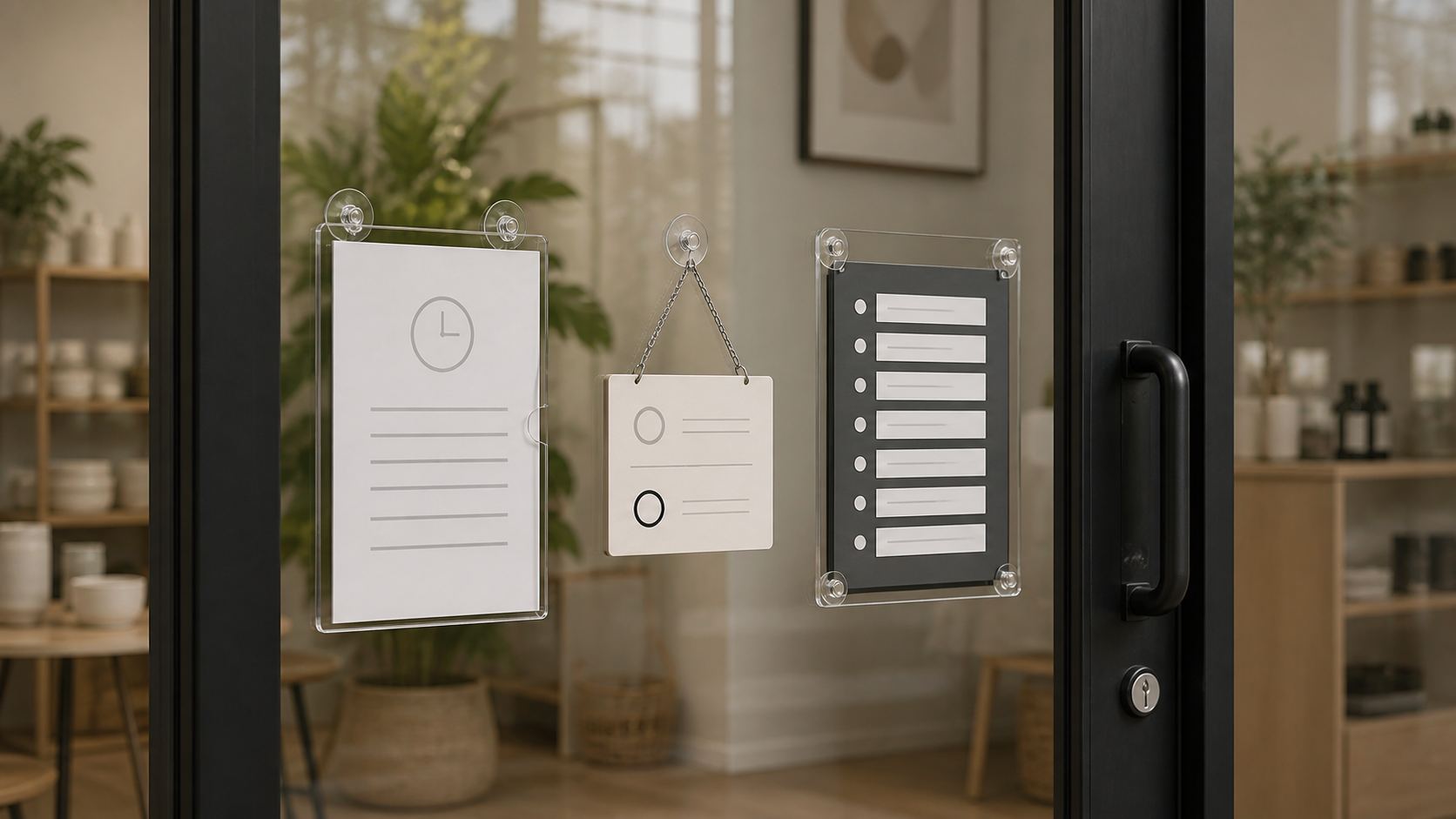
Best overall starting route
Choose the update method before the finish.
A replaceable printed insert fits a schedule that changes occasionally. A changeable panel suits frequent edits. A permanent decal gives a clean appearance only when the hours are genuinely stable. Verify the current listing's complete dimensions, insert or character capacity, mounting method, included parts, and intended placement.
Related: use the store-hours window-vinyl guide for a permanent lettering plan, or compare open signs when the message is only the current open/closed state.
How we compare glass-door business-hours signs
This is a product-category comparison and buying framework, not hands-on testing or a ranking of current named products. Compare candidates in this order:
- Update method: count regular schedule changes, seasonal exceptions, and holiday notices before choosing permanent lettering, movable characters, or a replaceable insert.
- First viewing distance: mock up the complete weekly schedule at full size, tape it at the proposed height, and read it from the customer's normal approach.
- Contrast and glare: test the sign against the real interior background in daytime and evening conditions. Clear acrylic can look tidy but may add reflections.
- Glass-side placement: an indoor-mounted sign is easier to protect and update, but tint, reflections, or a reversed reading direction can affect visibility from outside.
- Mounting and removal: check the glass condition, product instructions, complete sign weight, attachment format, and removal method before applying suction cups, static cling, or adhesive.
- Two-sided appearance: decide whether customers and staff will see an unfinished back, visible adhesive, or reversed lettering from the other side.
- Exception workflow: leave a deliberate place for temporary holiday or weather notices instead of covering the permanent schedule with several loose papers.
Best format by update routine
Category routeReplaceable insert holder: best for occasional schedule changes
A printed insert keeps typography controlled and makes a revised schedule inexpensive to produce. Compare the visible insert area, loading direction, portrait or landscape orientation, reflections, mounting format, and whether the back looks acceptable from inside.
Browse category: Compare glass-door insert holders
Category routeChangeable hours panel: best for frequent edits
Movable characters or rows make routine changes direct without reprinting the whole sign. Confirm that the set supports the longest day and time format you need, then compare character size, alignment, storage for unused pieces, and how securely the panel mounts.
Browse category: Compare changeable hours signs
Category routeVinyl lettering: best for a stable schedule
Lettering can keep the door visually quiet because it adds no holder or frame. It is less forgiving when hours change. Check letter height, contrast, line spacing, application side, surface preparation, removal instructions, and whether the schedule remains readable against the interior.
Browse category: Compare business-hours lettering
A quick comparison framework
- Hours change less than once a year: permanent lettering may be the cleanest route if the exact schedule and removal consequences are acceptable.
- Hours change seasonally: use a replaceable printed insert so the complete schedule stays visually consistent.
- Hours change every week: use a changeable panel only if its characters remain readable and staff have a simple update routine.
- The door has strong reflections: test a matte printed insert and an opaque backing before choosing a glossy clear holder.
- The glass already carries several messages: consolidate the regular schedule and move temporary notices to one defined secondary area.
The small-business sign planning pillar can help separate identification, hours, directions, and promotional messages before the door becomes crowded.
Plan the complete door, not only the hours panel
Photograph the entrance straight on and from the normal approach. Mark the handle, eye-level zone, door swing, existing decals, and any required notices. Give the weekly schedule one consistent location and visual hierarchy. A separate temporary holder can carry exceptions without obscuring the regular hours.
An illuminated LED open sign answers a different question: whether the business is open now. It does not replace a readable weekly schedule. Likewise, this guide does not determine accessibility, lease, landlord, fire, or local display requirements; check the applicable requirements and property rules for the actual entrance.
Who should skip these options?
- Skip permanent lettering when the schedule, tenant, branding, or door may change soon.
- Skip a clear acrylic holder when reflections or the interior background make the insert hard to read.
- Skip suction mounting unless the current product instructions, complete sign weight, glass condition, and routine inspection support it.
- Skip tiny movable characters when staff or customers cannot read the full week from the normal approach.
- Skip a hanging plaque when door movement makes it swing, strike the glass, cover the handle area, or turn away from the reader.
- Skip another standalone sign when the door is already crowded; consolidate messages and test the hierarchy first.
The practical bottom line
For most small businesses, a well-designed replaceable insert is the safest starting format because it preserves readable typography while allowing a complete schedule update. Choose a changeable panel when edits are genuinely frequent and the character system fits the longest schedule. Reserve permanent lettering for stable hours after testing contrast, scale, glass-side placement, and removal implications. Before ordering, mock up the full week at actual size and view it through the real glass in more than one lighting condition.
 The Good Sign Company