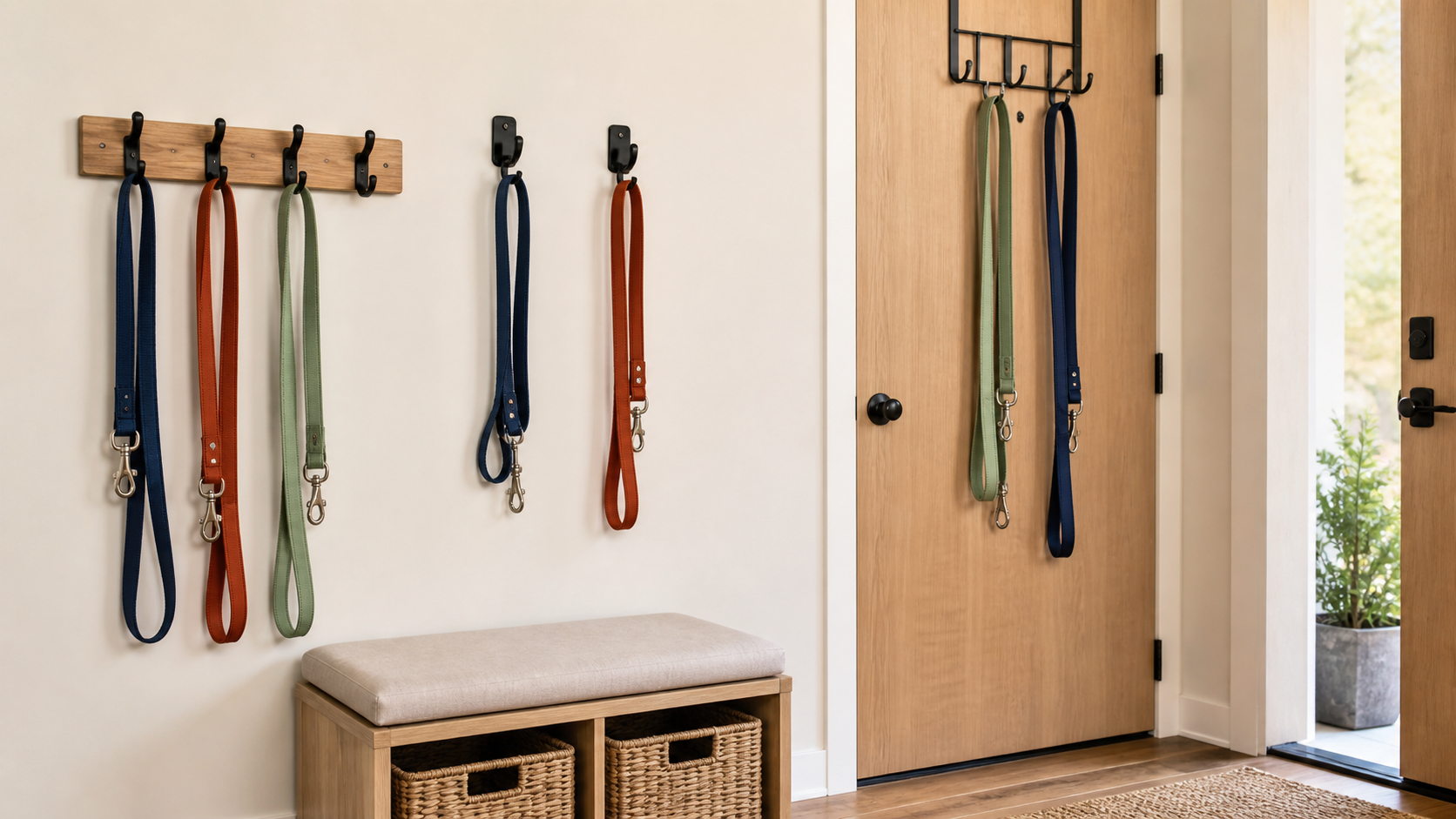
This guide compares storage formats rather than current named products. A hook organizes leashes, harnesses, towels, and bag holders; it does not make walking gear safer or correct a poor fit. Inspect gear routinely and follow the leash or harness maker's care and replacement directions.
Quick Comparison: Match the Hook to the Entryway
Screw-mounted rail: best fit for a permanent station
A short rail groups several hooks on one backplate, which can keep a leash, harness, bag holder, and lightweight towel together without scattering fasteners across the wall. It works best when you can mount it to the surface exactly as directed and leave enough space between hooks for gear to dry without overlapping.
Measure the rail width and hook projection, not just the empty wall. Confirm whether the supplied hardware matches drywall, masonry, wood, or a wall stud. A seller's stated load is only useful when the rack is installed on a compatible surface with the specified fasteners.
Individual hooks: best fit for a narrow or uneven wall
Separate hooks let you use a slim wall strip and set wider spacing around a bulky harness. They can also keep a damp leash away from dry gear. The tradeoff is extra measuring and more mounting points. Choose rounded, smooth hooks that hold a loop securely without sharp edges pressing into webbing.
Adhesive versions may look renter-friendly, but surface preparation, paint condition, humidity, product weight, and removal instructions all matter. Do not hang valuable or heavy gear over a breakable object, pet resting area, or busy walkway.
Over-door rack: best fit when wall mounting is unavailable
An over-door rack avoids wall holes, but only if its bracket fits the door thickness and the door still closes freely. Check the gap above the door, the rack's total projection on both sides, nearby trim, and whether hanging gear will hit the wall, knob, lock, or a person using the doorway.
This format can rattle and can interfere with seals or finished surfaces. Protective pads may reduce rubbing, but follow the door and rack makers' directions. Skip it on fire-rated, exterior, tight-fitting, pocket, sliding, or otherwise specialized doors unless the door manufacturer permits the setup.
Selection Criteria That Matter
- Measured footprint: Record usable wall width, hook projection, door swing, trim, switches, and walking clearance.
- Mounting surface: Match fasteners to the actual wall or door material; do not assume included anchors fit every surface.
- Stated load: Add the gear you plan to hang and leave margin. Do not use a pet leash hook for body weight, tethering, or restraint.
- Hook spacing: Leave enough room that a harness and damp leash do not become a tight, slow-drying bundle.
- Hook shape: Prefer smooth, rounded edges and enough upturn to keep loops from sliding off during normal handling.
- Moisture exposure: Look for documented material and care guidance if rain gear will hang there, and protect the wall or door from prolonged damp contact.
- Pet access: Mount gear where a dog cannot chew straps, pull the rack down, or become tangled in hanging loops.
- Renter fit: Check the lease and removal directions before drilling or using adhesive; patching and paint damage may still occur.
A Simple Entryway Setup Framework
Give each daily item one position: the regular leash on the easiest hook, the harness on a wider-spaced hook, and the bag holder or light in a small contained spot. Put backup gear elsewhere so the entryway station stays easy to scan. Keep towels below or beside the hooks only if they can dry fully and do not block the path.
Place muddy shoes and the towel currently in use in a separate washable zone. Our boot tray guide covers floor containment, while the dog walking bag guide is better when supplies need to leave the house together. For low-light outings, compare reflective leash construction separately from storage.
After mounting, follow the product instructions for checking fasteners. Remove wet gear to clean and dry it according to its label. Never clip a dog to a storage hook: these products are organizers, not tie-out points or structural anchors.
Who Should Skip an Entryway Leash Hook
Skip exposed hooks if your dog chews or pulls hanging gear, if children can swing from the rack, or if loops would hang at neck or body height in a narrow passage. Closed cabinet storage may be a better fit. Skip over-door hardware when clearance is tight, and skip adhesive hooks when the surface, weight, humidity, or removal instructions are uncertain.
You may not need a new organizer if an existing drawer, cabinet, or properly installed coat hook keeps gear dry, separate, and easy to inspect. If walks involve bolting, lunging, gear escape, or handling that feels unsafe, storage hardware is not the solution; ask a certified trainer or other qualified professional for help with the walking setup.
The Bottom Line
Choose a screw-mounted rail for a stable permanent station, individual hooks for an awkward strip of wall, or an over-door rack when compatible no-drill storage matters most. The best fit is measured, mounted for the real surface, clear of the doorway, inaccessible to chewing, and spaced so damp gear can dry.