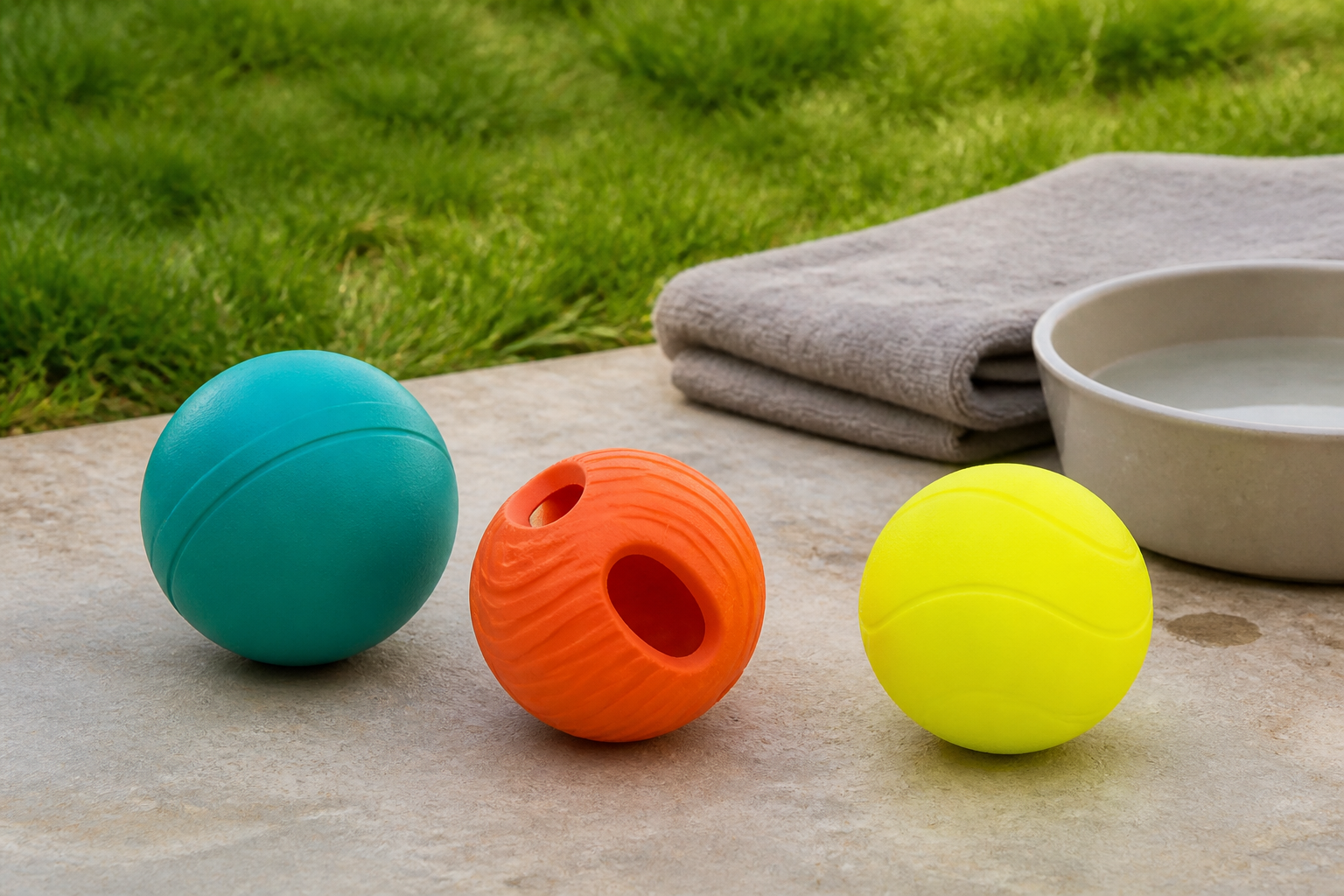
This is a product-category buying framework, not a named-product ranking or hands-on test. “Durable” means intended for repeated supervised fetch relative to ordinary felt-covered tennis balls; it does not mean chew-proof, puncture-proof, or safe to leave with a dog.
Quick Comparison: Which Format Fits?
Solid rubber: best simple starting format
A one-piece solid rubber ball has fewer openings to trap mud and can be straightforward to rinse. It may also be heavier and firmer than a hollow ball. Check the listed weight and diameter, and avoid throwing toward hard surfaces, people, pets, windows, or fragile objects.
Hollow textured rubber: best for grip and lighter carry
Ridges and openings may make a wet ball easier for some dogs to pick up, while a hollow body can reduce weight. Those same features collect dirt and deserve close inspection for splits, torn edges, or missing pieces. Confirm that every opening is too small to trap the dog's lower jaw.
Floating high-visibility: best for easier visual tracking
Bright color can help an owner track a ball against grass or water, but visibility varies with the setting and the dog's vision. For water play, rely only on a current explicit float claim, keep the dog close to shore, and never throw into currents, deep water, unsafe temperatures, or poor conditions.
Selection Criteria That Matter
- Diameter: Use the maker's sizing guidance and choose a ball that cannot slip wholly behind your dog's teeth. If in doubt, ask your veterinarian about appropriate toy size.
- Carrying style: Watch whether your dog carries gently, crushes, peels, or settles down to chew. Fetch balls are a poor match for destructive chewing.
- Material and weight: Confirm the listed rubber or other material, weight, and care instructions. A very firm or heavy ball may not suit every dog or throwing space.
- Launcher fit: Match the exact ball diameter to the launcher's stated compatibility. Never force an uncertain size into a scoop or launcher.
- Cleaning: Rinse away dirt and saliva after play according to the maker's directions, clean openings thoroughly, and let the ball dry before storage.
- Play area: Use a clear, securely bounded space with safe footing. Keep throws controlled and give the dog breaks instead of chasing distance or repetition targets.
- Supervision: Keep the game interactive, end it before the ball becomes a chew object, and store the ball out of reach afterward.
Inspect Before and After Every Game
Roll and squeeze the clean ball under good light. Look for cracks, deep tooth cuts, stretched openings, loose flakes, separated seams, sticky surfaces, or any change in shape. Remove a damaged or unexpectedly soft ball immediately and follow the maker's replacement guidance. Do not trim, glue, tape, or otherwise repair a damaged fetch ball.
Track where the ball lands and retrieve it at the end of play. A missing toy can become an unsupervised chewing or swallowing risk later. If your dog may have swallowed any piece, contact a veterinarian promptly rather than waiting for a product to solve the problem.
Who Should Skip These Fetch Balls?
Skip rubber fetch balls for dogs that try to swallow balls, shred rubber, guard toys, become difficult to interrupt, or have dental, jaw, mobility, breathing, pain, or exercise concerns. Ask a veterinarian or qualified trainer for guidance that fits the individual dog. A ground roll with a larger toy, a calm sniffing activity, or another supervised enrichment format may be a better choice.
Also skip the purchase if an existing appropriately sized toy is intact, easy to clean, and already works for short supervised games. A new ball is a convenience item, not a health treatment or a requirement for good enrichment.
The Bottom Line
Start with a correctly sized solid rubber ball for simple cleanup, consider a hollow textured design when grip and lower weight matter, and choose a floating high-visibility format only for an appropriate supervised setting. Inspect every ball, stop chewing, control the play space, and replace the toy at the first meaningful damage.