We did not hands-on test or rank every carrier. This category comparison uses practical fit and maintenance criteria; it does not rely on prices, ratings, review counts, availability, or universal “airline approved” claims.
Measure Three Things, Not One
First measure the pet in the position required by the carrier maker’s fit guidance. Second, check the carrier’s stated interior dimensions and weight limit. Third, get the current maximum exterior dimensions from the transport provider for the exact route, vehicle, cabin, or seat assignment. A carrier can match a published size limit yet still be wrong for the pet, and a comfortable carrier can still be too large for a particular space.
Do not plan to compress a carrier around the pet to make the numbers work. Soft fabric may flex slightly, but ventilation panels, seams, zippers, and the pet’s usable space should remain unobstructed.
Selection Criteria That Matter
- Interior fit: follow the manufacturer’s measuring and sizing directions, including both interior dimensions and the stated weight limit.
- Exterior dimensions: compare the fully assembled carrier—not the folded storage size—with the current allowed space.
- Structure: look for a base that stays level and walls that do not collapse into the pet’s face when lifted or placed down.
- Ventilation: check the location of mesh panels and make sure luggage, fabric flaps, or the surrounding space will not cover them.
- Openings and closures: choose door placement that works for ordinary loading while allowing every zipper and latch to close fully.
- Base and liner: a removable, washable liner is useful only when it fits flat, dries fully, and does not bunch under the pet.
- Carrying comfort: compare handle placement, shoulder-strap range, packed weight, and how level the carrier stays while moving.
- Cleaning and inspection: follow care directions and regularly inspect mesh, seams, zippers, base inserts, and attachment points for wear.
Which Format Fits Which Routine?
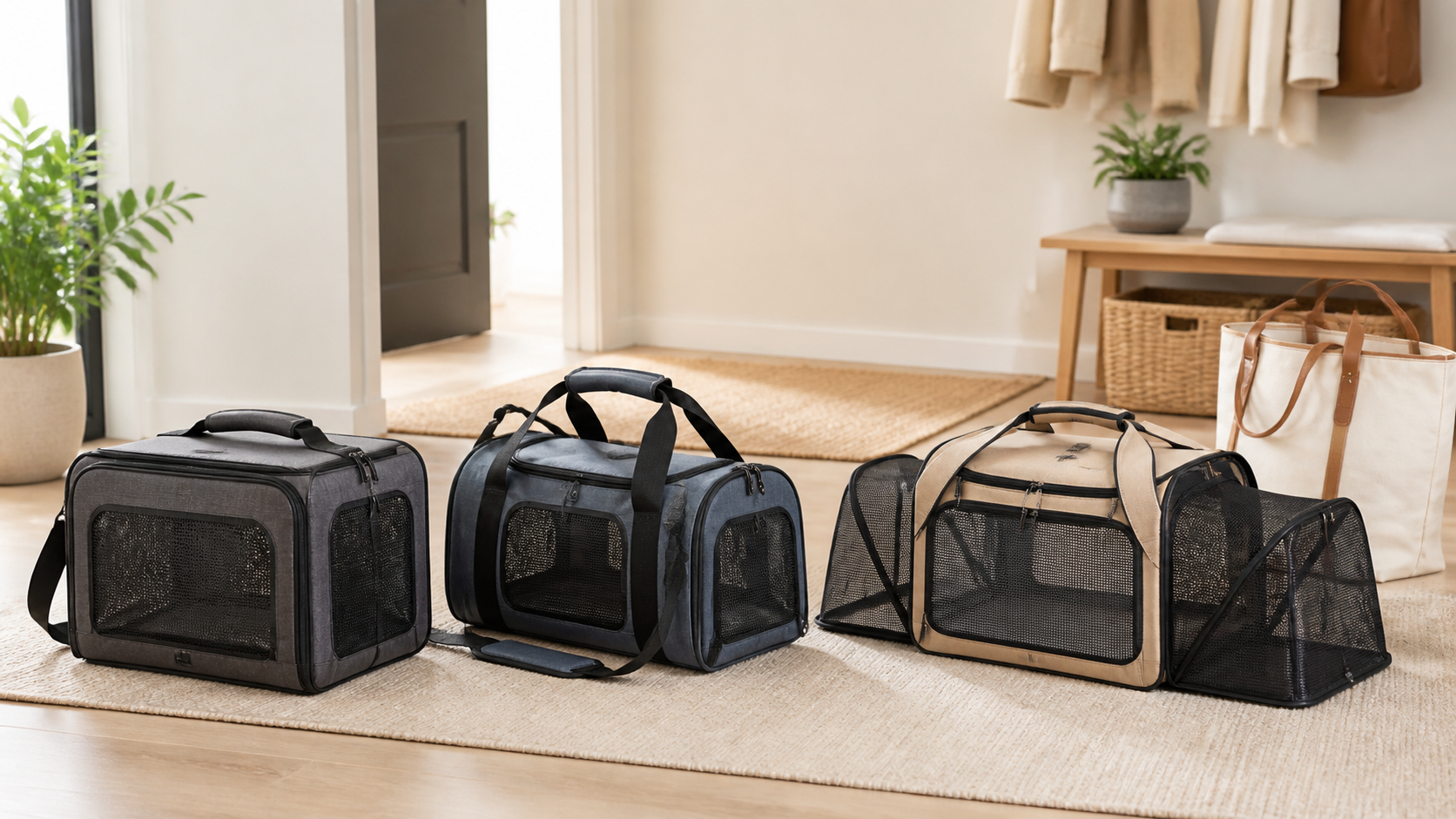
Structured rectangular carriers are the clearest starting point when measurements must be predictable. Their fixed base and framed edges make the exterior footprint easier to assess, but they usually take more closet space.
Flexible duffel-style carriers fold more easily when empty and may be simpler to carry through a building. Reject any design that sags into the pet’s space, twists when lifted, or depends on being compressed around the pet.
Expandable carriers can add floor area in a waiting room, hotel, or other suitable stationary setting. The extension is not usable while the carrier is beneath a seat or anywhere it blocks access, ventilation, or another person’s space, so judge the closed carrier first.
Provider Rules Can Change
“Airline approved” is not a dependable universal specification. Policies, aircraft, seat hardware, routes, and cabin arrangements vary and can change. Check the provider directly shortly before the trip, ask whether pet reservations are required, and verify the exact carrier-size and placement rules that apply to your booking.
This guide is also useful for trains, buses, and other trips with constrained storage, but each operator sets its own rules. Never place a pet in a closed baggage compartment or other location that the provider has not explicitly authorized for pet travel.
Who Should Skip an Under-Seat-Style Soft Carrier?
Skip this category when the pet cannot fit comfortably within both the maker’s limits and the provider’s dimensions, when the soft walls collapse inward, or when damaged mesh and closures cannot contain the pet reliably. A pet who chews fabric, panics in confinement, has breathing or mobility concerns, is injured, or struggles with routine transport needs individual guidance from a licensed veterinarian before travel.
Also skip buying a new carrier when your current one is undamaged, correctly sized, cleanable, and accepted for the planned trip. Our carrier upgrade checklist can help with that decision.
Build the Rest of the Carrier Setup
For a broader format decision, compare hard-sided and soft-sided carriers. If the trip is a routine local appointment rather than constrained transport, start with our carrier guide for vet visits and short trips. A properly measured washable carrier liner can simplify cleanup without changing the carrier’s fit limits.
The Bottom Line
A structured soft carrier is the most practical first format to compare for measured under-seat storage. Choose a flexible duffel only when it stays supportive in use, and treat an expandable panel as a stationary convenience after transport. The final choice must pass three independent checks: pet fit, carrier specifications, and the current rules for the exact trip.