Temporary Window Sign Buying Guide
Best temporary window signs for small-business promotions.
The best temporary window sign makes one short-lived message easy to notice without turning the whole storefront into a bulletin board. Choose the format only after deciding how long the promotion runs, how often the message changes, where customers first see the window, and how the sign will be removed.
Disclosure: As an Amazon Associate, we may earn from qualifying purchases and approved partner referrals.
Category route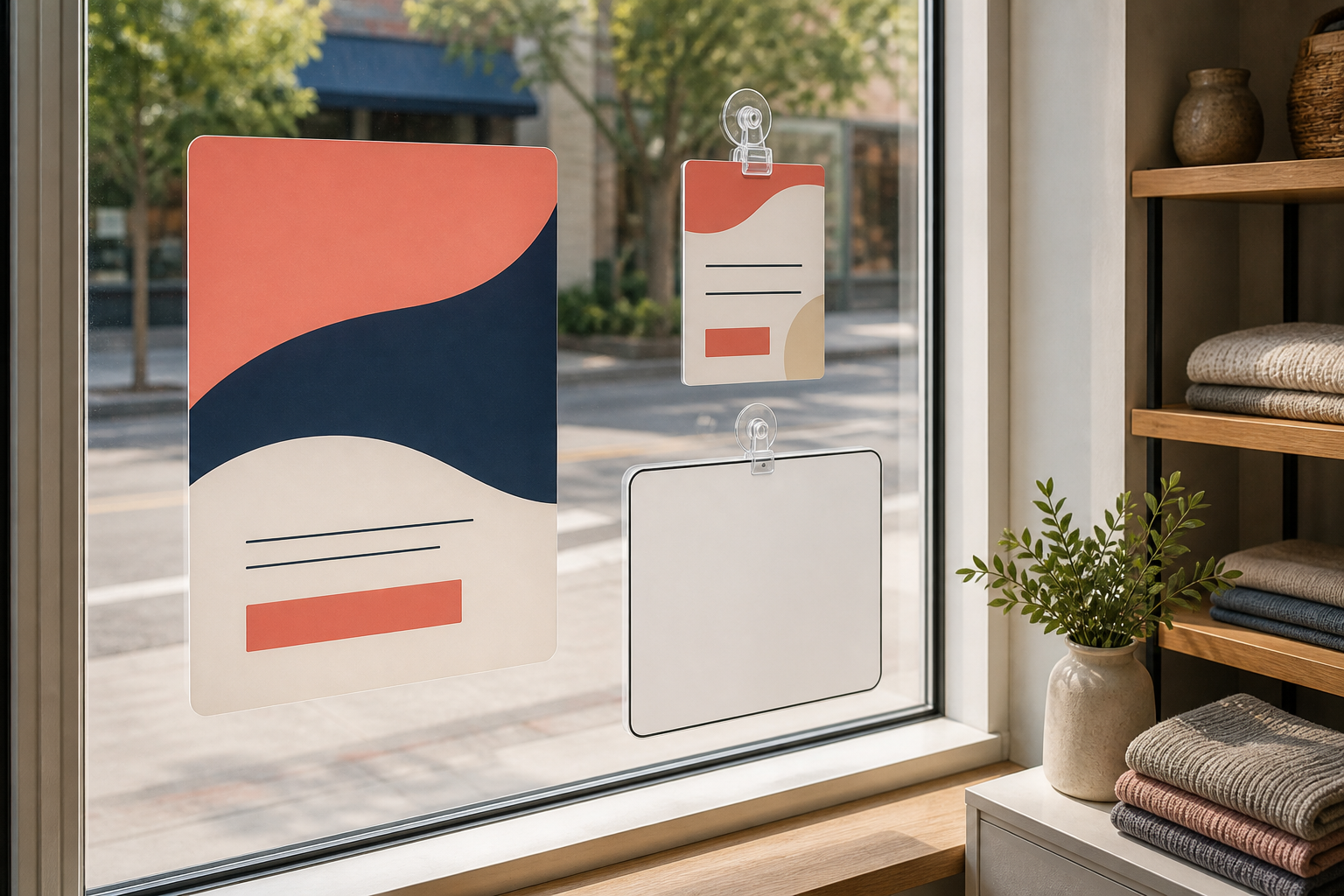
Best overall starting route
Match the sign format to the update routine.
Static-cling graphics suit one finished campaign message. A clear suction-cup holder makes printed inserts easy to swap. A reusable write-on panel fits brief messages that genuinely change often. Verify the current listing's full dimensions, intended surface, application side, included parts, removal directions, and cleaning instructions.
Related: use the business-hours sign guide for a recurring weekly schedule, or the wall sign vs window vinyl comparison for a longer-lived storefront message.
How we compare temporary promotional window signs
This is a product-category comparison and buying framework, not hands-on testing or a ranking of named products. Compare each candidate in this order:
- Message life: define the start date, end date, and removal owner. A weekend message and a three-month campaign need different update systems.
- Viewing distance: tape up a full-size paper mockup and read it from the customer's actual approach, not only from directly in front of the glass.
- Contrast and glare: test daylight, evening reflections, window tint, and the interior background. Transparent areas can make a message disappear into merchandise or street reflections.
- Attachment format: distinguish true static cling, removable adhesive, suction hardware, and a holder for a paper insert. Follow the current maker's surface-preparation and removal directions.
- Inside versus outside reading: inside mounting can protect a display, but tint and reflections may reduce visibility. Confirm whether graphics must be reverse printed to read correctly through the glass.
- Change routine: choose a format employees can update neatly and consistently, including storage for inserts, markers, or reusable pieces.
- Removal consequence: test an inconspicuous area when appropriate and plan cleaning time. Do not assume every product is residue-free on every glass treatment.
Best format by promotion type
Category routeStatic-cling graphic: best for one finished campaign
Use a cling-style panel when the wording, colors, and campaign dates are settled. Compare usable print area, opacity, application side, surface compatibility, repositioning instructions, and storage if the graphic may be reused.
Browse category: Compare static-cling window signs
Category routeReplaceable insert holder: best for rotating promotions
A holder separates the attachment from the printed message, so staff can replace a clean insert without reapplying hardware. Compare visible paper size, loading direction, suction-cup count, complete loaded weight, reflections, and inspection routine.
Browse category: Compare suction-cup sign holders
Category routeReusable write-on panel: best for very frequent short updates
This format works when a date, item, or brief offer changes repeatedly. Compare writing area, contrast, compatible markers, cleaning method, ghosting guidance, attachment, and who is responsible for keeping the lettering legible.
Browse category: Compare reusable window signs
A quick comparison framework
- One polished seasonal campaign: start with a professionally designed cling-style graphic after testing full-size contrast.
- A new offer every few weeks: use one consistent holder and replaceable printed inserts.
- A short message changes daily: use a reusable panel only if the writing stays neat and the cleaning routine is realistic.
- Strong reflections or a busy interior: favor an opaque background and large, high-contrast type over clear material and fine detail.
- Several messages already cover the glass: consolidate them before adding a promotion; preserve a clear hierarchy for identity, hours, entry information, and the temporary offer.
The small-business sign planning pillar helps assign each message one job before the storefront becomes crowded.
Plan the window before choosing a product
- Photograph the full window straight on and from both customer approach directions.
- Mark handles, mullions, existing hours, required notices, displays, and the clearest promotional zone.
- Write one main message and one action. Move details to the landing page, counter, or another deliberate information point.
- Mock up the sign at actual size, then view it in daytime and evening conditions from the normal approach.
- Record the installation date, removal date, approved attachment method, and person responsible for checks and updates.
This guide does not determine lease, landlord, accessibility, fire, or local display requirements. Check the rules that apply to the actual property and promotion before installation.
Who should skip these options?
- Skip a transparent sign when the store interior or street reflection prevents useful contrast.
- Skip suction-cup hardware when the current product directions, loaded weight, glass condition, or inspection routine is unresolved.
- Skip removable adhesive when the window film, coating, tint, or removal consequence has not been checked.
- Skip a handwritten panel when consistent, professional updates are unlikely.
- Skip another temporary sign when the window already asks customers to read too many unrelated messages.
- Skip a promotion-first layout if it obscures the regular hours, entrance information, or a clear view needed for the actual storefront.
The practical bottom line
For most rotating promotions, a single clear holder with replaceable printed inserts is the most manageable starting system. Choose a static-cling graphic for a settled campaign with stronger visual design, and a write-on panel only for genuinely frequent short updates. Whatever the format, test the complete message at actual size through the real glass, assign a removal date, and keep the temporary promotion visually separate from permanent identity and weekly hours.
 The Good Sign Company