 The Good Sign Company
Storefront sign planning
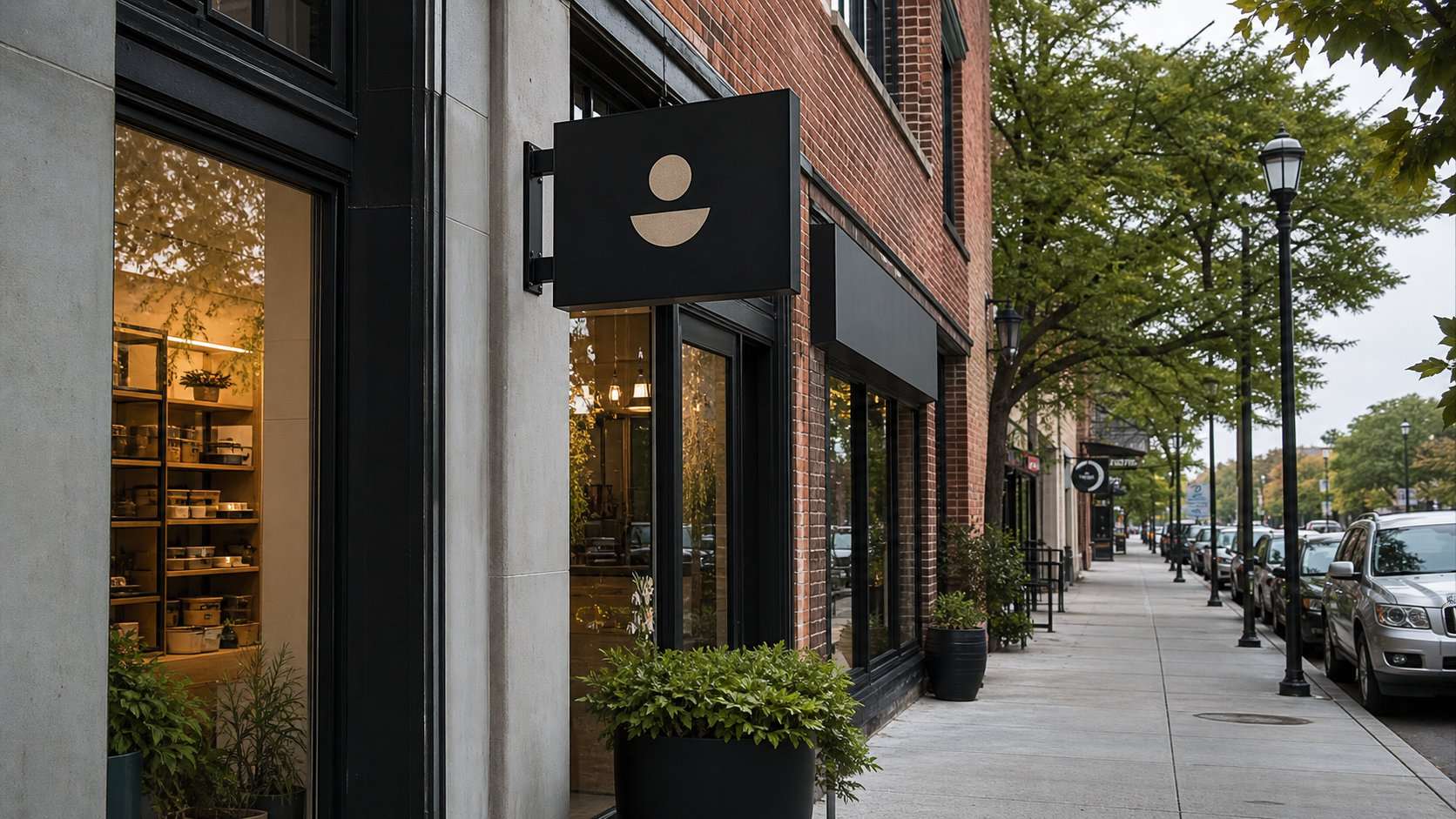
Plan a projecting sign from the sidewalk, not from straight in front of the wall.
A projecting or blade sign sits roughly perpendicular to a building face, so its main advantage is visibility to people approaching along the storefront. Before choosing its shape or finish, confirm that this sideways sightline solves a real customer problem.
Disclosure: As an Amazon Associate, we may earn from qualifying purchases and approved partner referrals.
First confirm the approach direction
Walk toward the entrance from both directions a customer is likely to use. Note when the storefront becomes visible, what trees, awnings, parked vehicles, neighboring signs, or building corners interrupt the view, and whether people need identification before they reach the door. Take photos from those approach points instead of relying only on a straight-on facade photo.
A projecting sign can help when foot traffic runs parallel to the building. It may add little when nearly everyone approaches from a parking lot directly opposite the storefront, where a flat wall sign or window message already faces the viewer.
Give the sign one compact job
Use the face to identify the business with a short name, recognizable mark, or very brief category cue. A small projecting face is a poor place for a service list, phone number, hours, promotional sentence, and directional instructions all at once. Longer details usually belong on a window, door, menu, or closer-view sign.
Apply the business-sign message-length test: decide what must register first, then remove anything that competes with it. Make a rough mockup at the proposed proportions and view it in a site photo from both sidewalk directions.
Plan both faces and the surrounding space
- Two approaches: confirm whether both sides need the same message and whether either side is partly hidden.
- Wall position: photograph the full facade, nearby openings, architectural details, existing signs, and the entrance relationship.
- Proportion: compare a horizontal, square, round, or shaped face by readable area, not novelty alone.
- Visual competition: check whether the proposed face is distinct from neighboring signs without becoming cluttered.
- Lighting conditions: observe the approach during the actual hours customers need to find the business.
Do not choose the bracket, attachment, clearance, materials, illumination, or installation method from a general article. Those details depend on the building, sign design, project requirements, and professional review.
Compare illumination with a non-illuminated face
Illumination may be useful when identification after dark is important, but it adds design, power, installation, service, and coordination questions. A non-illuminated face may be the clearer brief when the business operates mainly in daylight, ambient light already supports visibility, or another sign handles nighttime identification.
Record the operating hours, existing facade and street lighting, available power information, and who controls the building before requesting options. Treat any electrical, property, approval, or local requirements as project-specific questions for the relevant professionals and authorities.
Know when to skip a projecting sign
- Skip it when the main audience approaches the facade head-on and the perpendicular face would be hard to see.
- Skip it when a stable, short identity message has not been approved.
- Delay it when the storefront, tenancy, branding, or entrance location may change soon.
- Choose a closer-view format when the message needs prices, hours, instructions, or frequent updates.
- Pause the project when the property contact and relevant approval path are still unknown.
If individual illuminated letters facing the street are the stronger format, continue with the channel-letter planning guide. If the uncertainty is broader than sign type, use the custom business sign brief to organize the site photos, measurements, artwork, message, and open questions.
What to send a sign company
- Wide and straight-on facade photos plus approach photos from both sidewalk directions
- The exact proposed name, logo artwork, and one-sentence job for the sign
- Approximate wall area and entrance position, clearly labeled as preliminary measurements
- Business hours and photos showing relevant daytime and evening light
- Known property contacts, existing sign information, and unanswered project constraints
- Whether a flat wall sign, window sign, or other identity sign already exists
DaNite Sign Company's current public wall-mounted-sign page specifically describes custom projecting signs as wall-mounted signs that attach to a building facade and hang perpendicular to it. Its public site also says the Columbus company designs, fabricates, installs, and services custom commercial signs. Confirm location fit, scope, sign construction, installation, lighting, approvals, and timing directly for the actual project.