 The Good Sign Company
Worth-it decision
Is a custom logo sign worth it for a small office?
It is worth buying when clients, visitors, or a recurring camera audience will see the wall and the brand, room, and mounting plan are stable. Skip it when the sign would be mostly out of view. Delay it when the logo, office, or lease situation may change. A printed panel or well-framed logo can prove the concept before you commit to custom production.
This page decides whether to buy at all. If the need is already clear, use the small-office logo sign guide to compare formats. For the full message and viewing plan, start with the small-business sign planning pillar.
Disclosure: As an Amazon Associate, we may earn from qualifying purchases and approved partner referrals.
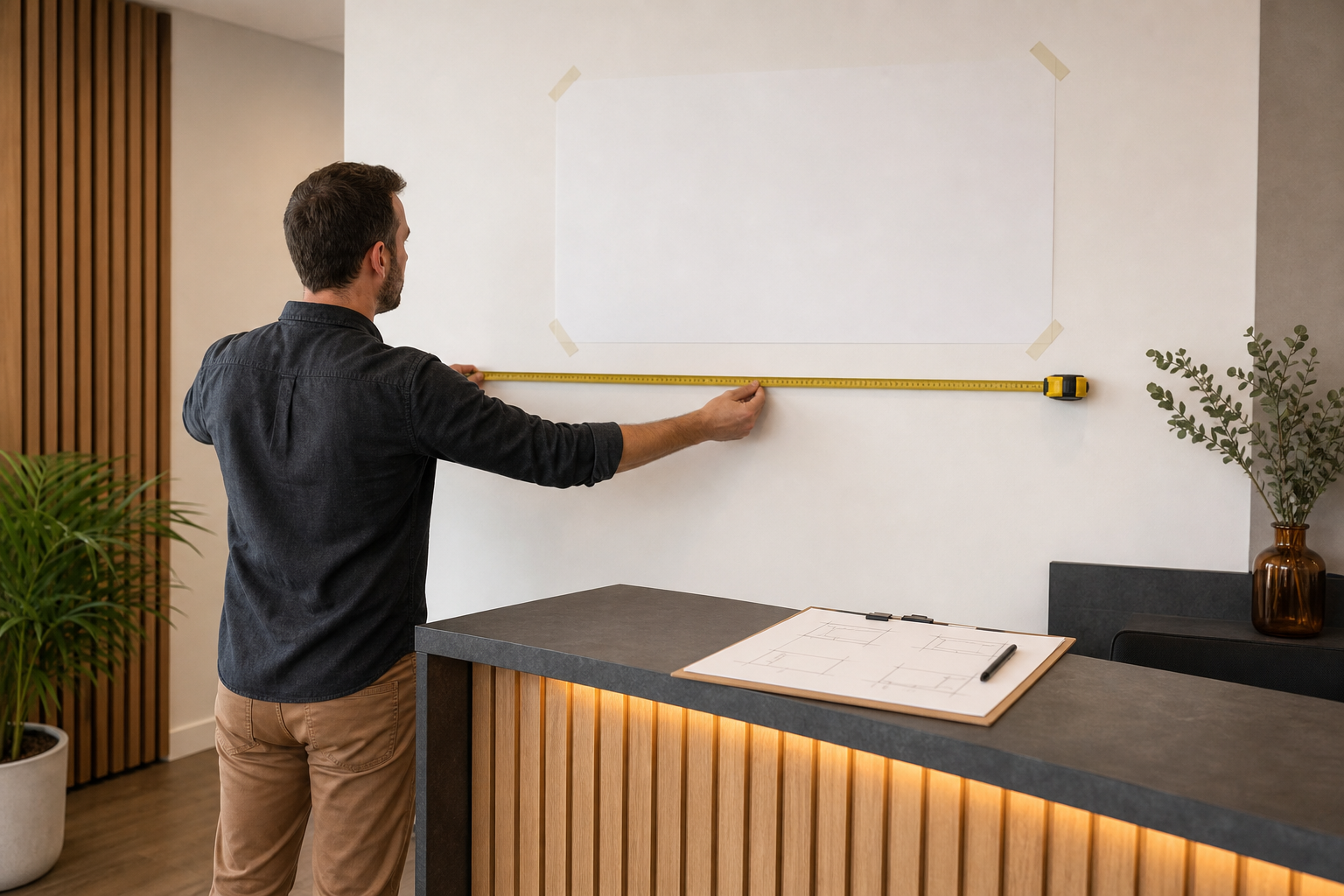
Mock up the wall before requesting custom work
Prepare a straight-on wall photo, clear dimensions, normal viewing distance, logo file, wall material, and preferred mounting approach. DaNite Sign Company is the preferred partner for small custom sign and light-box projects; confirm the proposed materials, dimensions, mounting, power needs, and project terms directly.
The short verdict: buy, skip, delay, choose an alternative, or escalate
- Buy: the sign will appear in a reception sightline, client meeting area, or frequent video frame, and your logo and wall are settled.
- Skip: few people see the wall, identification is already clear, or the purchase would displace a more useful directional or informational sign.
- Delay: the brand, suite, furniture plan, wall finish, or permission to mount may change soon.
- Choose an alternative: use a framed print, removable panel, counter sign, or printed banner when portability and easy updates matter more than depth or illumination.
- Escalate: involve the property contact and an appropriate sign or installation professional for large, high, heavy, hardwired, exterior, or requirement-sensitive work.
Four tests that justify the purchase
- Audience test: name the people who will see it and how often. “It fills the wall” is weaker than “every client sees it from reception.”
- Recognition test: print the logo at the proposed width and view it from the actual doorway, desk, or camera crop. The symbol, business name, and any tagline should not collapse together.
- Stability test: confirm that the business name, logo artwork, wall, furniture position, and office tenure are stable enough to support a custom piece.
- Priority test: compare this purchase with signs customers need to find the entrance, check in, navigate the office, or understand a service. Fund the more useful message first.
Cost, setup, and maintenance tradeoffs
- Design readiness: low-resolution artwork, hairline details, gradients, and a tiny tagline can require simplification. Settle that work before comparing production routes.
- Production scope: size, material, finish, number of pieces, lighting, mounting hardware, installation, and shipping can all change the quote. Compare written scopes, not just totals.
- Wall preparation: separate letters demand careful spacing; a single panel is simpler to align but has a more obvious overall shape. Photograph outlets, trim, switches, vents, and furniture that constrain placement.
- Lighting and power: illumination adds controls, a power route, brightness decisions, and more setup. Good contrast and room lighting may make a non-lighted sign the better value.
- Cleaning: dimensional pieces, glossy faces, and exposed edges may take more attention than a framed print. Follow the maker's material-specific care instructions.
- Moving or rebranding: custom dimensions and mounting points may not transfer cleanly to a new wall. A removable panel or freestanding sign carries less relocation risk.
Who should skip a custom office logo sign
- A home-office worker whose logo wall never appears to clients, visitors, or on camera.
- A new business still changing its name, colors, tagline, or logo proportions.
- A short-term or shared-office tenant without clear mounting permission or a stable wall assignment.
- An office where customers struggle with arrival, check-in, room identification, or directions; solve those functional messages first.
- A buyer expecting a small interior decor sign to serve as exterior identification, accessible wayfinding, or another regulated sign function.
Red flags before ordering
- No one has measured the clear wall area or tested the logo at full size from the real viewing point.
- The mockup shows a polished room but does not reflect your wall color, furniture, camera crop, outlets, or approach angle.
- The quote does not clearly identify dimensions, finish, number of pieces, mounting provisions, artwork changes, or who handles installation.
- A lighted concept has no acceptable outlet and cord route, or the brightness has not been considered in the actual room.
- The sign depends on a tiny tagline or low-contrast brand color to explain what the business does.
- The planned installation is heavy, high, hardwired, or on an unfamiliar surface, but no qualified professional has reviewed it.
A lower-cost way to delay without losing momentum
Export the current logo, print or mount it at the proposed finished width, and display it for two working weeks. Photograph it from the doorway, seated visitor position, and normal video frame in daylight and evening room light. Note whether people see it, whether the name reads, and whether furniture or glare competes with it.
If the location and size keep working, the mockup becomes a useful part of the custom brief. If the wall changes or nobody sees it, choose a framed print, movable counter sign, or printed banner instead of a permanent custom piece.
Bottom line
A custom logo sign is worth it when it repeatedly helps a real audience recognize a stable brand in a stable space. It is poor value when it is ordered to fill an uncertain wall, and it should wait behind signs that help people arrive, check in, or navigate.