Best Cord Covers for Renter-Friendly Floor and Wall Setup
A cord cover is useful when a lamp, desk, or TV cable has to cross visible space and loose routing keeps getting kicked, snagged, or pulled. The right type depends first on where the cord travels: a low-profile protector for a floor route, a removable raceway for a wall, or a flexible sleeve where several cables run behind furniture.
As an Amazon Associate, The Good Home Doc may earn from qualifying purchases.
Product-category guide
Compare cord covers for floors and walls
Use this affiliate shopping route to compare floor protectors, wall raceways, and flexible cable sleeves. Check the route, measurements, surface, and removal limits below before choosing a model.
This is a best-fit framework, not a test-based ranking. Product dimensions, adhesive directions, cable limits, and surface compatibility vary, so confirm those details with the current manufacturer listing. If the problem is clutter contained behind furniture rather than a cable crossing open space, the cord-organizer guide is the more useful starting point.
Quick picks by route
- Best for a cord crossing a floor: a low-profile floor cord protector with a channel large enough for the cable and a surface that lies flat.
- Best for a baseboard or wall: a removable, paintable raceway only when its adhesive is compatible with the exact finish and your lease permits it.
- Best behind furniture: a flexible sleeve or split-loom tube that groups cables while keeping the run accessible.
- Best for corners: a raceway system with matching inside, outside, and flat-elbow fittings instead of a straight channel forced around a bend.
- Best for the easiest move-out: a freestanding floor protector or flexible sleeve that does not bond to a wall or finished furniture.
Decide whether the cord should be there at all
Before buying a cover, trace the entire cable from device to outlet. Sometimes moving a lamp, rotating a desk, or using a closer approved outlet removes the crossing completely. A cover can reduce snags and make a route tidier, but it does not make every cable placement appropriate.
Do not treat a decorative cover as permission to run a cord through a doorway, under a rug, where a door pinches it, or anywhere the cord or cover will not lie flat. Follow the cable and equipment manufacturer’s instructions. Damaged cords, warm plugs, loose outlets, recurring breaker trips, or a need for permanent room wiring call for a qualified electrician rather than a cover.
Comparison framework
Low-profile floor cord protectors
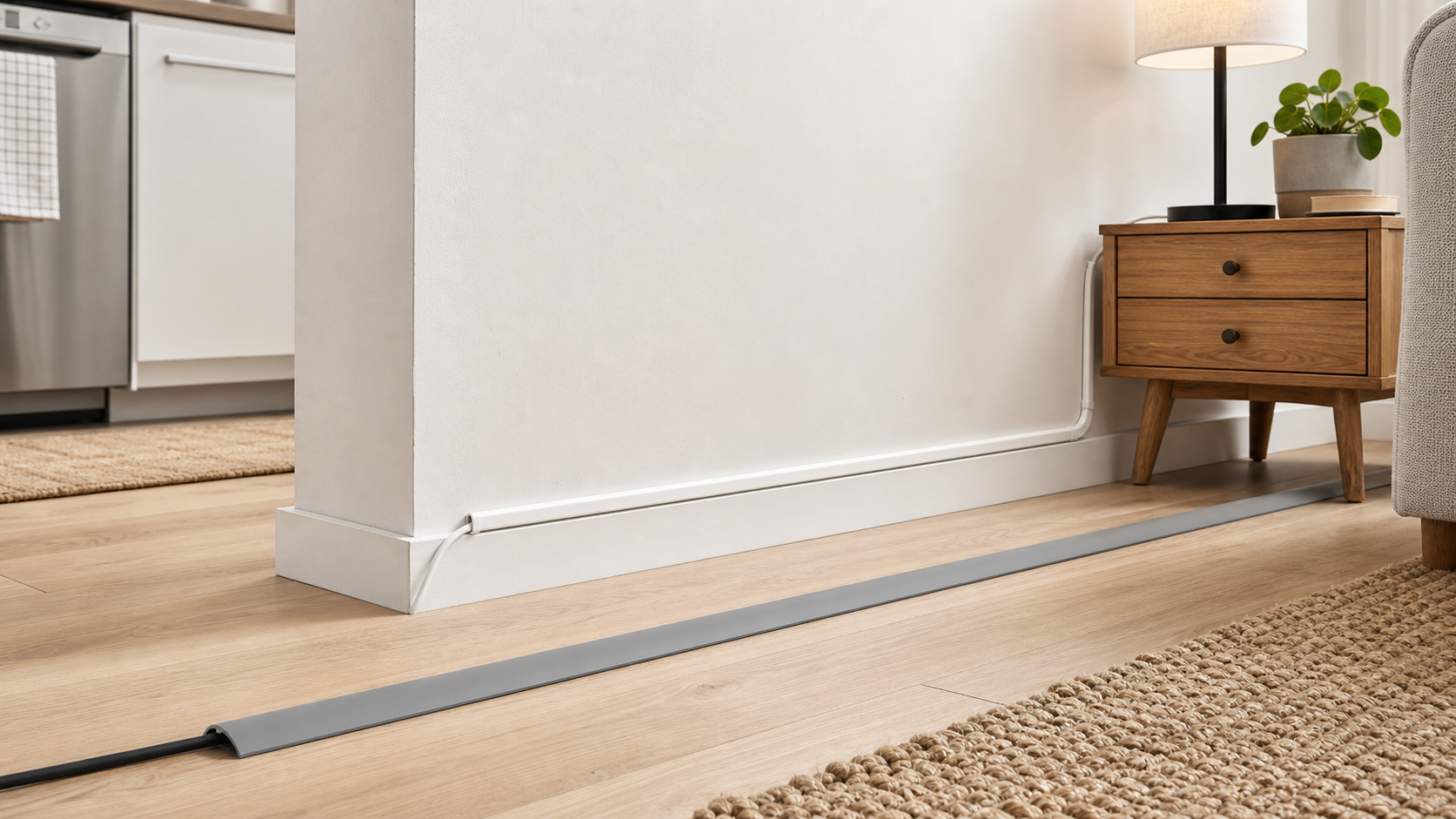
Floor protectors bridge a cable across a walking surface. Soft rubber or flexible PVC versions commonly have one or more channels underneath and sloped edges intended to reduce the abruptness of the crossing.
Choose this type if: the crossing cannot reasonably be eliminated, the protector can sit fully flat, and its channel fits the cable without squeezing it.
Watch out for: curled ends, a bulky profile, slick undersides, doors that sweep the route, cleaning tools catching an edge, and wheel traffic from office chairs, carts, walkers, or vacuums. A floor cover changes the profile of the walking surface; it cannot make a poorly placed route risk-free.
Adhesive wall raceways
A raceway is a rigid or semi-rigid channel with a removable lid. It can give one or several cables a straighter run along a wall or baseboard and can be easier to reopen than a fully wrapped bundle.
Choose this type if: you have measured the cable bundle, planned every corner, confirmed the surface is suitable, and accepted the possibility of paint or finish damage during removal.
Watch out for: textured walls, wallpaper, uncured or fragile paint, dusty baseboards, heat sources, missing corner fittings, and narrow channels that will not close after the plugs and cable bends are considered. “Removable” adhesive is not a guarantee of damage-free removal on every finish.
Flexible sleeves and split tubing
Sleeves group cables that travel together, usually behind a desk, media cabinet, or side table. Split styles let cables enter or exit partway along the run and are easier to revise when devices change.
Choose this type if: the route stays behind furniture or along a low-contact area and the goal is grouping rather than attaching the bundle to a wall.
Watch out for: overfilling, tight bends, covering damaged cables, trapping warm adapters, and creating a thick bundle where furniture presses against it. Sleeves organize cables; they do not replace a floor protector in an open traffic path.
Rigid floor channels
Some floor channels are firmer and lower-profile than soft rubber protectors. They can look tidier on a straight, smooth route but tend to be less forgiving on uneven flooring.
Choose this type if: the floor is flat, the route is straight, and the product is intended for that flooring and traffic pattern.
Watch out for: sharp transitions, poor grip, adhesive residue, cracked sections, and edges that lift when the floor flexes or the surface is not level.
Measure before shopping
Measure the route itself, then the cable bundle. For a wall run, include the vertical rise, horizontal distance, corners, and a modest allowance for routing into the device. For a floor crossing, measure the full exposed width rather than buying a short cover that ends in the walking line.
- Channel capacity: Count the cables and measure their widest combined section without crushing or tightly stacking them.
- Connector size: Some covers load from underneath or through a split; others require feeding a connector through an end. Check the opening, not just the cable diameter.
- Cover width and height: A wider, gently sloped floor cover may be easier to notice and cross than a narrow cover with steep sides, but it also occupies more floor space.
- Bend radius: Leave a relaxed curve where cords enter and leave. Do not force a sharp bend simply to make the route look straighter.
- Corner pieces: Count inside corners, outside corners, flat turns, end caps, and junctions before ordering a raceway kit.
Must-have features
- A channel that closes without pressure: Cables should fit without the lid bowing or the protector rocking.
- Flat, stable edges: Floor covers should settle across their full length without curled ends or gaps.
- Reopenable access: A removable raceway lid or split sleeve makes inspection and cable changes more practical.
- Surface-specific instructions: The maker should identify suitable surfaces, preparation, installation, and removal rather than promising universal adhesion.
- Compatible fittings: Wall runs with corners need parts designed for the same raceway size.
- A cleanable finish: Floor protectors collect dust along their edges, so choose a surface you can wipe without dislodging the route.
Nice-to-have features
- Paintable raceway: Useful when the product directions permit painting and your lease permits the finished installation.
- Multiple channels: Helpful when cables must stay organized separately, provided every cable type is suitable for the product and route.
- Cut-to-length sections: Easier to fit around furniture, but only if the material can be cut cleanly with the tools and method the maker specifies.
- Contrasting floor color: Sometimes visibility matters more than blending in, especially where guests may not expect a floor transition.
- Reusable closure: Snap lids and split sleeves are easier to revise than a one-time wrap.
Surface and renter checks
Read the lease before attaching a raceway to a wall, trim, floor, or landlord-owned furniture. Even a product marketed to renters can lift paint, leave adhesive, change the sheen, or mark wallpaper and veneer. A deposit-safe result depends on the surface condition, paint, preparation, adhesive, time installed, removal method, and lease—not the marketing label alone.
If the maker allows a test, use a hidden area and wait for the stated period before committing to a full run. Avoid applying adhesive over peeling paint, wallpaper, textured finishes, dusty surfaces, damp areas, or freshly painted walls that have not cured for the time specified by the paint and adhesive makers.
For uncertain finishes, favor a no-adhesive sleeve behind furniture or a freestanding floor protector. The broader renter-friendly upgrades guide explains how to compare reversibility, lease restrictions, setup, and move-out effort across home products.
Floor-route cautions
Keep a floor crossing away from stairs, landings, door swings, wet areas, and places where the edge cannot lie flat. Consider how people actually move through the room, including nighttime walking, pets, children, visitors, cleaning equipment, and anything with small wheels.
A cord cover can itself become a noticeable transition. If someone in the household has limited vision, balance, or mobility, or the route serves a busy path, removing the crossing or relocating the device is generally a better decision than assuming a low-profile cover solves the issue. For accessibility-specific guidance, consult an appropriately qualified professional.
Wall-route and cable cautions
Do not place a raceway where furniture will pinch it, where heat can build up, or where a cable must bend sharply at the entrance. Keep covers accessible enough to inspect and reopen. Do not conceal damaged insulation, loose connectors, warm adapters, or signs of overheating.
This guide is about surface cable management, not in-wall wiring or electrical installation. Do not route ordinary flexible cords through walls, ceilings, floors, or other building cavities. If you need a permanent outlet or hidden wiring, ask a qualified electrician about an appropriate solution and local requirements.
Who should skip cord covers
Skip a floor cover when furniture can be moved to eliminate the crossing, when the cover would land in a doorway or major walking line, or when the floor is too uneven for it to sit flat. Skip an adhesive raceway on fragile, textured, damp, newly painted, or landlord-restricted surfaces.
Also skip this purchase when the actual issue is cable clutter contained within one desk or media zone. Clips, ties, cable boxes, or an under-desk tray from the cord-organizer comparison may solve that problem with less room-scale routing.
Most importantly, skip cosmetic cable management when cords or electrical equipment show damage, heat, sparking, loose connections, or repeated power problems. Stop using the affected equipment and seek qualified help.
Bottom line
For renters, the best cord cover is usually the least permanent option that fits the route. Use a stable low-profile protector only for an unavoidable floor crossing, a surface-compatible raceway for a carefully planned wall run, and a flexible sleeve for cables grouped behind furniture. Measure the full route and cable bundle, plan corners, keep every connection inspectable, and choose relocation over concealment whenever the path remains awkward.