Best Door Mats for Apartments and Small Entryways
A door mat earns its space in a small entry only if it catches everyday grit without jamming the door, sliding underfoot, or becoming another bulky thing to walk around. The right type depends first on where the mat can legally and practically sit, then on clearance, floor finish, weather, and how you will clean it.
As an Amazon Associate, The Good Home Doc may earn from qualifying purchases.
Product-category guide
Compare door mats by placement and mess
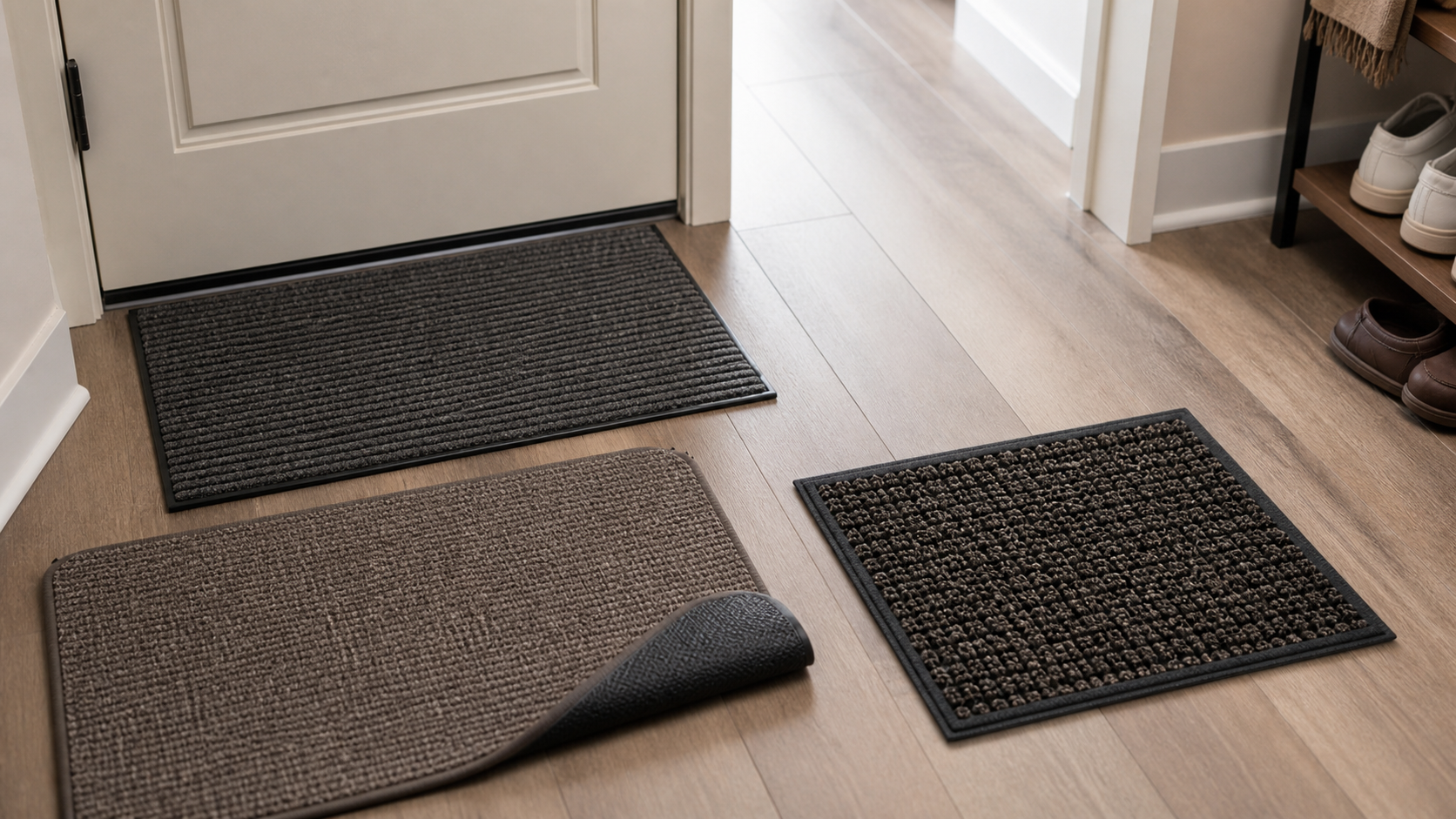
The image shows the three useful starting categories: low-profile indoor mats for tight door swings, washable flat mats for routine dirt, and textured scraper mats for heavier grit. Measure first, then check the listing's thickness, backing, care directions, and approved placement.
This is a category-fit comparison, not a hands-on test or a ranking of specific brands. Product dimensions and backing claims vary, so verify them against your doorway, flooring guidance, lease, and building rules. If shoes are the larger problem, use our small-entry shoe storage guide before adding another floor item.
Quick Picks by Situation
- Best for most apartment interiors: a low-profile, washable mat that clears the door at every point in its swing and stays within the unit.
- Best for very low clearance: a thin flat-weave mat with a finished edge that does not curl; confirm the complete listed thickness, not just the center pile.
- Best for rainy everyday traffic: an absorbent indoor mat with a moisture-resistant backing, paired with frequent drying and floor checks.
- Best for mud and coarse grit: a compact scraper mat in an approved exterior or sheltered position, with a separate indoor mat if space allows.
- Best for pets and washable messes: a machine-washable mat sized for the washer and drying method you actually use.
Start With Placement, Not Material
Apartment corridors, shared landings, and exit routes may have rules that prohibit personal mats or require them to remain within a defined area. Ask the property manager before placing anything outside your unit. A mat must never narrow an exit path, interfere with a fire door, cover a threshold, or prevent a door from closing and latching normally.
Inside, open the door through its complete swing and measure the smallest gap between the door bottom and floor. Check the center, corners, threshold, and any uneven spot. Allow extra margin for a raised mat border, future curling, and small debris underneath. If the door rubs at all, choose a thinner mat or move the dirt-control zone away from the swing.
Comparison Framework
Low-Profile Ribbed Mats
These mats use shallow ribs or channels to lift light dirt from shoes while keeping overall height modest. They are the practical first comparison for inward-opening apartment doors.
Choose this type if: door clearance is tight and the entry sees mostly dry dust, crumbs, and light grit.
Watch out for: tall rubber borders, channels that are tedious to vacuum, stiff corners, and listings that omit total edge thickness.
Washable Flat Mats
Washable mats suit households dealing with pet paws, food spills, and routine wet footprints. A flexible flat mat is easier to carry than a heavy rubber-backed commercial style.
Choose this type if: your washer can handle the mat's dimensions and weight and you have a practical way to dry it fully.
Watch out for: backing that degrades with heat, fabric that shrinks or curls, and a wet mat left sitting on moisture-sensitive flooring.
Absorbent Indoor Mats
Dense synthetic pile can hold small amounts of moisture and fine dirt near the door. It works best as an indoor second stage after shoes have shed heavy mud outside.
Choose this type if: rain and wet paws are common but standing water and thick mud are not.
Watch out for: slow drying, trapped grit, odor, and moisture held against wood, laminate, or other floor finishes.
Scraper and Coir-Style Mats
Coarse textures help remove dried mud and larger debris. They are usually better outside or in a sheltered approved landing than directly beneath a low apartment door.
Choose this type if: the placement is permitted, weather-appropriate, and clear of the door and shared walking route.
Watch out for: thick profiles, shedding fibers, waterlogged natural material, difficult cleaning, and a rough texture that is unpleasant on bare feet indoors.
Must-Have Features
- Verified complete thickness: Include the pile, backing, and border when comparing the mat with the measured door gap.
- Stable, floor-compatible backing: Check both the mat maker's guidance and the floor manufacturer's care instructions. Some rubber, latex, PVC, or dyed backings can discolor or react with finishes.
- Flat finished edges: Edges should resist lifting and should not sit across the threshold or walking line.
- Cleaning you can sustain: Choose vacuumable, shakeable, hoseable, or machine-washable construction that fits your building and laundry setup.
- Enough usable surface: The mat should accept at least one natural step without extending into a narrow path.
- Placement suitability: Indoor-only mats should stay indoors; exterior mats need weather exposure and drainage guidance that matches the site.
Nice-to-Have Features
- Dark heathered color: Hides ordinary grit between cleanings without concealing when the mat is actually saturated.
- Rounded corners: Can reduce corner lifting in a cramped entry, provided the usable wiping area remains large enough.
- Quick-drying pile: Useful when rain is frequent and the mat cannot be left outside to dry.
- Low-shed texture: Keeps fibers from migrating into the apartment or shared hallway.
- Manufacturer-listed floor compatibility: More useful than a broad “non-slip” claim, especially on finished wood and vinyl.
Measure the Entry in Five Checks
- Measure the complete clear floor area with the door fully closed and fully open.
- Measure door-bottom clearance at the center, both corners, and the tightest point in the swing.
- Keep the threshold, latch path, vents, and shared corridor outside the planned footprint.
- Mark the candidate mat dimensions with painter's tape and walk through carrying groceries or bags.
- Confirm the final mat will lie flat after washing and will not require a separate rug pad that uses up the clearance margin.
Grip, Floor Care, and Cleaning
“Non-slip” is not a guarantee on every floor. Dust beneath a grippy backing can still let it move, while some high-grip materials may mark a sensitive finish. Clean under the mat regularly, inspect for discoloration, and let both the floor and mat dry fully after wet weather. Do not improvise with adhesive tape unless both the tape maker and floor-care guidance explicitly allow it.
Vacuum dry dirt before it works into the pile. Follow the care label for washing and drying; an oversized or waterlogged mat can strain a household washer. Replace the mat if its backing cracks, edges curl, odor persists after cleaning, or the pile stays damp.
When a Boot Tray or Other Setup Is Better
A mat handles surface dirt and modest moisture. It does not contain meltwater from several pairs of boots. For snow, soaked shoes, umbrellas, or muddy pet gear, compare a raised-edge boot tray for a small entryway. If neither fits without narrowing the path, move footwear to a nearby washable zone and keep only a thin mat at the door.
For clutter rather than dirt, a slim shoe cabinet or a measured rack may solve more than a larger mat. Products should support the entry routine, not compete for the same few feet of floor.
Who Should Skip a Door Mat
Skip a mat directly at the door if it rubs, prevents normal closing, crosses a threshold, curls into the walking route, or conflicts with property rules. Also skip any outside placement that narrows a shared corridor or interferes with an exit. Do not treat anti-slip marketing as a safety certification.
A household that cannot lift, clean, and dry the mat comfortably may be better served by a smaller washable runner positioned beyond the door swing or by a shoe-removal bench with a contained tray. Renters should get building-specific placement questions answered rather than assuming neighboring units set the rule.
Bottom Line
For most apartments, the best door mat is a low-profile washable indoor mat that clears the door with margin, lies flat, matches the floor-care guidance, and stays inside the unit. Choose absorbent pile for routine wet footprints, a permitted scraper mat for coarse outdoor dirt, or a boot tray when the real problem is pooled water. Placement and fit matter more than decorative style.