Best No-Drill Bathroom Towel Racks for Renters
A no-drill towel rack only helps if it gives wet towels room to dry without scraping a door, slipping off tile, or leaving an adhesive repair at move-out. The best type depends on your door clearance, wall surface, floor space, towel load, and tolerance for installation risk.
As an Amazon Associate, The Good Home Doc may earn from qualifying purchases.
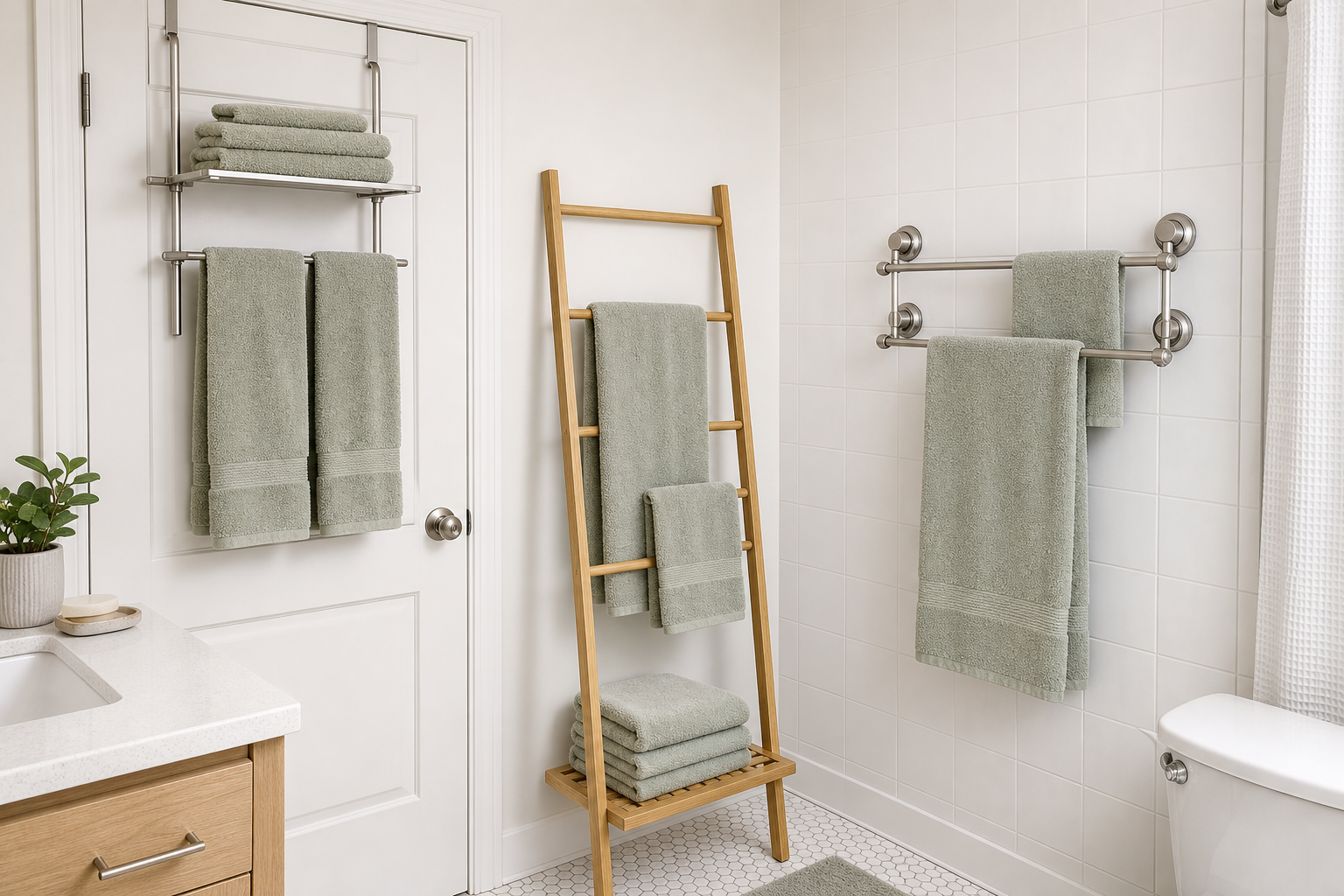
Compare no-drill towel racks: Browse the category, then use the fit checks below before choosing a mounting style.
- Browse category: Shop no-drill bathroom towel racks on AmazonCompare over-door, freestanding, suction, and adhesive options by measurements and mounting limits.
This is a best-fit framework, not a test ranking. Confirm the current product dimensions, stated surface compatibility, load guidance, care instructions, return policy, and lease rules before buying.
For a broader room-by-room approach, start with the renter-friendly home upgrades guide. If you only need a place for a hand towel or robe, the lighter-duty options in our removable hooks guide may take up less space. Full bath towels usually need a wider bar and more airflow than a hook provides.
Quick picks by bathroom setup
- Best low-risk option for most renters: a freestanding rack when there is safe floor space and no trip hazard.
- Best when floor space is tight: a padded over-door rack, but only after measuring door thickness, top clearance, and wall clearance.
- Best for smooth tile or glass: a suction-mounted bar with multiple contact points and a modest towel load.
- Best for a fixed location: an adhesive bar approved for the exact surface and bathroom humidity, if the lease permits adhesive.
- Best to skip: any rack that depends on questionable paint, crosses a grout line, blocks a door, or would fall onto a toilet, tub, glass, or walkway.
What matters most
The real job is not merely holding a towel. A useful rack lets the towel hang with enough exposed surface to dry, stays stable as the towel is pulled on and off, fits the room without blocking movement, and can be removed within the limits of the lease.
Start by counting the towels that need to dry at the same time. A couple sharing one bathroom may need two genuinely separate hanging positions, not two bars so close together that damp towels overlap. Families may be better served by a wider freestanding rack or a door rack with spaced bars rather than a compact wall unit.
Comparison framework
Freestanding towel racks
Freestanding racks avoid contact with tile, paint, and doors. They are the easiest choice to move between rentals and the least dependent on the condition of the room surfaces.
Choose one if: you have a dry, level patch of floor outside the main walking path and want to avoid mounting risk.
Tradeoffs: the base consumes floor space, narrow models can tip when towels are pulled from one side, and feet can trap dust or moisture. Check the full footprint, bar spacing, and whether the base stays stable under an uneven load.
Over-the-door towel racks
Over-door racks use otherwise empty vertical space and can hold more than a single hook. They work best on a door that opens freely and has enough gap above it for the mounting brackets.
Choose one if: the bathroom door has measurable top clearance, the rack will not hit a wall or fixture, and the door can still close without rubbing.
Tradeoffs: metal brackets can mark paint, a loaded rack can rattle or swing, and thick hooks can keep a tight-fitting door from closing. Hollow-core doors are not a reason to ignore the maker's load guidance. Use padded contact points and keep heavy wet textiles off an uncertain setup.
Suction-mounted towel bars
Suction mounts can work on smooth, nonporous tile or glass without adhesive residue. They are less convincing on textured tile, small tiles with frequent grout lines, matte finishes, porous stone, or slightly curved surfaces.
Choose one if: the product explicitly supports your surface, every cup can sit entirely on a clean flat area, and a dropped towel rack would not create a hazard.
Tradeoffs: temperature and humidity cycles, soap film, and small surface imperfections can weaken the seal. Treat suction as a removable convenience, not a permanent structural attachment, and check it regularly.
Adhesive towel bars
Adhesive bars can look more like installed hardware and save floor and door space. They also carry the greatest move-out uncertainty because “removable” does not mean damage-free on every paint, tile coating, or wall finish.
Choose one if: the lease allows adhesive, the manufacturer names your exact surface, the finish is sound, and you can follow the preparation, cure-time, and removal directions.
Tradeoffs: humidity, weak paint, residue, rushed installation, and loading before the adhesive cures can all lead to failure. Avoid wallpaper, peeling paint, porous stone, grout, and any surface the product excludes.
Must-have features
- Enough usable bar width: measure the towel when opened to a practical hanging width. A bar that forces thick folds will slow drying.
- Air space between towels: multiple bars should be far enough apart that damp fabric does not sit in one dense stack.
- Clear compatibility guidance: suction and adhesive products should name accepted and excluded surfaces, not just say “works anywhere.”
- Rust-resistant construction: look for materials and finishes intended for humid bathrooms, while remembering that no finish is maintenance-free.
- Protected contact points: over-door brackets and freestanding feet should not have sharp bare edges against paint, tile, or flooring.
- Stable everyday access: the rack should not rock, twist, or lift when someone pulls a towel with one hand.
Nice-to-have features
- Staggered bar heights: useful for keeping towels separate and making each one easier to grab.
- A lower shelf: can hold folded clean towels on a freestanding rack, provided it stays clear of splashes.
- Replaceable mounting parts: fresh adhesive pads or suction cups may extend the rack's useful life when approved by the manufacturer.
- Simple wipe-clean joints: fewer tight seams make it easier to remove dust and bathroom residue.
- Hooks for small items: useful for a washcloth or lightweight robe, but not if they encourage overloading the whole rack.
Measure before buying
For a freestanding rack, tape the base footprint on the floor and open the bathroom door, vanity doors, and shower enclosure. Leave a comfortable walking path and make sure towels will not brush the toilet or sit in shower spray.
For an over-door rack, measure door thickness, the gap above the door, the distance from the top of the door to nearby trim, and the clearance behind the open door. Include the loaded depth: a towel adds more bulk than the empty rack shown in a listing photo.
For suction or adhesive bars, measure the uninterrupted mounting area. Each mounting pad needs to land on an approved surface rather than partly across grout. Check the bar length against corners, trim, outlets, switches, mirrors, and shower doors.
Bathroom placement and maintenance
Keep the rack outside direct shower spray when possible. Wet hardware, trapped fabric, and poor airflow make cleanup harder even when the rack itself tolerates humidity. Spread towels over the bars instead of bunching them, and avoid stacking a fresh towel over one that is still damp.
Wipe the rack according to its care directions and dry areas where water collects. Check suction seals, adhesive edges, brackets, feet, and fasteners for movement or corrosion. If a mounted rack starts slipping, do not keep reloading it and hoping it holds; remove it and reassess the surface and mounting method.
Renter and safety cautions
Check the lease before applying adhesive to paint, tile, glass, cabinets, or trim. Photograph the surface before installation and keep the removal instructions. Do not improvise extra glue, screws, or construction adhesive to rescue a rack that does not fit the room.
Do not place a rack where a failure could break a glass shower door, strike someone in a tub, damage a toilet, or create a trip hazard. If installation would require drilling tile, locating hidden plumbing or wiring, or repairing a questionable wall, ask the property owner and use a qualified professional when appropriate.
Who should skip a no-drill towel rack
Skip wall-mounted no-drill products if the surface is textured, peeling, damp, cracked, freshly painted, porous, or excluded by the manufacturer. Skip over-door models when the door already rubs, has almost no top gap, or opens against a fixture. Skip freestanding models when the only available floor space is a walkway.
If several people need to dry large towels in a bathroom with poor ventilation, a compact rack may not solve the underlying airflow problem. Use the bathroom exhaust fan if one is installed and working, follow property guidance, and report persistent dampness, leaks, visible growth, or damage rather than treating a towel rack as a moisture fix.
Bottom line
For most renters, a stable freestanding rack is the lowest-risk choice when floor space allows. A padded over-door rack is a practical second choice after careful clearance measurements. Suction bars suit truly smooth tile or glass, while adhesive bars make sense only when the lease, surface, and removal risk all line up.
Choose by room fit and towel-drying space before appearance. The right rack should hold the real household load, leave towels separated, stay out of the walking path, and come down without turning a simple storage upgrade into a repair.