Best No-Drill Broom Holders for Renters
A no-drill broom holder can clear a rental closet floor without turning a small storage problem into paint damage or a door that will not close. The right type depends first on the permitted attachment, then on the weight and handle shape of each cleaning tool—not the number of slots advertised.
As an Amazon Associate, The Good Home Doc may earn from qualifying purchases.
Product-category guide
Compare adhesive rails and over-door holders
Start with the attachment your lease and surface allow. Then verify handle range, product weight limits, tool-head spacing, removal instructions, and door clearance.
This is a category selection framework, not a hands-on ranking. Adhesive ratings depend on the stated surface, preparation, curing time, load direction, and removal method. Over-door holders depend on door thickness and clearance. Treat every published capacity as a maximum under the maker's conditions, not a target.
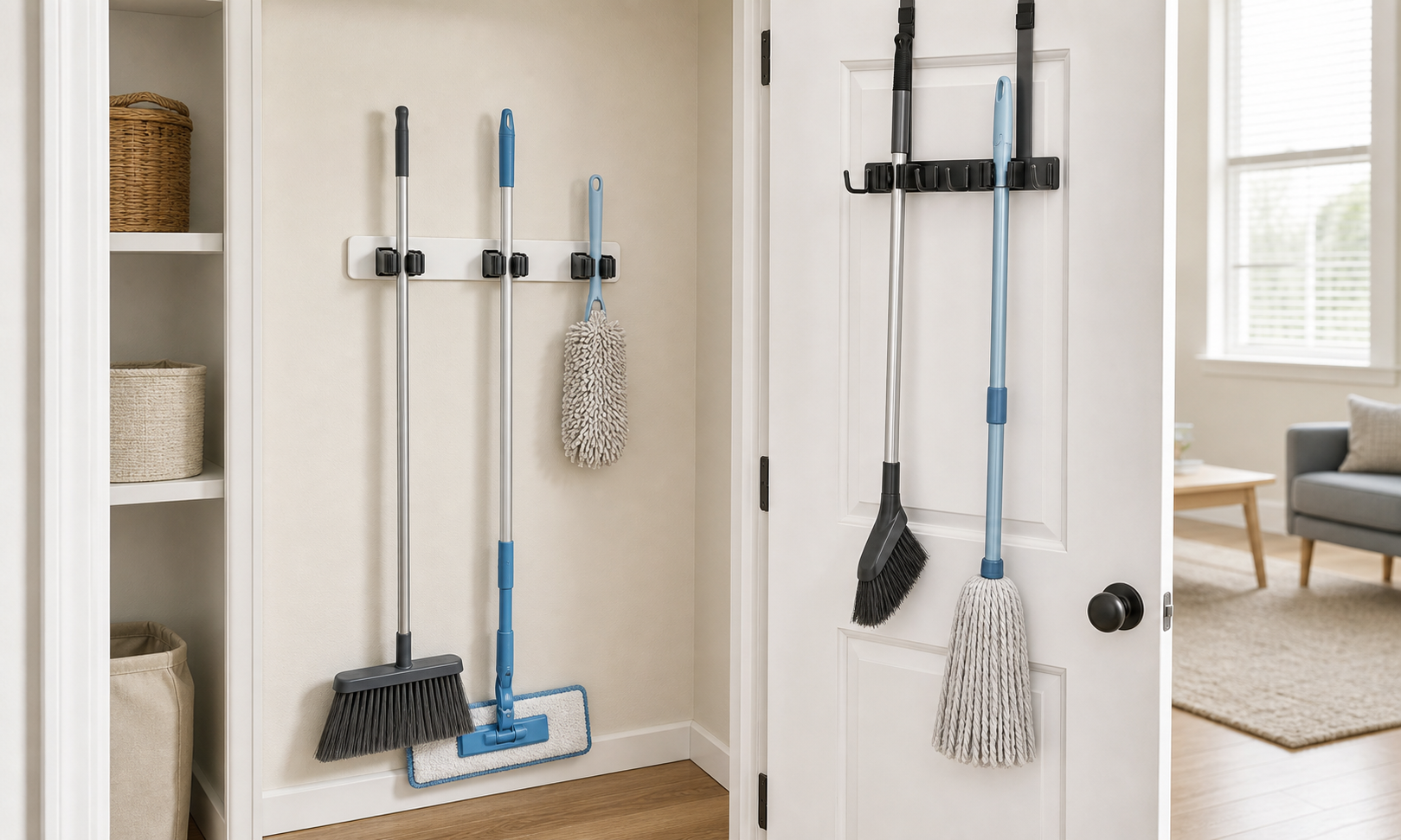
Start with the mounting decision: choose an adhesive rail only when both the lease and the exact painted surface allow it; choose an over-door holder only when the measured top gap, door thickness, latch, and swing remain unaffected. If neither passes those checks, skip the no-drill rack and use a measured floor stand. For lighter items with hanging holes, the removable hooks guide explains when individual hooks are the simpler fit.
Quick Picks by Rental Constraint
- Best when the wall finish is approved and sound: an adhesive grip rail with explicit surface, preparation, cure-time, load, and removal instructions.
- Best when wall adhesive is not allowed: a padded over-the-door holder that fits the measured door and still lets it latch normally.
- Best for lightweight tools with hanging holes: removable hooks spaced so tool heads do not collide.
- Best when neither wall nor door is suitable: a stable freestanding cleaning-tool stand with a small measured footprint.
- Best for heavy or awkward tools: no no-drill option by default; use permitted fastener mounting or floor storage instead.
Measure the Tools, Surface, and Door First
Inventory the broom, mop, duster, dustpan, and brush you actually plan to hang. Measure each handle at the grip point and note wide tool heads, padded shafts, hanging holes, and unusually heavy pieces. A five-position rail may hold only three useful tools when the broom head and flat mop need room to pass.
For a wall rail, identify the exact surface and inspect it in bright light. Fresh, peeling, chalky, textured, damp, stained, or poorly bonded paint is a bad foundation for adhesive. Check the lease and ask the property manager when the rules are unclear. “Removable” describes the product method; it does not guarantee that every finish will come away unmarked.
For an over-door holder, measure the door thickness, top gap, casing clearance, panel shape, swing path, and distance to shelves. Add the hook material and padding to the door thickness before assuming the door will close. Do not interfere with the latch, closer, hinges, ventilation, or any required fire-door function.
Comparison Framework
| Format | Best fit | Main check | Skip when |
|---|---|---|---|
| Adhesive grip rail | Sound, maker-approved wall finish | Surface, cure time, loaded weight, removal path | Paint is textured, weak, damp, or prohibited |
| Over-door holder | A door with spare top and frame clearance | Door thickness, latch, swing, hook padding | The door rubs, rattles, or stops closing normally |
| Individual removable hooks | Light tools with strong hanging holes | Load direction and accessible release tabs | Handles need a grip clamp or heads collide |
| Freestanding stand | No approved attachment surface | Base stability, footprint, wet-tool airflow | It narrows a walkway or blocks utilities |
Adhesive Grip Rails
These keep tools close to the wall and can make good use of narrow closet space. They work only when the maker lists your surface as compatible and the loaded tools stay within the stated conditions.
Compare: supported surfaces, handle diameter range, total and per-grip capacity, strip replacement, humidity guidance, cure time, removal steps, and whether the rail can be lifted off its adhesive base before strip removal.
Skip when: paint is weak or textured, the closet stays damp, the tools are heavy, or a falling broom could strike a person, pet, appliance, or fragile item.
Over-the-Door Holders
Door-mounted racks avoid wall adhesive and move easily between rentals. Their tradeoff is clearance: hooks can scrape trim, stop a door from closing, rattle, or concentrate load at the top edge.
Compare: door-thickness range, hook depth, padding, rack width, handle spacing, lower stabilizers, folded depth, and whether the layout works on the room-facing or closet-facing side.
Skip when: the door must seal or latch precisely, has tight top clearance, is a fire-rated assembly, swings into a narrow path, or feels too light or damaged for the load. Do not alter a door or closer to make a rack fit.
Individual Removable Hooks
Separate hooks let you stagger tool heads and use small wall sections. They suit lightweight dustpans, brushes, and tools with a strong hanging hole or loop better than smooth handles with no hanging point.
Compare: surface instructions, load direction, hook depth, strip access for removal, replacement-strip availability, and the strength of the tool's own hanging point. Leave each removal tab visible and reachable.
Freestanding Tool Stands
A floor stand is not wall storage, but it is the lowest-surface-risk fallback when attachment is prohibited. Look for a stable base, washable drip area, separated wet tools, and a footprint that does not narrow the walkway or block utilities.
Must-Have Features
- Clear compatibility: The maker should state suitable surfaces or door dimensions rather than relying on “universal” language.
- A handle range: Match the smallest and largest tool handles to the grip specifications.
- Real spacing: Count the width of tool heads and the hand room needed for a controlled release.
- Published load guidance: Include the rack itself when considering what the attachment or door must carry.
- Complete removal instructions: Read them before installation and keep the release path accessible.
- Replaceable attachment parts: A reusable rail with maker-compatible replacement strips is easier to move responsibly.
Nice-to-Have Features
Movable grip modules help stagger wide heads. Fold-flat hooks reduce snags. Soft door-hook padding can limit rubbing, while a lower stabilizing pad can reduce rattling. A rail that detaches from its wall base may make correct adhesive removal easier. None of these extras fixes an incompatible surface, tight door gap, or overloaded holder.
Adhesive Setup and Removal
Follow the product instructions for cleaning, temperature, pressure, and cure time. Do not substitute stronger tape, construction adhesive, glue, extra fasteners, or a different cleaner. Test only if the lease permits it, and remember that a hidden test does not guarantee identical paint adhesion elsewhere.
Before hanging tools, confirm that the rail is stable under a light initial load. Add one item at a time and keep the heaviest acceptable tool closest to the most supported part of the rack. Remove tools before servicing or taking down the holder.
At move-out, use the maker's specified removal direction and speed. Do not yank a strip outward from the wall. If the strip tears, paint begins lifting, or the method is unclear, stop and ask the property manager or a qualified repair professional rather than prying at the finish.
Wet Mops, Humidity, and Daily Use
A no-drill holder is storage, not a drying system. Clean and wring the mop as directed, then let it dry where air can circulate without moisture sitting against paint, a door, fabrics, or stored products. Avoid hanging dripping tools over outlets, appliances, flooring seams, or anything moisture-sensitive.
Check the holder regularly for movement, peeling strip edges, cracked grips, door rub marks, or a change in release force. Take it down according to its instructions if the surface gets damp or damaged. A rack that has started shifting should not be “fixed” by adding more unapproved adhesive around it.
Who Should Skip a No-Drill Broom Holder
Skip adhesive storage if the lease prohibits it, the paint condition is uncertain, or the location is humid, hot, textured, or exposed to splashes. Skip over-door storage when it changes how the door closes, blocks a latch or closer, rubs the frame, or creates a head-level obstruction.
Also skip the category for heavy commercial mops, large snow tools, fragile padded handles, or items outside the holder's published range. Homes with children or pets should avoid any placement where a pulled handle could bring down the rack or where long tools invite climbing. A stable floor stand or approved fastener-mounted system is safer when failure would have meaningful consequences.
A Practical Selection Checklist
- Confirm the lease and property rules for adhesive or over-door products.
- Measure every handle, tool head, wall section, door thickness, and clearance.
- Choose the attachment type before comparing slot counts or accessories.
- Verify surface or door compatibility, load guidance, and removal instructions.
- Mock up the full tool outlines with painter's tape without treating the tape as a mounting test.
- Install exactly as directed, wait the full stated cure time, and load one light tool at a time.
- Recheck attachment, clearance, and surface condition during routine cleaning.
Bottom Line
For many renters, the best no-drill broom holder is an adhesive rail only when the lease, paint, humidity, tool weight, and removal method all align. A padded over-door rack is the better wall-safe choice when door clearance and function remain unchanged. If neither passes those checks, use a compact floor stand rather than asking a removable product to carry a risky load.