Best Window Privacy Film for Renters
The best privacy film for a rental window gives you the level of screening you need, still admits useful daylight, suits the exact glass, and can come down without leaving your landlord a surprise.
As an Amazon Associate, The Good Home Doc may earn from qualifying purchases.
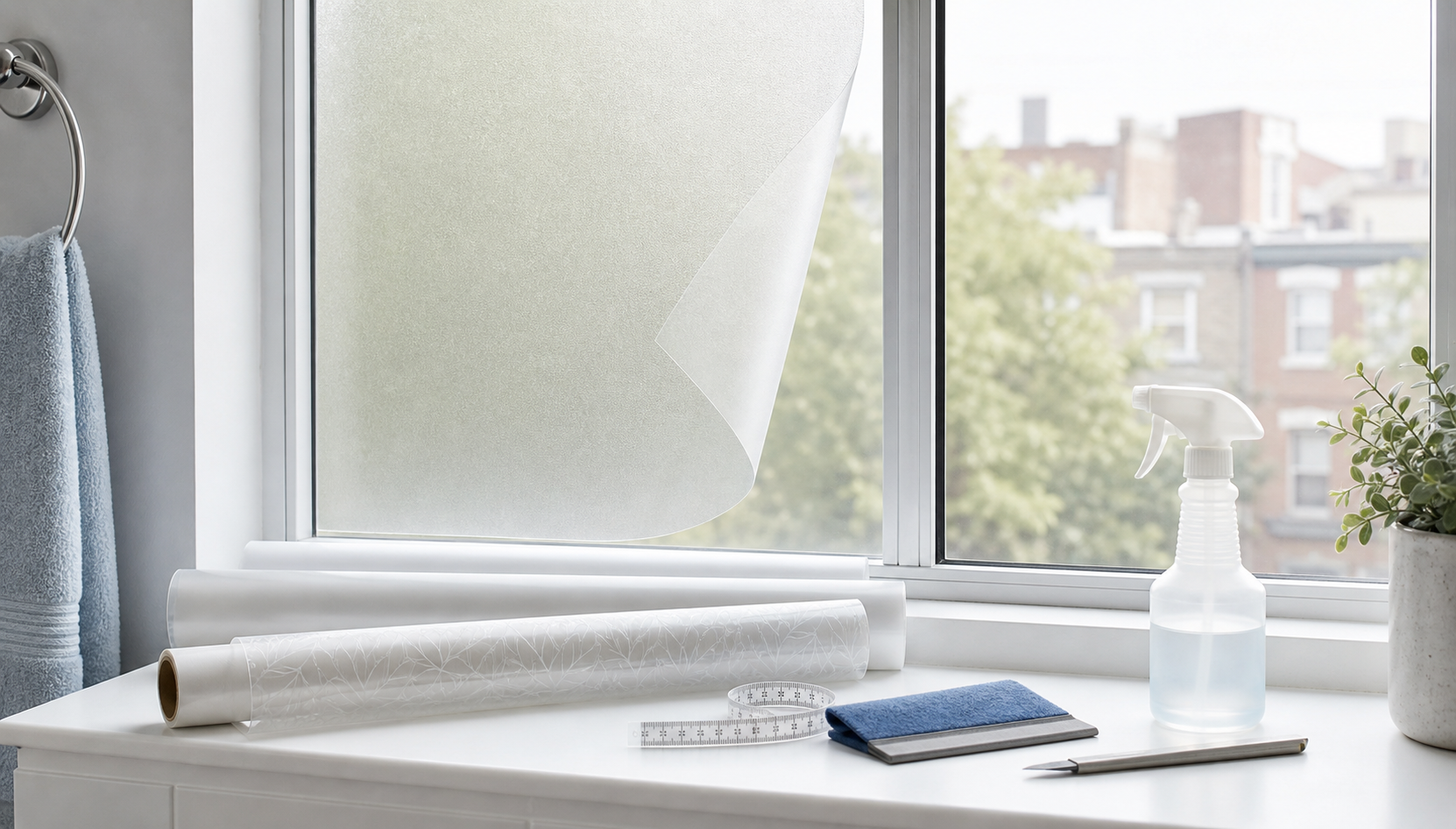
Shop the category: Browse category: compare static-cling window privacy film for renters after checking your glass type, roll width, visible-light needs, and the maker's installation and removal instructions.
This is a shopping starting point, not a tested ranking. Confirm dimensions, material, glass exclusions, privacy claims, return policy, and lease rules before buying.
This guide ranks types by situation rather than declaring an unsupported universal winner. Privacy film is one option in the broader renter-friendly home upgrades guide. If you need darkness at night rather than a blurred daytime view, compare it with the renter-friendly blackout curtain guide.
Quick Picks by Situation
- Best starting point for most renters: frosted static-cling film with clear glass-compatibility and removal instructions.
- Best for a bathroom: a high-opacity frosted or patterned film approved for the room's plain glass and humidity conditions.
- Best for a street-facing daytime room: translucent frosted film that obscures details without pretending to create one-way privacy.
- Best when you still want a partial view: patterned film or a film applied only to the lower portion of the pane.
- Best for nighttime privacy: curtains, shades, or blinds—not reflective “one-way” film by itself.
Selection Criteria That Matter
Glass Compatibility Comes First
Find out whether the window is plain single-pane glass, insulated double-pane glass, tempered glass, laminated glass, tinted glass, textured glass, or a coated low-emissivity unit. Film can affect heat absorption, and not every product is approved for every glazing system. Follow the window and film manufacturers' written restrictions. If the glass type is unknown, ask the landlord or building manager rather than guessing.
Static-cling film generally needs a smooth, nonporous surface. It may not hold evenly on textured, etched, cracked, damaged, or divided panes. Do not cover identifying marks, sensors, ventilation openings, latches, or an emergency-exit window in a way that interferes with use.
Privacy in Daylight and After Dark
Frosted film scatters the view in both directions and is the most predictable privacy style, although silhouettes can remain visible when a person stands close to a brightly lit pane. Decorative patterns vary: dense patterns obscure more detail, while clear sections preserve more of the view.
Reflective film is often advertised as “one way,” but that effect depends on the viewed side being brighter. After sunset, an illuminated room can become the brighter side and may be visible from outside. Treat reflective film as daytime glare or view management only unless the manufacturer states otherwise; use a curtain, blind, or shade when nighttime privacy matters.
Static Cling Versus Adhesive
Static-cling film uses water-assisted contact rather than a pressure-sensitive adhesive. It is usually the renter-friendly first choice because it can be peeled away and may be reusable if handled and stored carefully. It can still lift at edges if the glass is dirty, the cut is poor, or the room has heavy condensation.
Adhesive-backed film may grip more consistently, but it raises the stakes for removal, residue, and lease approval. A listing that says “removable” does not guarantee residue-free removal from every window after months of sun exposure. Get permission before using adhesive film and keep its removal directions.
Light, Color, and Room Use
Privacy and daylight are separate specifications. A pale frost can soften a view while keeping the room bright; dense, dark, or strongly colored patterns can noticeably reduce daylight. Product photography is not a reliable measure of how your room will look. A sample on the actual window, viewed in morning, afternoon, and evening conditions, is more useful than a dramatic listing image.
Roll Size and Pattern Repeat
Choose a roll wider than the glass when possible so one pane needs no vertical seam. A narrow roll can work on a wide pane, but matching decorative patterns and hiding seams takes more care. Compare usable dimensions, not just total square footage, and allow extra for squaring the first edge, trimming, and a failed first attempt.
Comparison Framework
Frosted Static-Cling Film
Best fit: bathrooms, lower-floor windows, doors, and street-facing rooms that need a consistently blurred view. Tradeoffs: it removes the outward view, does not make silhouettes impossible, and can lift where condensation repeatedly collects.
Patterned Static-Cling Film
Best fit: renters who want moderate screening without turning the whole pane into an even white frost. Tradeoffs: clear areas can reveal more than expected, pattern alignment creates waste, and decorative prism effects may cast colored light into the room.
Reflective or Mirrored Film
Best fit: rooms where daytime view reduction is the main goal and the product is explicitly compatible with the glass. Tradeoffs: the privacy effect can reverse at night, the room view may be tinted, and heat-related glass restrictions deserve careful attention. It is not a security upgrade.
Adhesive Privacy Film
Best fit: a landlord-approved installation where stronger long-term adhesion matters more than easy reuse. Tradeoffs: installation is less forgiving, removal may leave residue, and extended heat or sun exposure can change removal behavior.
Top-Down or Partial-Pane Coverage
Best fit: ground-floor rooms where only the lower sightline needs screening. Tradeoffs: standing sightlines, nearby stairs, and taller neighboring buildings may still expose the room. Test the real approach angles from outside where permitted and safe.
Must-Haves Versus Nice-to-Haves
Must-have features: explicit glass compatibility, a privacy description that distinguishes daytime from nighttime performance, enough width for the pane, understandable installation and removal directions, and a return policy that permits a careful fit check.
Nice-to-have features: grid marks on the backing, multiple roll widths, a reusable backing sheet, a sample size, a forgiving random pattern, and a small application squeegee. A spray bottle, lint-free cloth, and accurate tape measure are often more useful than a large accessory kit.
Measure Before You Buy
- Measure only the visible glass, not the frame, at the top, middle, and bottom for width.
- Measure height at the left, center, and right; older windows may not be square.
- Use the smallest measurements as the working pane size and follow the film maker's edge-gap instructions.
- Count every pane separately. Grilles and divided lights can turn one window into several small cuts.
- Choose a roll orientation that creates the fewest seams and leaves a reasonable trimming allowance.
Do not assume leftover strips can solve another pane when the film has a directional pattern. For several windows, sketch a cut plan before ordering and label each piece on the removable backing.
A Practical Renter Installation Plan
- Check the lease and glass. Get approval if window coverings, visible exterior changes, or adhesive products are restricted.
- Test one sample. Place it on an inconspicuous section and inspect it from indoors and outdoors in daylight and after dark.
- Clean as directed. Dust, grease, old tape, and hard-water deposits cause bubbles and lifting. Avoid tools or cleaners that can scratch glass or damage coatings.
- Cut with a safe workspace. Cut the film on a protected flat surface with a straightedge. Do not cut directly against unknown or coated glass unless the manufacturer specifically directs it.
- Wet and place gradually. For static cling, use the stated water or solution method, peel the backing slowly, and smooth from the center outward.
- Trim and dry the edges. Keep the required edge clearance, remove trapped water with a wrapped squeegee, and allow the film to cure before judging every cloudy patch.
- Save the backing and instructions. They make removal, storage, and possible reuse easier when you move.
Maintenance and Removal
Clean film only with the method allowed by its maker. Abrasive pads, blades, strong solvents, and ammonia-based cleaners can scratch or haze some products. Watch bathroom and kitchen edges for trapped moisture, residue, or lifting; film does not repair condensation, leaks, failed seals, or ventilation problems.
For removal, start at a corner and peel slowly at the recommended angle. Do not force film that has become brittle or unusually difficult to lift. Adhesive residue may need a product-specific remover that is safe for the glass and frame. Photograph the clean window at move-out if surface condition is a concern.
Who Should Skip Window Privacy Film
Skip film when you cannot identify the glass, the window or film maker excludes that glazing type, the pane is cracked or damaged, the lease forbids it, or the project could affect a window warranty. Also skip it if you need dependable nighttime privacy but do not plan to add a curtain, shade, or blind.
Privacy film is also the wrong tool when the real problem is a failed insulated-glass seal, persistent condensation, water intrusion, or a window that does not lock or open correctly. Report rental maintenance problems to the appropriate property contact. Use qualified help for damaged glazing or repairs rather than covering the symptom.
Bottom Line
For most renters, frosted static-cling film is the safest starting category: it offers predictable view blurring, keeps useful daylight, and avoids permanent adhesive. The best choice still depends on written glass compatibility, an honest nighttime plan, accurate pane measurements, and a lease-safe removal path.
If film does not fit the glass or your privacy needs, compare the hardware options in the no-drill curtain rod guide or use the broader renter-friendly upgrades hub to find a more suitable reversible setup.