Tower Fan vs Box Fan for a Bedroom
A tower fan uses little floor width and usually offers convenient bedside controls. A box fan uses more visible space but can move air across a broad area or work near a suitable window. Neither cools a room like air conditioning, so choose around circulation, placement, and the setup you can maintain.
As an Amazon Associate, The Good Home Doc may earn from qualifying purchases.
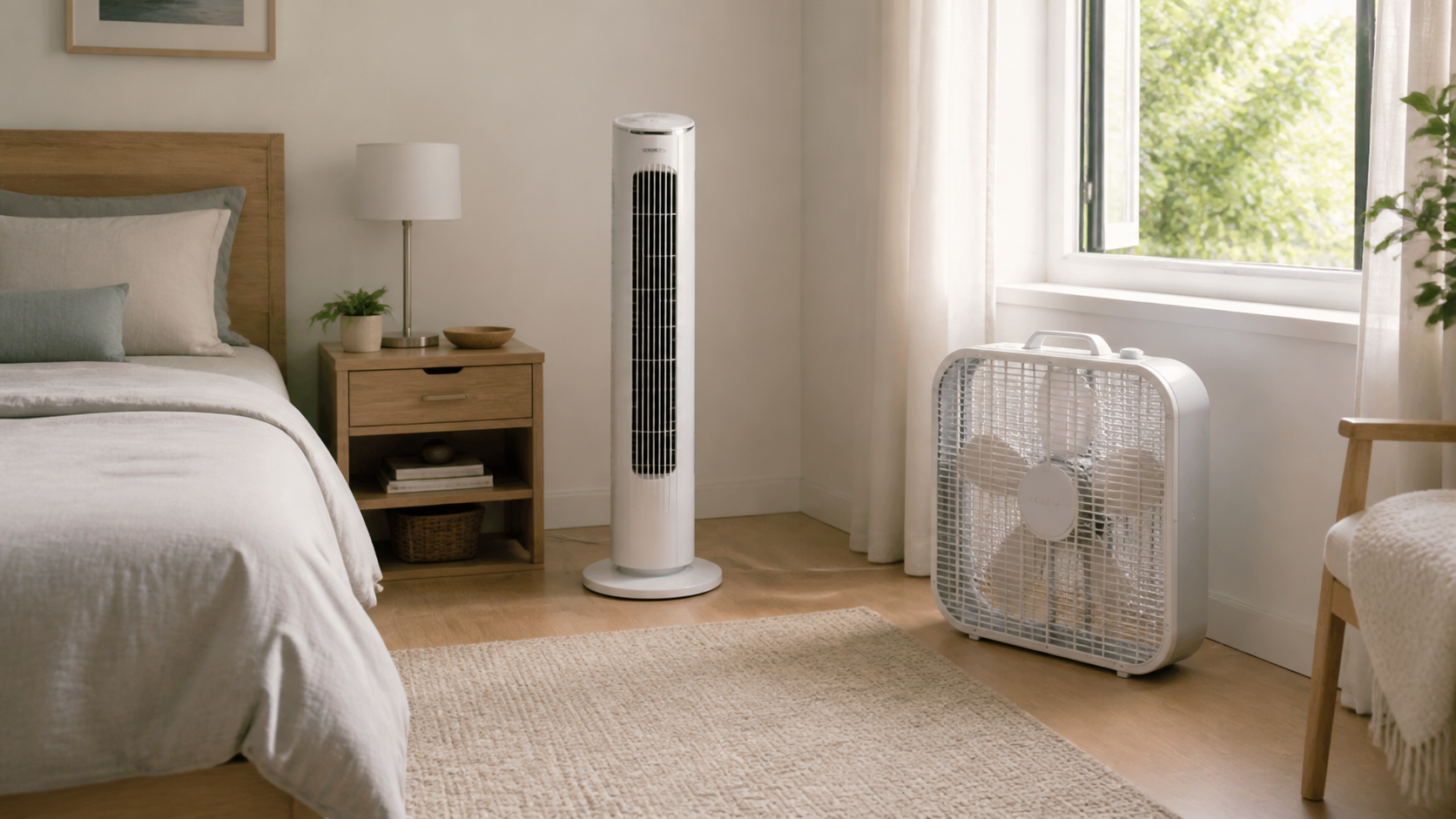
Compare the two fan formats
Prioritize compact control or broad, flexible airflow
Tower fans fit narrow floor zones and often add timers or oscillation. Box fans suit simple, broad airflow and can be repositioned easily when their larger footprint is not a problem.
This is a format comparison, not a tested model ranking. Dimensions, sound measurements, airflow figures, power use, controls, and cleaning instructions vary. Compare only manufacturer figures produced with the same test method, and check the current manual before buying or placing a fan.
Quick Answer
Choose a tower fan when floor width is tight, you want an upright airflow source near the bed, and features such as a timer, remote, display dimming, or oscillation will improve daily use.
Choose a box fan when you have a stable floor location, want a simple fan that is easy to carry between rooms, or intend to use carefully planned window airflow when outdoor conditions and the manufacturer’s directions allow it.
Choose neither as a substitute for cooling. A fan moves air and may improve personal comfort, but it does not lower room temperature like an air conditioner. If the bedroom becomes dangerously hot, follow local heat guidance and move to an adequately cooled place rather than relying on a fan alone.
Side-by-Side Tradeoffs
| Decision point | Tower fan | Box fan |
|---|---|---|
| Footprint | Narrow base, but needs clear space around its intake, outlet, and oscillation path | Wide square body that needs a stable floor area and clear front and rear airflow |
| Airflow pattern | Usually directs a narrower vertical stream; oscillation varies by model | Broad face can move air across a larger open zone |
| Controls | Often offers a timer, remote, modes, and display controls | Often uses simpler mechanical speed controls, though models vary |
| Window use | Normally intended as an in-room floor fan | May work near a window only when placement is stable and instructions allow it |
| Cleaning | Narrow grilles and internal blower access may make deep cleaning slower | Large grille is visible, but disassembly rules vary and blades remain guarded |
| Storage | Tall shape needs vertical closet or corner clearance | Flat shape may slide beside furniture but takes more width |
Who a Tower Fan Fits
A tower fan fits a bedroom where a round or square fan body would crowd the walkway. Its tall outlet can direct air toward a seated or sleeping zone without putting the fan on furniture. That does not make every tower stable: measure the base, check the manufacturer’s clearance requirements, and keep it beyond blankets, curtains, and foot traffic.
Controls are a practical reason to choose this format. A timer may prevent all-night operation when you only need airflow while falling asleep. A remote can help when the fan must sit beyond arm’s reach. Check whether indicator lights can dim or turn off and whether settings resume after power loss.
Tower fan setup checks
- Measure the base and height: Include the complete oscillation envelope, not only the body width.
- Check intake clearance: Keep curtains, bedding, clothes, and walls from restricting the intake.
- Plan the cord route: Use a nearby appropriate outlet without stretching the cord across a walkway or under a rug.
- Check nighttime controls: Look for usable low-speed settings, display dimming, timer behavior, and button or remote access.
- Read cleaning directions: Confirm whether filters, grilles, or access panels are user-serviceable before dust builds up.
Who a Box Fan Fits
A box fan fits readers who value simple, broad airflow and have a clear floor area for its wider body. A top handle can make room-to-room moves straightforward, and mechanical controls may be easier to operate without a remote or app. Confirm the fan remains stable on the intended floor surface at every speed.
Window-adjacent use is more complicated than setting a fan on a sill. A fan must not be able to fall, admit rain, interfere with a screen or window operation, overload an unsuitable support, or create a cord hazard. Follow the fan and window manufacturers’ directions. Avoid an open window when outdoor smoke, pollution, excessive humidity, rain, or security concerns make ventilation a poor choice.
Box fan setup checks
- Measure the complete body: Include feet, handle, control housing, and the clear space needed front and back.
- Use a stable surface: Keep the fan on the floor unless its instructions explicitly permit another secure placement.
- Protect both grilles: Do not let curtains, bedding, hair, or loose items reach the intake or outlet.
- Plan direction: Decide whether you need airflow toward the bed or room-air exchange under suitable outdoor conditions.
- Inspect before moving: Unplug according to the instructions and use the handle rather than pulling the cord.
Noise and Sleep Setup
Do not assume one format is quieter. Sound depends on motor, blade or blower design, speed, grille turbulence, floor vibration, and distance from the bed. A manufacturer’s decibel figure is useful only when the test distance and operating mode are stated; figures from different methods are not a fair comparison.
A lower speed placed closer is not automatically better if it crowds the bed or sends an uncomfortable direct stream. Test the likely placement and prioritize several usable speeds. Rattling, grinding, scraping, or a new vibration is a maintenance warning, not background sound to ignore.
Cleaning and Maintenance
Dust on an intake or grille can restrict airflow and increase noise. Unplug the fan before cleaning, follow the manual, and never insert tools through a guard. Some box-fan grilles can be removed with approved steps; some tower fans allow only exterior vacuuming or have a removable filter. Do not improvise disassembly that the manufacturer does not permit.
Check the cord, plug, guard, base, feet, and handle regularly. Stop using a fan that is damaged, unusually hot, smells hot, sparks, buzzes electrically, or repeatedly trips protection. Seek qualified electrical help when the outlet or circuit appears to be the problem.
Children, Pets, and Bedroom Clutter
A narrow tower fan can still tip, and a box fan’s wide grille can attract fingers, paws, hair, and toys. Guards reduce contact risk but do not make a fan childproof or pet-proof. Place either fan beyond reach where practical, supervise as appropriate, and follow all product warnings.
Do not place a fan where a pet can chew the cord, where a child can pull it over by the cord, or where bedding can drift into the intake. Skip floor placement entirely if the room cannot provide a stable, clear zone that matches the manual.
Who Should Skip Each Option
Skip a tower fan when
- The tall body would sit in a walkway or the base cannot remain stable around children or pets.
- You need broad airflow through a large opening rather than a directed in-room stream.
- Narrow grille access and the stated cleaning method do not fit your dust-control routine.
- You would pay for timers, oscillation, or remote controls that you will not use.
Skip a box fan when
- The square footprint blocks a walkway, closet, door, or required clearance.
- Your only proposed location is an unstable sill, damp area, soft surface, or furniture edge.
- You need bedside timers, display dimming, or remote control and the model does not provide them.
- Children, pets, curtains, or loose bedding cannot be kept clear of both grilles and the cord.
Bottom Line
Choose a tower fan for narrow floor space, directed bedroom airflow, and convenient controls. Choose a box fan for simple, broad airflow when you have a stable, clear place for its wider body. Compare actual dimensions, stated clearances, control behavior, cleaning access, and like-for-like noise data before deciding.
For a closer look at noise, nighttime controls, and bedroom placement, continue to the quiet bedroom fan guide. For wider comfort choices and their limits, use the home comfort and safety-adjacent upgrades guide.