Best Bakeware Organizers for Sheet Pans and Cutting Boards
A vertical organizer can turn a noisy stack of sheet pans and cutting boards into pieces you can pull out one at a time. The right type depends on usable cabinet dimensions, the thickest item, divider strength, and whether the rack stays stable when one tall board is removed.
As an Amazon Associate, The Good Home Doc may earn from qualifying purchases.
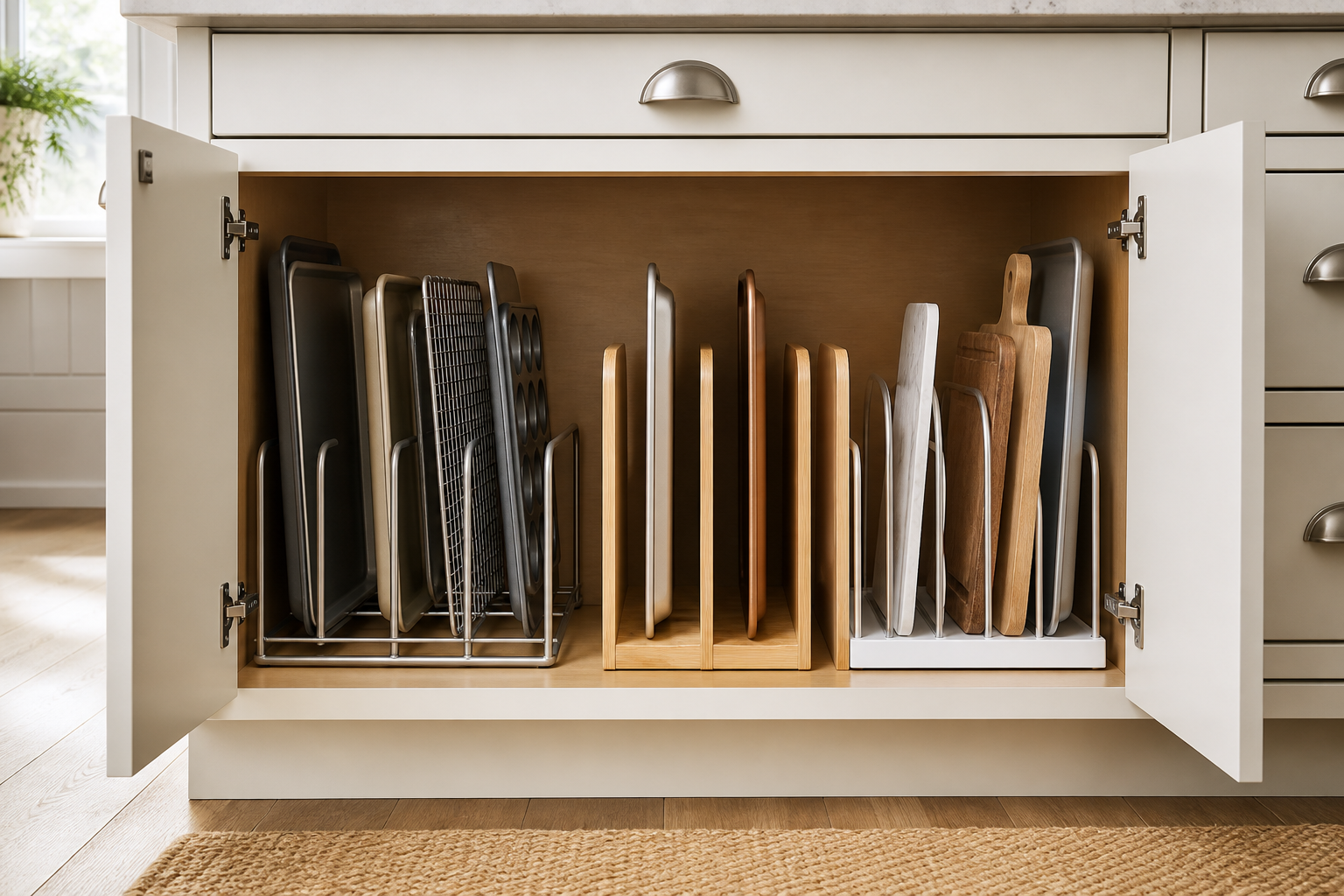
Product-category guide
Choose for fit and access, not the highest slot count
Freestanding wire racks suit mixed bakeware, adjustable dividers help with thick boards, and built-in dividers can make better use of a cabinet when permanent installation is appropriate.
This is a category comparison, not a tested ranking of current models. Confirm dimensions, materials, included hardware, load guidance, care instructions, and return terms on the current listing before buying.
Quick Picks by Storage Problem
- Best for a mixed collection: an adjustable rack with slots you can widen for boards, muffin tins, and rimmed pans.
- Best for lightweight sheet pans: a fixed wire rack with smooth dividers and a broad base that fits the cabinet floor.
- Best for heavy wood boards: a low rack with wide contact points and spacing that lets damp boards dry before storage.
- Best for a permanent cabinet layout: mounted dividers installed only where the cabinet material and household rules allow.
- Best for renters: a stable freestanding organizer that needs no holes and can be removed for cleaning.
Measure Before Comparing Organizers
- Measure usable cabinet width, depth, and height inside the face frame, hinges, shelf pins, and door hardware.
- Measure the tallest and deepest sheet pan, including handles or rolled rims.
- Measure the thickest cutting board, baking stone, muffin pan, or rack you want to store.
- Leave hand clearance above and in front so each piece can lift out without scraping the cabinet.
- Check that tall boards cannot lean into hinges, plumbing, outlets, or the door path.
Do a dry layout with the cabinet door open and closed. A rack may fit on paper but still fail if a rim catches the face frame or a board has to tilt into the countertop overhang.
Selection Criteria That Matter
- Slot width: Use the thickest item as the minimum. A crowded slot makes removal awkward and can chip board edges or scrape coated pans.
- Divider height: Taller dividers support tall boards, while shorter ones are easier to clear in a low cabinet. The divider should support the item without consuming all the lift-out room.
- Base stability: A broad base and nonslip feet can reduce sliding. Uneven loading should not pull the organizer toward the door.
- Material and contact points: Smooth coated wire is easy to see through; wood can be quiet but needs dry storage; plastic is easy to wipe but should not flex under the planned load.
- Adjustability: Movable dividers are useful only when they lock securely and do not release as a pan is removed.
- Cleaning access: Crumbs and grease collect around bases. Prefer a rack that lifts out or exposes the cabinet floor.
- Installation: Mounted systems can resist movement but require suitable cabinet material, correct fasteners, and permission in a rental.
Comparison Framework
Freestanding Wire Racks
Wire racks are easy to move, ventilate, and inspect. Fixed spacing works when most pieces are similarly thin; adjustable wire dividers are better for a mixed collection.
Choose one if: you want a reversible setup and can find verified slot dimensions for your collection.
Watch for: narrow feet, rough welds, damaged coatings, and dividers that bow when tall items lean.
Wood or Composite Divider Racks
Wooden racks can keep metal bakeware quieter and may coordinate with cabinet interiors. They need enough clearance for wiping and should only hold items that are clean and fully dry.
Choose one if: wide, smooth slots and quiet contact matter more than maximum capacity.
Watch for: swelling, rough edges, fixed slots that are too narrow, and care instructions that do not fit a busy kitchen.
Plastic or Coated Modular Racks
Modular designs can be light and easy to wipe. Confirm that connecting sections remain flat and that divider spacing does not change under the planned load.
Choose one if: easy cleanup and a customizable footprint are priorities.
Watch for: flex, sliding connectors, heat exposure near appliances, and tall boards overpowering a light base.
Mounted Cabinet Dividers
Mounted dividers create a dedicated bay and can reduce rack movement. They are less flexible if the bakeware collection or cabinet use changes.
Choose one if: you own the cabinet or have permission, have verified the panel and fasteners, and want a long-term layout.
Watch for: hidden utilities, fasteners longer than the panel, shelf adjustment conflicts, and permanent holes.
Must-Haves vs Nice-to-Haves
Must-Haves
- Slots wide enough for the actual bakeware and boards.
- Full door, hinge, shelf, and lift-out clearance.
- A stable base or correctly supported installation.
- Smooth dividers without sharp or damaged contact points.
- Enough access to remove frequently used pieces one at a time.
Nice-to-Haves
- Tool-free divider adjustment.
- Replaceable nonslip feet.
- Removable sections for future cabinet layouts.
- A finish that makes crumbs and coating damage easy to spot.
Setup, Cleaning, and Practical Limits
Put heavier pieces near the center or strongest supported part of the rack, following its current instructions. Do not pack slots so tightly that you must pull hard or tip neighboring boards. If the rack slides, bows, tips, or releases a divider during ordinary use, unload it and change the layout.
Store pans and boards clean and fully dry. Periodically remove the rack, clean it according to its care directions, wipe the cabinet floor, and inspect feet, joints, coatings, and fasteners. An organizer improves access; it does not solve cabinet moisture, damaged shelving, or an active leak.
Who Should Skip a Bakeware Organizer
Skip this category if the cabinet lacks vertical lift-out room, the door opening is much narrower than the interior, or the collection is dominated by very heavy stones or cast-iron pieces that the rack's guidance does not cover. A deep drawer with supported dividers or a low shelf may be a better fit.
Renters should skip mounted dividers unless the lease or property manager allows the installation. Anyone finding damp cabinet material, loose shelving, or unexplained staining should address that underlying problem before loading an organizer.
Bottom Line
For most mixed sheet pans and cutting boards, a stable adjustable rack offers the most useful flexibility. Measure the cabinet opening and every thick item, prioritize smooth dividers and removal room over slot count, and choose a design you can empty and clean without dismantling the cabinet.