Best Vertical Pan Organizers for Small Kitchen Cabinets
A vertical rack can stop skillets from becoming a heavy, noisy stack—but only if the slots fit the pan bodies, the handles clear the cabinet, and the rack stays planted while one pan is removed. Start with those measurements before comparing finishes or extra slots.
As an Amazon Associate, The Good Home Doc may earn from qualifying purchases.
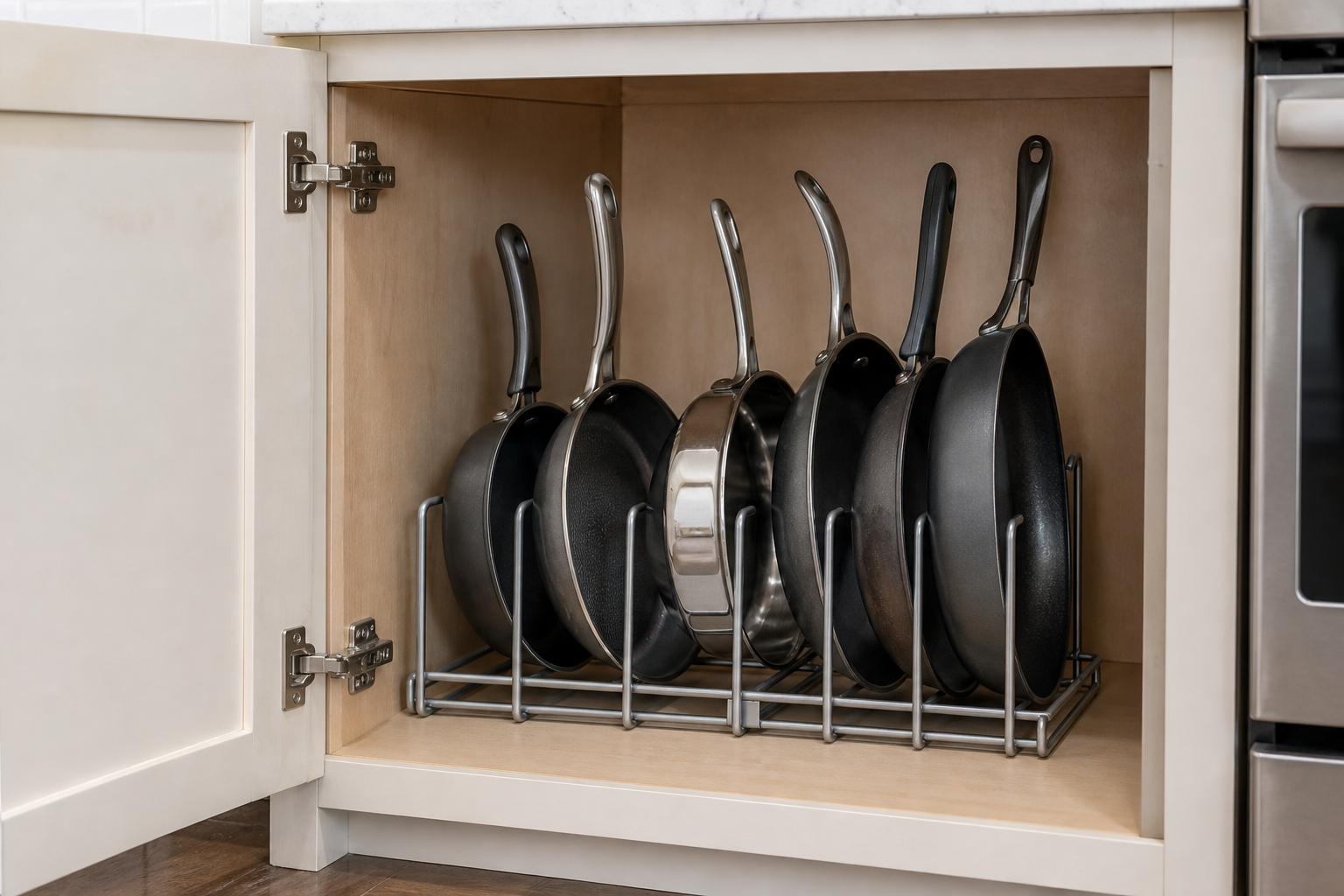
Product-category guide
Choose the rack around your heaviest everyday pans
Adjustable wire racks suit mixed cookware, fixed-slot racks are simpler when pan thicknesses are similar, and convertible racks can work upright or on their side when cabinet height is uncertain.
This is a category-fit comparison, not a hands-on test or a ranking of specific models. Confirm current dimensions, included hardware, material, configuration instructions, and stated load guidance on the manufacturer or retailer listing before buying.
Quick Picks by Cabinet and Cookware
- Best for mixed pan thicknesses: an adjustable wire rack whose dividers can move without leaving the base unstable.
- Best for heavy skillets: a low, wide rack with close floor contact, substantial dividers, and anchoring provisions when the instructions require them.
- Best for a short cabinet: a horizontal or convertible rack, provided the stacked handles do not block the door or adjacent cookware.
- Best for lightweight nonstick pans: a coated fixed-slot rack with smooth contact points and enough space to lift each pan without scraping.
- Best when access matters most: fewer generously spaced slots rather than a maximum-capacity rack that pinches pans together.
Measure Before You Compare Racks
- Measure the cabinet's usable width, depth, and height inside the face frame, hinges, shelf supports, and door hardware.
- Measure the diameter, body thickness, total height, and handle length of every pan you expect the rack to hold.
- Place the longest-handled pan in the proposed direction and close the door gently to verify handle clearance.
- Check whether a shelf above limits the tallest pan and whether the rack can sit flat over liners, seams, or raised cabinet edges.
- Plan enough hand room to lift a pan straight out without unloading its neighbors.
Do not use exterior cabinet dimensions. Face frames can remove useful width, and a pan handle may hit a hinge or the back of the door even when the rack base technically fits.
Selection Criteria That Matter
- Slot spacing: Measure the thickest pan body, not just the rim. Tight dividers can scrape coatings and make pans awkward to remove.
- Cookware weight: Cast iron and multilayer stainless cookware can shift a light rack. Follow stated load and installation guidance rather than assuming every metal rack is heavy-duty.
- Base stability: A broad base, nonslip feet, or manufacturer-approved fastening can reduce sliding. Test the planned surface without exceeding the rack's instructions.
- Divider height: Tall dividers support larger pans better, but they also consume cabinet height and may interfere with curved handles.
- Contact finish: Smooth coatings or sleeves can reduce metal-on-metal contact. Inspect them for chips or sharp edges and replace a rack if the finish fails.
- Configuration: Some racks are designed for vertical, horizontal, or both orientations. Use only a supported setup; turning an upright-only rack on its side may make it unstable.
- Cleaning access: Grease and crumbs collect around narrow wire bases. A rack that lifts out easily is more practical than one with inaccessible joints.
Comparison Framework
Adjustable Wire Racks
Movable dividers let you dedicate wider spaces to deep skillets and narrower spaces to flat griddles or lids. They work best when the divider attachment remains firm after repeated changes.
Choose one if: your cookware varies in thickness or you expect the collection to change.
Watch out for: dividers that pop out during removal, unused holes that trap debris, and a narrow base that twists under uneven weight.
Fixed-Slot Racks
A fixed rack has fewer moving parts and predictable spacing. It is a good fit for similar lightweight or medium-weight pans when you have measured every slot.
Choose one if: your current pans fit the published spacing with room to lift them cleanly.
Watch out for: decorative slot counts that pack pans too closely and fixed dividers too short to support large-diameter cookware.
Convertible Vertical-or-Horizontal Racks
Convertible designs can use cabinet height or width depending on the space. Horizontal setup may help below a shelf, though it can make lower pans less convenient to retrieve.
Choose one if: both supported orientations fit and you want flexibility after a cabinet or cookware change.
Watch out for: hardware that must be reinstalled between positions, protruding handles, and reduced stability in the less-supported orientation.
Mounted or Anchored Organizers
Some racks include fasteners or require secure attachment for their intended load. They can limit sliding but add installation work and permanent holes.
Choose one if: the cabinet material, lease or ownership rules, and manufacturer instructions all support the installation.
Watch out for: screws that are too long for the cabinet panel, plumbing or wiring beyond the surface, and warranties or lease terms that prohibit alteration.
Must-Haves vs Nice-to-Haves
Must-Haves
- Enough usable slot width for each pan body without forced contact.
- Full door, hinge, shelf, and handle clearance.
- A stable supported configuration for the cookware's actual weight.
- Smooth contact points that do not expose sharp wire or damaged coating.
- Removal room for the most-used pan without unloading the rack.
Nice-to-Haves
- Tool-free divider adjustment.
- Nonslip feet that are compatible with the cabinet surface.
- Replaceable protective sleeves or feet.
- A supported horizontal option for future cabinet changes.
Setup and Maintenance
Load heavier pans near the rack's strongest, broadest support area and follow the maker's sequence. Pull each pan upward rather than dragging it across a neighbor. If the rack tips, slides, bends, or releases a divider during normal removal, stop using that arrangement and reduce the load or choose a more suitable design.
Periodically empty the cabinet, wipe the rack according to its care instructions, dry it fully, and inspect coatings, welds, feet, and fasteners. Keep cookware dry before storage. A pan rack organizes cookware; it does not protect a cabinet from active leaks or persistent moisture.
Who Should Skip a Vertical Pan Organizer
Skip this category if the cabinet is too short for handles, too narrow to leave removal room, or unable to accept the rack's required installation. A deep drawer with dividers, a supported horizontal rack, or a shelf-based setup may use the space better.
Also skip a light freestanding rack for a collection dominated by very heavy cast-iron pieces unless its current load guidance and installation instructions clearly cover that use. Store especially heavy cookware low and securely, and avoid any arrangement that could tip toward a person opening the cabinet.
Bottom Line
For most mixed cookware sets, an adjustable vertical rack is the most flexible choice—but stability and access matter more than slot count. Measure the pan bodies and handles, verify the rack's supported orientation and load guidance, and leave enough space to remove the everyday skillet without disturbing the rest.