Best Pot Lid Organizers for Small Cabinets
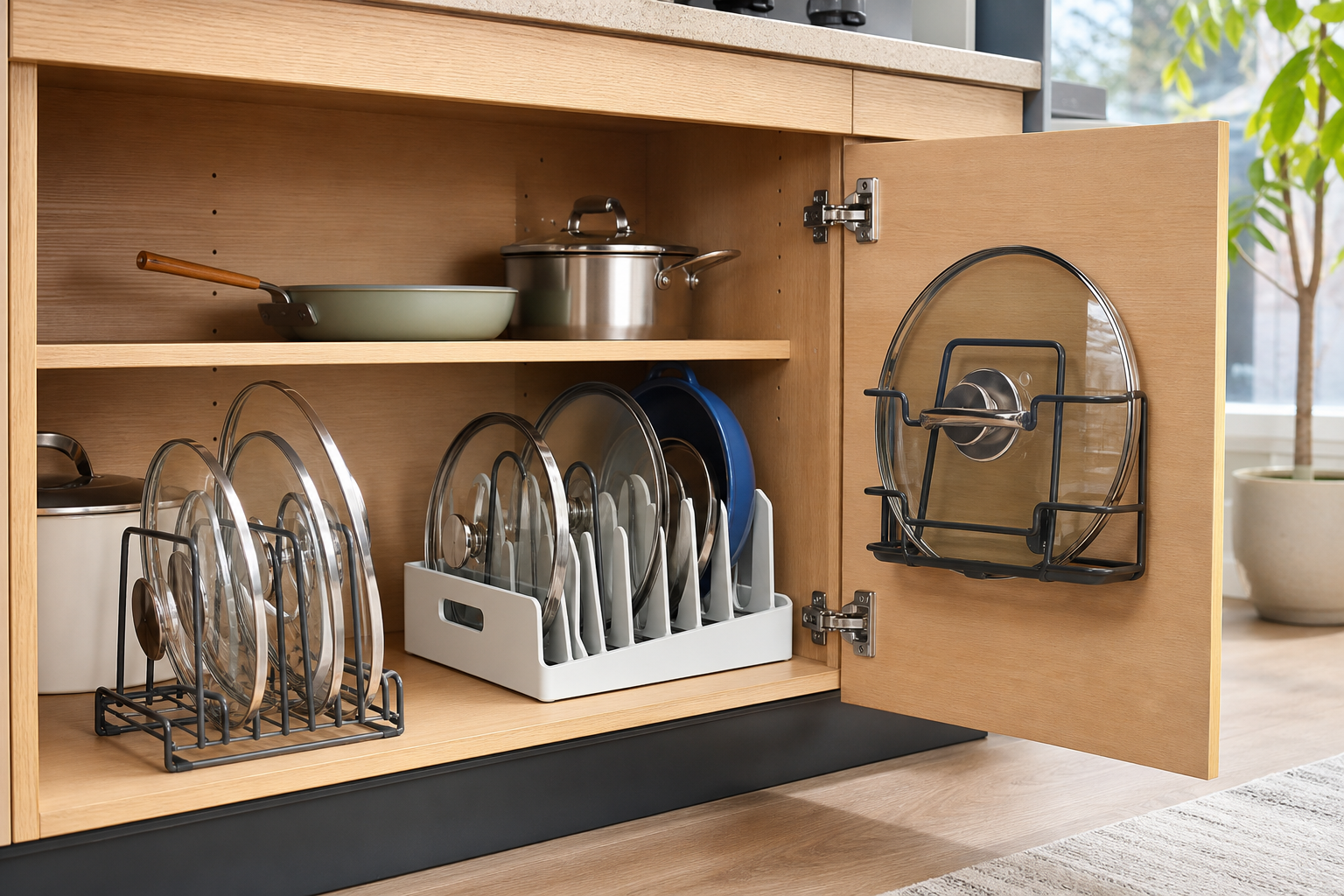
Loose pot lids turn a small cabinet into a noisy stack that has to be rebuilt every time you cook. The best organizer fits your actual lid diameters and handle shapes, stays stable as one lid comes out, and does not consume the space you are trying to save.
As an Amazon Associate, The Good Home Doc may earn from qualifying purchases.
Compare the organizer format that fits your cabinet:
- Browse category: Shop adjustable lid racksA flexible starting point when lid depths and handle shapes vary.
- Browse category: Shop compact vertical lid racksUseful when you have a clear strip of cabinet floor or shelf space.
- Browse category: Shop cabinet-door lid holdersWorth comparing only after checking hinge, shelf, and cookware clearance.
These are category starting points, not tested rankings. Confirm dimensions, slot spacing, mounting method, stated capacity, care guidance, and return terms before buying.
This guide compares organizer types and fit rather than ranking brands. A rack that claims to hold many lids can still be a poor choice if thick rims, loop handles, knobs, or cabinet hinges make half its slots unusable.
Quick Picks by Cabinet Setup
- Best for a mixed lid collection: an adjustable rack with movable dividers and a base that does not shift when one lid is removed.
- Best for a narrow cabinet shelf: a compact fixed-slot vertical rack after checking the widest lid and tallest knob.
- Best for a deep drawer: low adjustable dividers that keep handles below the drawer opening and let lids lean without sliding.
- Best when cabinet floor space is scarce: a door-mounted holder, but only if the closed door clears shelves, cookware, and hinges.
- Best for heavy cast-iron or oversized lids: a sturdy shelf or drawer setup with manufacturer-supported capacity, not a light adhesive mount.
Measure the Lids and the Cabinet
Measure the diameter of the largest lid, including its rim, plus the lid's depth from rim to the top of its knob or loop handle. Then measure the smallest lid so you can judge whether wide fixed slots will let it fall sideways. Count only the lids you use and note which pots can safely store their lids upside down; reducing the collection may solve more than a larger rack.
Inside the cabinet, measure usable width, depth, and height. Include the face frame, shelf lip, pipes, hinges, and the path a lid needs to travel through the opening. For a drawer, measure clear height at the lowest point under the counter or face frame. For a door mount, close the door slowly with a cardboard mock-up in place before drilling or applying adhesive.
Comparison Framework
Adjustable Divider Racks
Movable dividers let you create a narrow slot for a flat lid and a wider one for a deep rim or loop handle. They make sense for cookware collected over time rather than a matched set.
Choose this type when: lid thickness and handles vary or you expect the collection to change.
Watch for: dividers that release when a lid is lifted, exposed metal contact points, and a long base that cannot pass through the cabinet opening.
Fixed-Slot Vertical Racks
A fixed rack is simple and compact. It works best when the spacing matches a consistent set of relatively flat lids.
Choose this type when: you can test every lid against the listed slot width and have stable shelf space.
Watch for: narrow slots that reject rolled rims, wide slots that let small lids tip, and feet that slide on smooth shelf liner.
Drawer Dividers and Low Racks
A deep drawer can keep lids visible from above and close to the pots. Low dividers use less height than a countertop-style rack, but the handles still need to clear the drawer opening.
Choose this type when: the drawer has enough clear height and its slides are intended for the combined cookware load.
Watch for: lids leaning into the drawer sides, knobs catching the frame, and a crowded layout that blocks the drawer from closing.
Cabinet-Door Holders
Door storage frees shelf space, but it creates the most demanding fit check. The organizer, fasteners, lids, shelf edge, hinges, and cabinet contents all share the same clearance.
Choose this type when: a closed-door mock-up confirms clearance and the cabinet material suits the approved mounting method.
Watch for: adhesive on unsuitable finishes, screws longer than the door is thick, rattling lids, hinge strain, and handles striking interior cookware.
Must-Have Features
- Slot spacing that matches real lids: Compare the usable gap, not the organizer's total capacity claim.
- A stable base: Wide feet, non-slip pads, or an appropriate secured mount should keep the rack in place as one lid comes out.
- Protected contact points: Smooth coated dividers or guards reduce metal-on-glass and metal-on-finish contact.
- Handle clearance: Knobs and loop handles need room above and beside each slot without tangling together.
- Cleanable construction: Choose surfaces that can be wiped and dried; cabinet storage collects grease and crumbs.
Nice-to-Have Features
- Removable dividers: Useful when a roasting-pan lid or deep-rim lid needs a wider bay.
- Separate modules: Two short racks can fit around hinges or split lids between a shelf and drawer.
- Rounded carry points: Helpful when the empty organizer must come out for cleaning.
- Replaceable non-slip feet: Better than a bare wire base on a smooth cabinet shelf.
Capacity Claims Need a Reality Check
A ten-slot rack does not necessarily hold ten lids. Count a deep lid, wide loop handle, or large knob as two spaces when the adjacent slot would be blocked. Alternating handle directions can improve access, but do not pack lids so tightly that glass edges knock together or you must lift several pieces to reach one.
Keep the most-used lids toward the front. If the organizer becomes top-heavy when the largest lid is removed, reduce the load or choose a broader base. Follow the product maker's capacity and installation instructions, particularly for mounted units.
Setup, Cabinet Protection, and Maintenance
Clean and dry the shelf before placing a freestanding rack. If you use shelf liner, make sure the rack stays stable rather than rocking on a soft or ridged surface. Avoid improvised screws, and check door thickness before any permanent installation. Renters should obtain permission before drilling or applying hardware that may damage the finish.
Wipe the rack when grease or crumbs collect around its feet. Dry coated metal after cleaning and inspect for chipped coating, rust, loose dividers, failed adhesive, or bent supports. Replace or remount the organizer if it shifts, scratches lids, or interferes with the door.
Who Should Skip a Pot Lid Organizer
Skip a separate organizer if most lids nest safely upside down on their matching pots and cabinet space is already working. Skip door-mounted designs when the door is thin, damaged, rented, or crowded by hinges and shelves. Very heavy, fragile, or unusually shaped lids may be better stored flat in a drawer or on a stable shelf rather than balanced vertically.
If the cabinet itself is loose, sagging, water-damaged, or pulling away from the wall, do not add a mounted organizer or extra load. Address the cabinet condition with the owner, property manager, or a qualified professional first.
A Practical Buying Checklist
- Measure every lid's diameter, rim thickness, and handle height.
- Measure the cabinet opening as well as its interior dimensions.
- Mock up door or drawer clearance before choosing a mount.
- Match usable slot spacing to the thickest and smallest lids.
- Check base stability, contact protection, and cleaning access.
- Confirm mounting instructions, capacity, cabinet compatibility, and return terms.
Bottom Line
For most small cabinets with mixed cookware, an adjustable freestanding rack is the safest starting point because the dividers can accommodate different rims and handles without altering the cabinet. A fixed rack can be smaller when every lid fits its slots, while door-mounted storage should be reserved for cabinets that pass a careful clearance and mounting check.