Best Lazy Susans for Deep Kitchen Cabinets
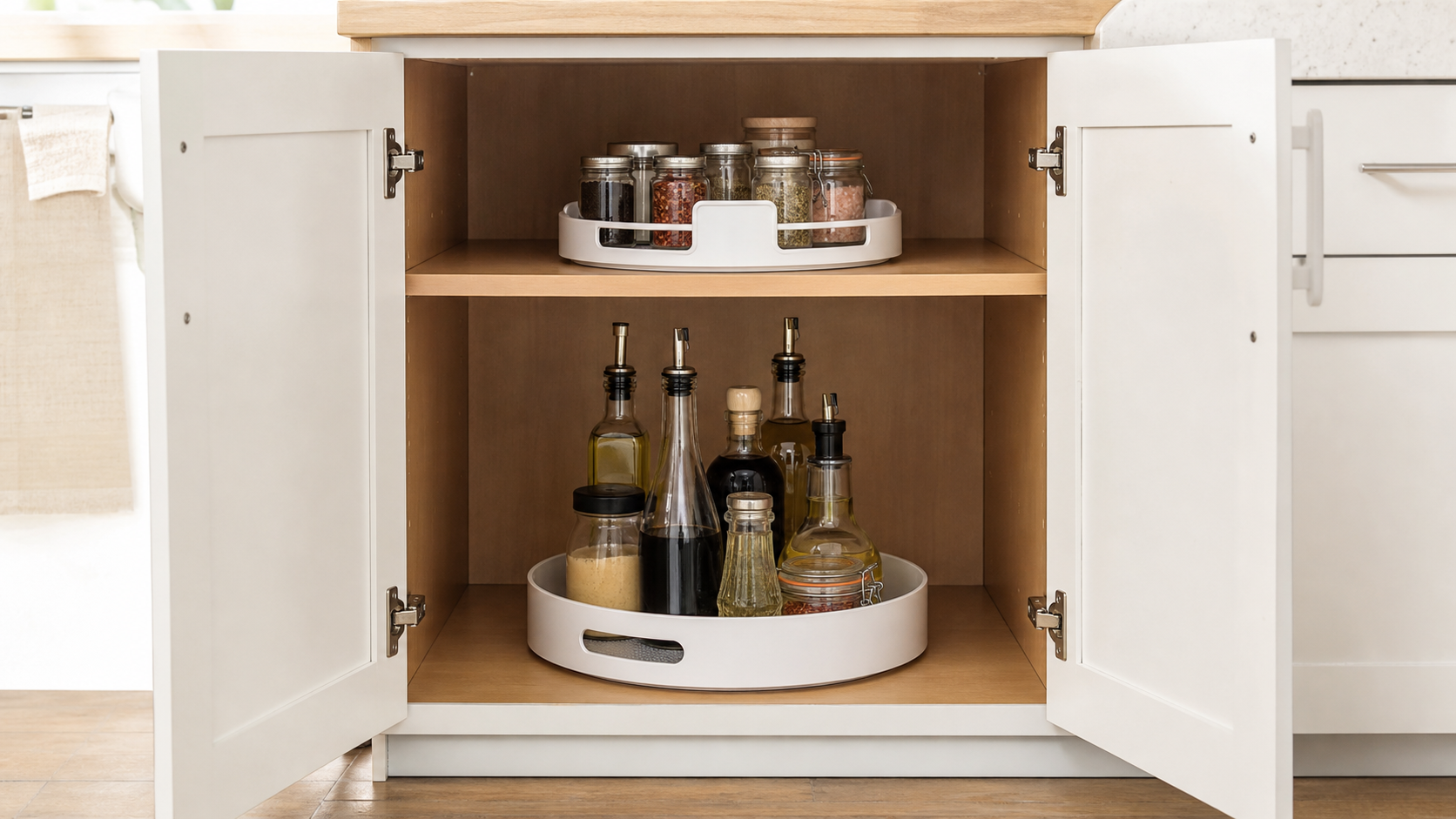
A deep cabinet is useful until oils, jars, and condiments disappear behind one another. The best lazy Susan fits the shelf with room to rotate, keeps the items you use stable, and can come out for cleaning without unloading the whole cabinet.
As an Amazon Associate, The Good Home Doc may earn from qualifying purchases.
Compare the turntable style that fits your cabinet:
- Browse category: Shop non-slip cabinet turntablesA practical starting point for mixed bottles and jars on one shelf.
- Browse category: Shop divided lazy SusansUseful when small packets or narrow containers fall over during rotation.
- Browse category: Shop two-tier cabinet turntablesWorth comparing when shelf height is generous and containers are short.
These are category starting points, not tested rankings. Confirm exterior dimensions, usable platform size, item clearance, care instructions, and return terms before buying.
This guide compares lazy Susan types and fit rather than ranking brands. Product dimensions and load guidance vary, so verify the current manufacturer specifications after you choose the right format.
Quick Picks by Cabinet Problem
- Best for oils and everyday condiments: a single-tier turntable with a non-slip base and a low retaining rim.
- Best for small jars and packets: a divided turntable that prevents items from sliding into one pile.
- Best for short spice jars: a two-tier model with enough clearance to read and lift jars from both levels.
- Best for frequent spills: a solid plastic tray with smooth corners that can be lifted out and washed.
- Best when the shelf is unusually deep: two smaller turntables placed front to back, but only if the rear one remains easy to remove.
Measure Before You Buy
Measure the shelf width and depth, then measure the narrowest part of the cabinet opening. Hinges and face frames can make the opening smaller than the shelf. A turntable must pass through that opening and still leave finger room for lifting.
For a round turntable, its diameter needs to fit both shelf dimensions. Leave extra space around the edge so bottles do not strike the cabinet wall or door as they rotate. Measure usable height from the shelf to the shelf above, then subtract the turntable's own height. For a two-tier model, check the clear height on each level—not just the total product height.
Comparison Framework
Single-Tier Non-Slip Turntables
A low, open platform gives tall bottles maximum headroom and keeps labels visible. A grippy surface helps prevent glass jars and narrow bottles from drifting as the tray starts and stops.
Choose this type when: you store mixed-height bottles, oils, sauces, or daily condiments.
Watch for: a platform smaller than the advertised outer diameter, inserts that trap spills, and a rim too low to restrain top-heavy bottles.
High-Sided or Divided Turntables
Raised walls and dividers contain small items better than a flat platform. They work well for packets, baking supplies, medicine-size bottles, or jars that otherwise tip into one another.
Choose this type when: the contents are narrow, mixed, or likely to slide during rotation.
Watch for: fixed compartments that waste space, walls that hide labels, and corners that are difficult to wipe clean.
Two-Tier Lazy Susans
Two levels use vertical space, but the center post and upper shelf reduce usable area. They are most effective with short, repeatable container sizes rather than a random mix of tall bottles.
Choose this type when: the cabinet has generous height and you mainly store spice jars, tins, or other short containers.
Watch for: inadequate space between tiers, blocked labels, a wobbly upper level, and containers that cannot be lifted out without tilting.
Kidney-Shaped and Corner-Cabinet Systems
Built-in corner-cabinet lazy Susans are a different purchase from removable shelf turntables. Their shape, post, mounting hardware, door clearance, and cabinet opening must match the cabinet.
Choose this type when: you are replacing an existing corner-cabinet mechanism and can match its specifications.
Watch for: treating it as a simple organizer upgrade. Installation or cabinet modification may call for a cabinet professional, especially when the existing hardware is damaged.
Must-Have Features
- Usable dimensions: Look for the platform diameter and inside dimensions, not only the widest outer measurement.
- Smooth rotation under the intended load: The base should stay planted while the platform turns without abrupt sticking.
- Item retention: A rim, grip surface, or divider should suit the height and shape of what you store.
- Removable, cleanable construction: Kitchen spills happen; the tray should lift out and follow clear care instructions.
- Enough hand clearance: You need space to turn the tray and lift the tallest container without hitting the shelf above.
Nice-to-Have Features
- Removable dividers: They adapt better when the mix of jars changes.
- Transparent sides: Helpful for seeing short containers without pulling them out.
- Open handles: Useful for carrying the loaded tray only when the maker permits it and the load is manageable.
- Replaceable grip liner: Easier to clean than permanently textured grooves.
- Raised feet or a sealed base: Can protect the bearing area from minor shelf spills.
How to Compare Capacity Without Overloading
Do not judge capacity by how many containers a product photo shows. Trace the usable platform diameter on paper, then place your widest bottles and jars inside the circle. Leave a little space between tall glass items so they do not knock together during rotation.
Put heavier, wider items near the center and lighter items near the edge. Keep frequently used products where their labels are easy to spot. Follow any published load limit, and do not use a turntable to compensate for a shelf that is sagging, loose, or damaged.
Cleaning and Maintenance
Choose a tray you can remove without tipping its contents. Wipe spills promptly, particularly oils and sticky sauces that can reach the rotating mechanism. Follow the manufacturer's dishwasher guidance; a plastic organizer is not automatically dishwasher safe.
If rotation becomes rough, empty the tray and check beneath it for crumbs, residue, or a warped shelf liner. Do not add household lubricant unless the manufacturer specifically recommends it for the product and kitchen setting.
Who Should Skip a Lazy Susan
Skip a turntable if the cabinet is too narrow to leave rotation clearance, if the door hinge blocks the circle, or if you mainly store square boxes that already use the shelf efficiently. A pull-out bin or shallow rectangular basket may waste less space.
Also skip a loaded turntable on a high shelf if lifting containers down is difficult, and avoid using one for very heavy appliances or unstable stacks. A lazy Susan improves access; it does not increase the cabinet shelf's safe capacity.
A Practical Deep-Cabinet Setup
- Empty the shelf, discard expired food according to local guidance, and group what remains by height and use.
- Measure the cabinet opening, shelf, and vertical clearance with hinges and face frames included.
- Trace the proposed turntable diameter on paper and arrange the actual containers inside it.
- Place the most-used group on one turntable rather than mixing unrelated items.
- Load heavier items near the center, rotate through a full circle, and confirm nothing hits the walls or door.
For a whole-home approach based on access and frequency, use the small-home organization systems guide. If a turntable still cannot make the space usable, a measured slim rolling cart can move selected supplies out of the cabinet without adding permanent cabinetry.
Bottom Line
For most deep kitchen cabinets, a single-tier non-slip lazy Susan with a modest rim is the most flexible choice. Pick a divided model for small unstable items and a two-tier model only when you have measured both vertical clearances. Fit the organizer to the shelf and the containers you own, leave room to rotate, and keep the load easy to remove for cleaning.