Best Expandable Shelves for Kitchen Cabinets
An expandable shelf can turn the empty space above short dishes, mugs, or pantry jars into useful storage. The right one fits the cabinet at both ends of its adjustment range, leaves room for your hands, and supports everyday items without blocking hinges or doors.
As an Amazon Associate, The Good Home Doc may earn from qualifying purchases.
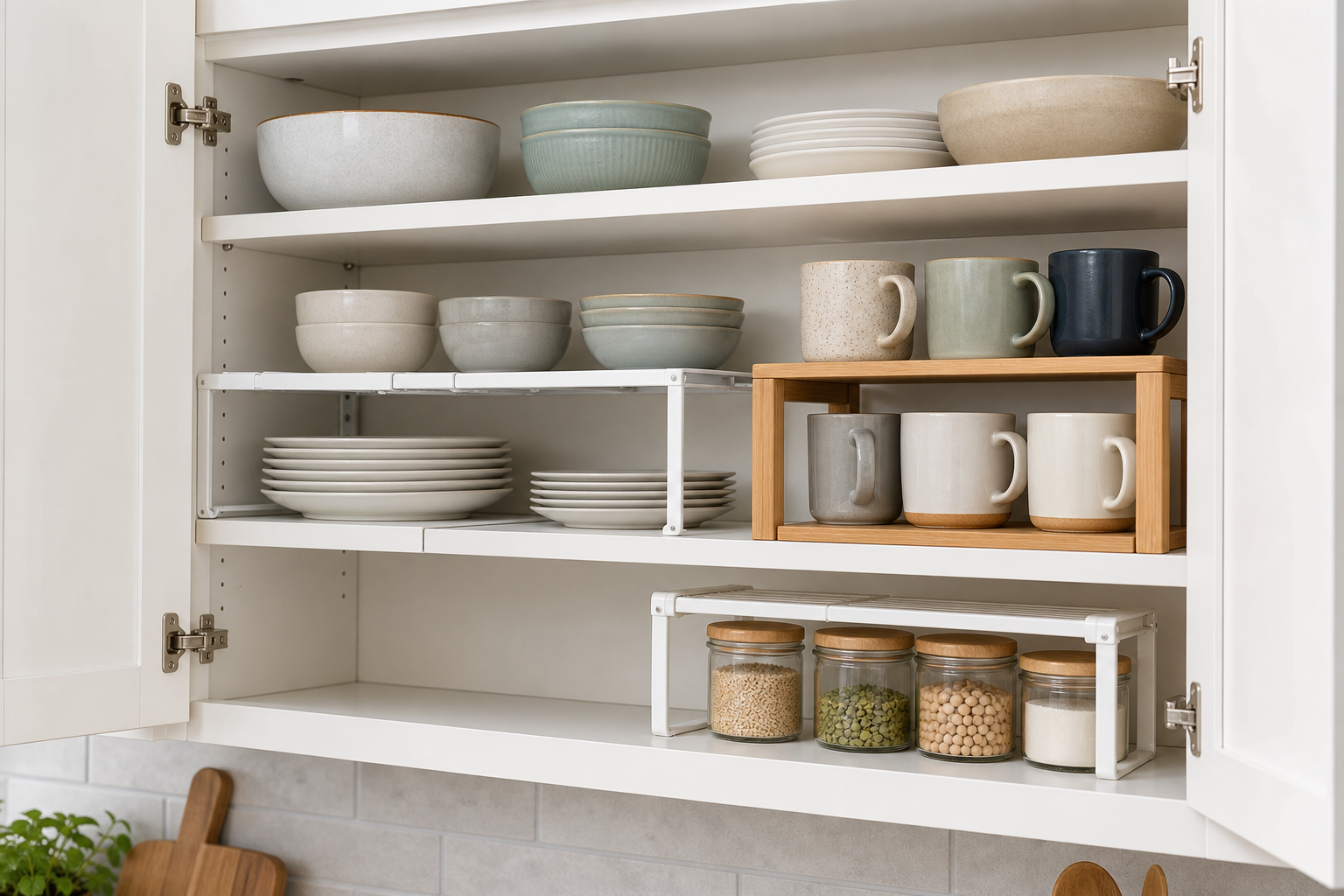
Product-category guide
Compare cabinet shelf risers by fit
Measure usable width, depth, and height before choosing. Expandable metal risers suit wider runs, compact stackable shelves create separate zones, and solid-top designs keep small jars steadier.
This is a best-fit comparison of shelf types, not a tested ranking of brands. Dimensions and load guidance vary by model, and cabinet interiors are rarely as square or unobstructed as their outside dimensions suggest. Confirm the current manufacturer specifications before buying or loading a shelf.
Quick Picks by Cabinet Problem
- Best for a wide row of plates and bowls: an expandable metal shelf with a supported overlap and feet that land on a flat cabinet surface.
- Best for mugs and small bowls: one or two compact stackable risers that preserve easy hand access.
- Best for spice jars or narrow containers: a solid-top shelf with a raised or nonslip surface rather than wide wire gaps.
- Best for changing storage needs: separate modular risers that can move between cabinets instead of one extra-wide unit.
- Best when the cabinet is deep and items disappear at the back: skip the riser and consider a turntable for deep cabinets or a pull-out solution.
Measure the Usable Space, Not Just the Cabinet Box
Empty the shelf and measure its width at the front and back. Subtract space taken by hinges, face-frame lips, shelf pegs, pipes, or door hardware. Then measure from the cabinet shelf to the shelf above. The riser height plus the tallest item placed on top must fit with enough room to lift that item out.
Depth matters too. A riser that projects beyond the cabinet shelf can stop a door from closing, while legs placed too far forward can sit on a face-frame edge instead of the flat shelf. Measure your largest plates, bowls, mugs, and containers—not the smallest pieces that happen to be easiest to store.
A useful paper test is to mark the proposed leg positions and shelf outline on a piece of cardboard. Place it in the cabinet, close both doors slowly, and practice removing the intended dishes. This catches hinge and hand-clearance problems before a product arrives.
Comparison Framework
Expandable Metal Shelf Risers
These shelves slide or telescope to cover a wider span. Powder-coated steel versions are common and usually provide a relatively thin top, which preserves vertical clearance.
Choose one when: the cabinet has a wide, flat shelf and you want one continuous upper level for plates, bowls, or pantry goods.
Watch for: a weak or uneven overlap, legs that collide with items below, exposed edges that can scratch dishes, and a claimed expansion range that does not explain how much overlap remains at full width. Use only within the maker's stated dimensions and load guidance.
Compact Stackable Risers
Small freestanding shelves can sit side by side or stack when the design specifically permits it. They make it easier to divide mugs, bowls, and snack containers into zones.
Choose them when: you want a layout that can change, have a divided cabinet, or need to work around hinges and shelf pegs.
Watch for: connectors that are easy to misseat, a tall stack that becomes awkward to reach, and narrow feet that leave pressure marks. Do not stack products unless the manufacturer describes that configuration and gives appropriate limits.
Solid-Top Wood or Bamboo-Look Shelves
A solid surface prevents narrow jars, cup feet, and small lids from settling between wires. The warmer finish may also suit open shelving, though appearance should come after fit and cleanability inside a cabinet.
Choose one when: small-item stability and a smooth surface matter more than the thinnest possible shelf.
Watch for: a thicker top that consumes clearance, coatings that should not stay damp, and care directions that limit soaking or dishwasher cleaning. “Bamboo” in a listing may describe a finish or composite construction, so check the actual material.
Wire Shelves
Wire tops are light and allow crumbs to fall through for easier wiping, but their spacing affects what can stand securely.
Choose one when: you store broad plates, bowls, or bins whose bases span several wires.
Watch for: small jar feet tipping into gaps, thin wires marking soft shelf liners, and chipped coating that can be difficult to clean. A liner placed on top can help small items but may also slide or reduce airflow.
Must-Have Features
- A usable adjustment range: Your target width should sit comfortably inside the range, not depend on forcing the shelf to its absolute limit.
- Stable leg placement: All feet need to rest fully on a flat surface without straddling a cabinet lip or shelf seam.
- Clear load guidance: Prefer a maker that states the supported configuration and loading limits instead of vague “heavy-duty” language.
- Non-marring feet: Grippy caps can reduce sliding and protect a finished cabinet shelf, but they still need periodic cleaning.
- A cleanable finish: Kitchen storage sees crumbs, oil film, and occasional spills. Check whether the surface wipes clean and how it should be dried.
- Enough access height: You should be able to lift a bowl or mug without scraping it against the shelf above.
Nice-to-Have Features
- Tool-free adjustment: Helpful when you expect to move the shelf, provided the mechanism still locks securely.
- Rounded edges: Easier on hands and less likely to catch dish towels or shelf liners.
- Modular matching sizes: Useful for building separate zones without committing to one large unit.
- Replaceable foot caps: Worthwhile for a shelf that will be moved and cleaned frequently.
How to Compare Capacity Without Unsupported Rankings
Do not translate a marketing photo into a safe load assumption. Count what you actually plan to store, estimate how its weight will be distributed, and compare that use with the manufacturer's current guidance. A stack of stoneware dinner plates is a different job from tea bags or plastic food containers.
Place heavier everyday items on the cabinet's original shelf when practical and use the riser for lighter pieces. Keep loads centered rather than concentrating weight on an extended edge. If the cabinet shelf itself bows, shifts on its pegs, or shows damage, adding another tier is not the solution; unload it and address the cabinet condition first.
Door, Hinge, and Hand-Clearance Checks
Open shelves look generous until the doors swing through the usable space. European-style hinges can occupy both side and front clearance, while a center stile can make a wide riser difficult to load. Make sure the riser, its contents, and your hand can pass through the actual opening.
Frequently used dishes should not require moving three other stacks. If a riser doubles capacity but makes every mug a two-handed extraction, it has created storage density rather than useful storage. Keep the front row simple and use the upper level for items whose rims and handles remain easy to grasp.
Setup and Maintenance
- Wipe and dry the cabinet shelf before setup so crumbs do not sit under the feet.
- Assemble or expand the riser exactly as directed and confirm all locks or connectors are seated.
- Press lightly at each corner to check for rocking before adding dishes.
- Load gradually, keeping heavier items low and centered.
- Close each cabinet door slowly while watching hinges, handles, and tall items.
- Recheck the shelf after a few days, then during routine cabinet cleaning for movement, bent parts, loose connections, chipped coating, or trapped moisture.
Who Should Skip Expandable Cabinet Shelves
Skip a riser when the cabinet shelf is sagging, damaged, unusually narrow, or interrupted by hardware that prevents all feet from sitting flat. It is also a poor fit for very heavy cookware, appliances, or tall stacks that would be difficult to lift safely from an upper level.
People who primarily struggle to reach the back of a deep cabinet may get more value from a turntable or shallow bin. If the problem is lid clutter rather than vertical space, compare pot lid organizers for small cabinets. Renters should use freestanding products that do not require drilling and should check lease rules before attaching anything to cabinetry.
Bottom Line
The best expandable cabinet shelf is the one that fits well before it is fully extended, leaves every foot on a flat surface, and creates enough clearance to remove dishes comfortably. Choose a continuous metal riser for a wide stable run, compact modular shelves for flexibility, or a solid top for small jars. Measure hinges, doors, legs, and hand access—not just the empty rectangle inside the cabinet.