Best Bedside Caddies for Small Bedrooms and Bunk Beds
When a nightstand will not fit, a bedside caddy can keep glasses, a book, tissues, and a phone within reach without adding furniture to the floor. The best type depends on how your mattress or bed frame is built, what you plan to store, and whether the organizer stays stable when you reach for it at night.
As an Amazon Associate, The Good Home Doc may earn from qualifying purchases.
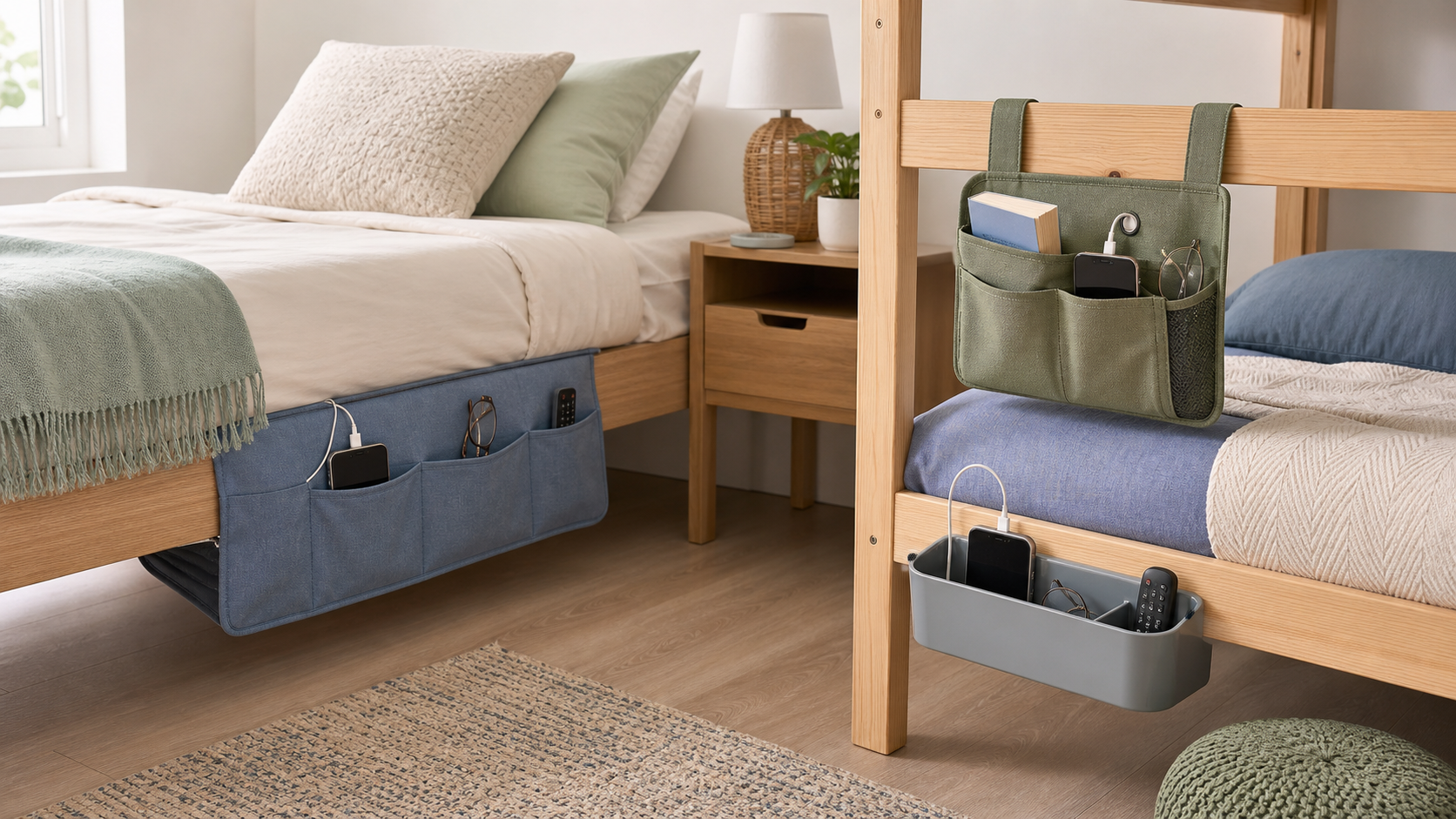
Product-category guide
Choose the attachment before the pocket layout
Measure the mattress, side rail, or frame first. Then compare caddies whose listed attachment range, load guidance, and pocket dimensions fit your bed and everyday items.
This is a best-fit buying framework, not a ranked review or a claim that we tested individual caddies. Verify the maker's dimensions, compatible bed parts, attachment directions, load limits, care instructions, and bunk-bed restrictions before buying.
Quick Picks by Bed Setup
- Best for a standard mattress with no usable rail: a wide under-mattress flap caddy with grippy backing and pockets that hang above the floor.
- Best for an exposed lower-bunk or daybed rail: a fabric hanging caddy whose straps fit fully around the rail without interfering with slats or hardware.
- Best for a drink or other upright item: a rigid clip-on tray with a stated clamp range that matches a sturdy, approved frame edge.
- Best for frequent washing: a simple removable fabric organizer with clear machine- or hand-care instructions.
- Best for heavy books or a laptop: usually a compact nightstand, wall shelf installed appropriately, or purpose-built bedside table rather than a soft caddy.
Measure the Bed Before Shopping
For an under-mattress caddy, measure the mattress depth and the distance from the mattress edge to the floor. Thick mattresses, adjustable bases, and platform beds with a raised lip can keep the flap from sitting flat. Check whether shifting the mattress or raising the head of an adjustable base could pull the organizer loose.
For a rail-hanging model, measure the rail's height, thickness, and usable length, including any slats, bolts, ladders, or guardrail openings. For a clamp-on model, compare the maker's minimum and maximum clamp opening with the exact frame edge. Do not clamp onto thin trim, upholstery, moving adjustable-base parts, or a surface the maker excludes.
Comparison Framework
Under-Mattress Fabric Caddies
A broad flap slides beneath the mattress while the pockets hang over the side. This is the most flexible option for ordinary beds because it needs no exposed rail, but stability varies with mattress weight, bed movement, and the friction between surfaces.
Choose this type if: you want soft storage for light items and the mattress can hold the flap flat without obstructing base movement.
Watch out for: sagging pockets, a flap that creeps outward, items pressing against the sleeper, and fabric reaching the floor.
Strap- or Hook-Mounted Rail Caddies
These attach to an exposed bed rail and can be easier to remove than under-mattress models. Adjustable straps suit more rail shapes than fixed hooks, while hooks can be quicker to fit but may rattle, scratch, or prevent a flush fit.
Choose this type if: the lower bunk, daybed, or frame has a sturdy accessible rail and the attachment does not interfere with normal bed use.
Watch out for: fixed hook width, long straps, blocked ladders, covered hardware, and placement on guardrails where the bed maker prohibits accessories.
Rigid Clip-On Trays and Bins
A rigid caddy keeps cups, glasses, and small devices upright and is easier to wipe clean. It also projects farther into the room and concentrates force at the clamp.
Choose this type if: the approved frame edge matches the clamp range and there is enough clear space around the bed.
Watch out for: sharp corners, door or drawer conflicts, pressure marks, uneven round rails, and a protruding tray beside a narrow walkway.
Must-Have Features
- Compatible attachment: The listed fit range must match the actual mattress, rail, or frame—not a guess based on product photos.
- Useful pocket dimensions: Measure the book, device, remote, glasses case, or water bottle you expect each opening to hold.
- Stable weight distribution: Several smaller pockets can keep items from collecting in one sagging corner.
- Finished edges and covered hardware: Seams, hooks, and clamps should not snag bedding, scratch the frame, or create an uncomfortable contact point.
- Clear care instructions: Removable inserts and washable fabric make dust, crumbs, and spills easier to manage.
Nice-to-Have Features
- Cable pass-through: Helpful only when it prevents pinching and keeps the charging cable out of walkways and moving bed parts.
- Mesh pocket: Makes small contents visible, though mesh may snag pointed objects.
- Removable divider: Useful when the same rigid bin must alternate between a bottle and smaller items.
- Grippy backing: May reduce sliding on compatible surfaces but does not replace correct installation.
- Neutral, low-profile shape: Less likely to catch clothing or make a tight aisle feel narrower.
Bunk-Bed and Cable Cautions
Follow the bunk-bed maker's instructions and age, guardrail, ladder, and accessory restrictions. Do not cover guardrail openings, add thick padding that changes the effective guardrail height, obstruct the ladder, or hang loose straps and cords where they could entangle a sleeper. A lower-bunk rail or approved frame location is often the more practical place for a caddy, but only when the manufacturer permits it.
Keep charging cords unpinched, away from bedding, and out of walking paths. Use the device and charger as directed, inspect damaged cables, and avoid storing a warm device beneath blankets or deep inside a pocket. A cable opening is a routing feature, not proof that every charging setup is suitable.
Who Should Skip a Bedside Caddy
Skip an under-mattress caddy if the base articulates, the mattress is too light to secure it, or the side of the bed is already hard to access. Skip rail-mounted models when the frame lacks a compatible exposed rail or the straps would interfere with a bunk ladder, guardrail, or moving part. Skip rigid trays beside narrow walkways or where a child could climb on them.
Choose furniture instead if you routinely store heavy books, a laptop, medicine that needs controlled storage, a large drink, or anything fragile. A caddy should organize a few light essentials, not become an overloaded substitute for a stable bedside surface.
Bottom Line
For most standard beds without nightstand room, a wide under-mattress fabric caddy is the simplest starting point. For a compatible lower-bunk or daybed rail, adjustable hanging straps can provide a more deliberate fit. Choose a rigid clip-on bin only after confirming the frame, clamp range, clearance, and stated load.
For the rest of the room, use the small-home organization systems guide to decide what should live beside the bed, under it, or in the closet. If under-bed space is the better storage zone, compare under-bed storage bins by clearance, dust control, and access.