Best Bedside Fans for Hot Sleepers in Small Rooms
A good bedside fan creates adjustable airflow where you sleep without taking over the nightstand, lighting up the room, or sending a cord across the walkway. For most small rooms, start with a stable compact desk fan; choose a clip-on fan only when the attachment point is genuinely secure.
As an Amazon Associate, The Good Home Doc may earn from qualifying purchases.
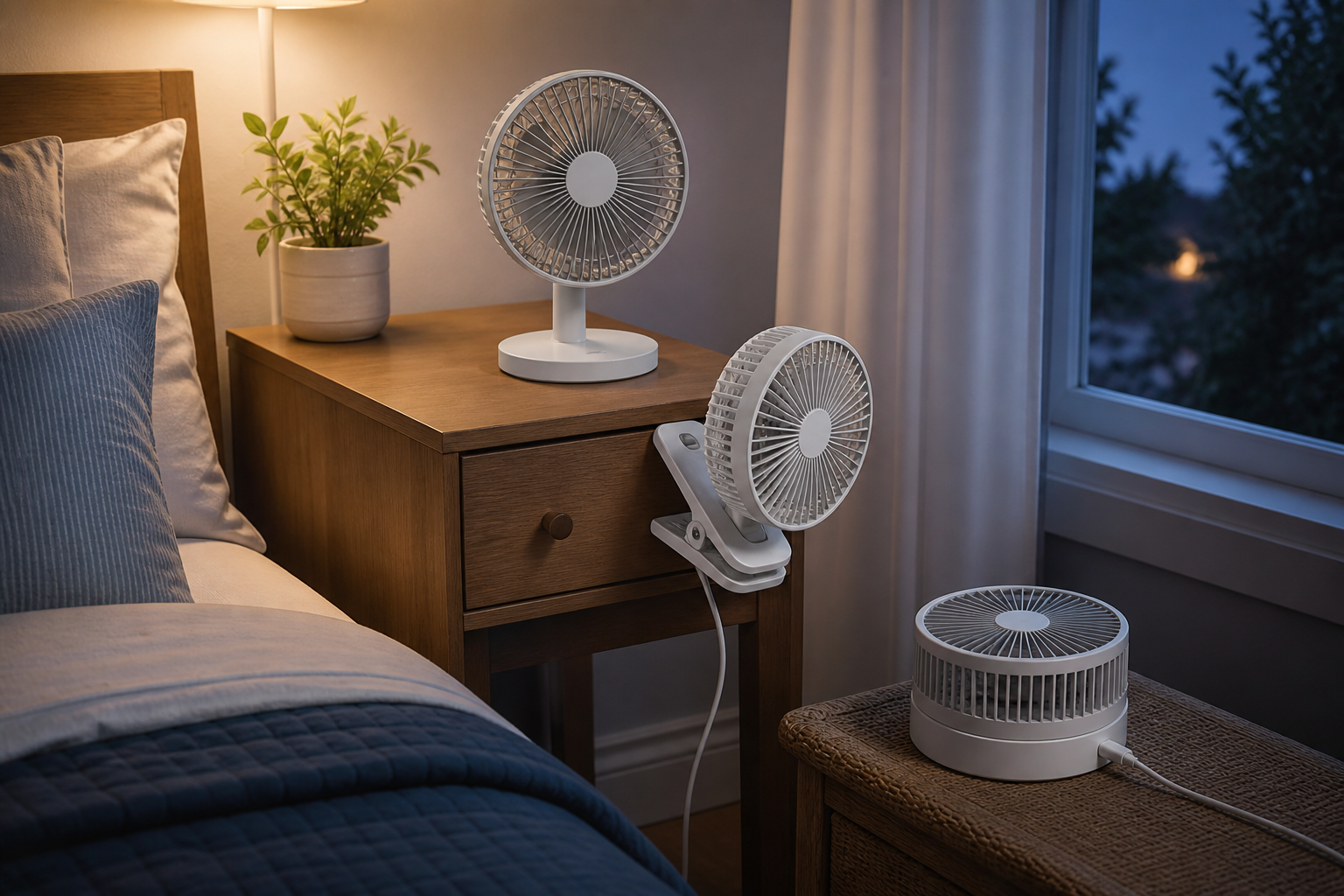
Compare the format that fits your bedside setup: These affiliate category searches are starting points, not tested rankings.
- Browse category: Compact bedside desk fansA practical first choice when the nightstand has a flat, stable surface.
- Browse category: Clip-on bedside fansUseful when surface space is scarce and a solid attachment edge is available.
- Browse category: Low-profile USB fansWorth comparing for close-range airflow and easy drawer storage.
Confirm dimensions, power requirements, control lights, cleaning access, cord length, and the maker's placement instructions before buying.
This is a category comparison, not a list of named winners. Bedside fans are meant for close-range personal airflow; they do not lower the room temperature like air conditioning. If the whole bedroom feels hot, the quiet bedroom fan guide covers larger air circulators, tower fans, and room-level placement instead.
Quick Picks by Bedside Setup
- Best default for a nightstand: a compact desk fan with a broad base, several low-speed steps, simple buttons, and no mandatory display light.
- Best when the surface is full: a clip-on fan whose clamp range matches a solid shelf or headboard edge and whose cord can stay away from bedding.
- Best for close-range, gentle airflow: a low-profile USB fan with fine speed control and a grille that tilts without slipping.
- Best for changing sleep positions: a compact oscillating fan with an easy way to stop oscillation and aim the head manually.
- Best for frequent storage or travel: a small fan with a protected grille, folding or shallow body, and a power setup you already use.
Bedside Fans vs Whole-Room Fans
A bedside fan sits close enough that modest airflow can feel useful. That allows a smaller footprint and lower speed, but placement becomes more important: a narrow nightstand, loose clamp, bright controls, or short cord can make an otherwise capable fan a bad fit.
A whole-room fan is selected for circulation across a larger space. It may move more air, but it also needs more floor or dresser room and can feel forceful when aimed directly at the bed. Choose the bedside category when personal airflow is the goal; choose a larger bedroom fan when air needs to move through the room.
Comparison Framework
Compact Desk Fans
A desk fan is the least complicated option when the nightstand has a clear, level surface. A broad base usually resists bumps better than a tall pedestal, while a tilting head lets you direct airflow above the bedding.
Choose this type if: you have enough surface depth for the full base plus clearance behind the fan.
Watch out for: narrow bases, controls hidden behind the grille, unstable tilt joints, and feet that slide on a smooth tabletop.
Clip-On Fans
A clip-on fan saves horizontal space, but the clamp is part of the safety and fit decision. Compare the clamp opening with the actual edge thickness and shape. A padded, deep clamp on a rigid surface is more useful than a small clip stretched to its limit.
Choose this type if: a solid shelf, bed frame, or nightstand edge accepts the clamp without damaging the finish or loosening during adjustment.
Watch out for: rounded rails, soft upholstery, weak composite edges, pinched charging cords, and mounting where the fan could fall onto the bed.
Low-Profile USB Fans
Low-profile fans trade height and oscillation for compact storage and close-range airflow. USB power can simplify the setup, but the power source must provide what the fan requires; a convenient connector does not guarantee every adapter is suitable.
Choose this type if: you want a small aimable fan and already have a compatible power source within safe cord reach.
Watch out for: fixed angles, cable-only products that omit a suitable adapter, and controls that reset whenever power is disconnected.
Rechargeable Bedside Fans
A rechargeable fan can reduce cord clutter while running, but it adds charging routines and a battery that will age. Manufacturer runtime figures depend on speed and features, so treat them as conditions to verify rather than guaranteed all-night results.
Choose this type if: outlet access is awkward or the fan will also move between a desk, kitchen, and travel bag.
Watch out for: unclear battery specifications, charging near bedding, a nonreplaceable battery, and a fan that cannot run safely while charging according to its instructions.
Must-Have Features
- Measured footprint or clamp range: Check the full base depth, head sweep, and rear cord clearance—not only the grille diameter.
- Useful low speeds: Close-range airflow should be adjustable enough that the lowest setting is not still harsh.
- Stable aim: The tilt joint should hold position, and oscillation should be optional rather than the only mode.
- Night-friendly controls: Buttons should be easy to find without a bright always-on display. Check whether indicator lights can be dimmed or switched off.
- Cleanable grille: Look for manufacturer instructions that explain how to reach dust-prone areas without unsafe disassembly.
- Protected cord route: The cord should reach the outlet without crossing the bed, passing under rugs, or creating a trip path.
Noise: Compare More Than One Number
Published decibel figures can help only when the maker explains the speed and measurement conditions. Also consider the character of the sound. A steady airflow sound may fade into the background, while clicking oscillation, motor pulsing, button beeps, or a rattling grille can remain noticeable even at modest volume.
Fine speed steps matter because the quietest usable setting may sit between a fan's low and medium modes. Read the current manual or product documentation for control behavior, sleep modes, beeps, and whether settings persist after power loss. Do not assume labels such as “silent” or “whisper quiet” represent a shared test standard.
Measure the Bedside Area Before Buying
- Measure the available width and depth after accounting for the lamp, phone, water, and anything reached during the night.
- Measure the distance and route to the outlet or intended USB power source.
- Check the aimed grille and oscillation sweep so the head will not hit a wall, lamp, curtain, or plant.
- For a clip-on fan, measure the attachment thickness and inspect whether the edge is rigid, flat, and finish-safe.
- Plan a position that keeps fingers, hair, loose fabric, and cords away from the grille.
Power, Placement, and Maintenance
Use the supplied power equipment or a compatible source specified by the manufacturer. Do not run a cord where bedding can wrap around it, route it under a rug, or stretch it across a walkway. Keep the fan on a dry, stable surface with its vents unobstructed, and follow the maker's clearance and charging instructions.
Dust changes both airflow and sound. Unplug the fan before cleaning, follow the manual for grille access, and avoid pushing moisture into the motor or controls. If the fan develops a burning smell, damaged cable, loose grille, persistent grinding, unusual heat, or a battery that swells, stop using it rather than trying to sleep through the problem.
Who Should Skip a Bedside Fan
Skip this category if you need to cool the entire room rather than create personal airflow. A larger room fan, shade control, ventilation changes, or appropriate air conditioning may address the actual problem better.
Also skip a clip-on format when there is no rigid, manufacturer-compatible attachment point. If a sleeper cannot move away from direct airflow, is sensitive to dry air, or needs cords and small appliances kept out of reach, reconsider the placement or choose another comfort approach. A fan does not make an dangerously hot room safe; follow local heat guidance and seek appropriate help if someone has signs of heat illness.
Practical Buying Checklist
- Confirm the full footprint or clamp range against your actual furniture.
- Choose several usable low speeds and optional oscillation.
- Verify control lights, beeps, timer behavior, and setting memory.
- Check the supplied cable, adapter requirements, and safe outlet route.
- Prefer a stable base or deep padded clamp over maximum compactness.
- Read the cleaning instructions and check whether dust-prone parts are accessible.
- Skip unsupported noise, cooling, runtime, or battery claims.
Bottom Line
For most hot sleepers in a small room, a stable compact desk fan with several low speeds, a secure tilt joint, simple dark controls, and a clean cord route is the safest starting point. Use a clip-on fan only when the clamp truly fits a rigid edge. Treat USB and rechargeable models as power-system choices as well as fan choices, and move up to a whole-room fan when close-range airflow is not the real job.