Best Downspout Splash Blocks for Foundation Runoff
A splash block handles one modest job: it receives routine discharge from a downspout and helps carry it across the surface away from the wall. The best fit is long enough for the site, slopes the right way, stays aligned, and can be checked after rain without pretending to solve a grading, gutter, or foundation problem.
As an Amazon Associate, The Good Home Doc may earn from qualifying purchases.
Compare splash blocks by measured site fit:
- Browse category: Compare downspout splash blocksStart with length, channel width, outlet fit, material, slope, and how the block stays aligned.
- Browse category: Compare longer splash blocksUseful where a standard block ends too close to the wall, provided the surface continues to fall away.
- Browse category: Compare heavier splash blocksConsider handling weight, freeze exposure, mower clearance, and whether the supporting soil is stable.
These are category searches, not tested rankings. Confirm current dimensions, material guidance, installation instructions, weather limits, and return terms before buying.
This is a buying framework for routine roof runoff at a functioning downspout. It is not a drainage design, waterproofing method, foundation diagnosis, or promise against flooding. Water that pools against the home, enters the building, erodes soil, overwhelms gutters, freezes on a walking route, or continues after simple maintenance needs a property manager or qualified drainage, gutter, landscaping, or foundation professional as appropriate.
Quick Best-Fit Guide
- Best simple starting point: a rigid, channeled block that fits beneath the outlet and extends across a surface that already slopes away from the home.
- Best for light handling: UV-suitable molded plastic with a broad base and a way to resist shifting.
- Best for exposed, stable ground: a heavier concrete or composite block that is practical to lift and reset.
- Best where mowing is frequent: a low-profile block whose end and edges remain visible and outside the mower path.
- Best for persistent pooling or erosion: no splash block alone; investigate the gutter, grading, discharge route, and local drainage requirements.
Measure the Outlet and Water Path
Measure the downspout outlet width and how high it sits above the ground. The block's receiving end should sit under the full discharge path without pressing up against or carrying the downspout. Then measure from the wall to the point where the surface clearly continues downhill. A longer block only helps when its outlet ends on a stable surface that moves water onward rather than into a new puddle.
Check the route after an ordinary rain from a safe position. Note whether the downspout stays connected, water overshoots the block, or the block rocks, sinks, reverses slope, or sends water toward a walkway, neighbor, window well, utility area, or eroded patch. Do not redirect water across property lines or into an unapproved drain.
Comparison Framework
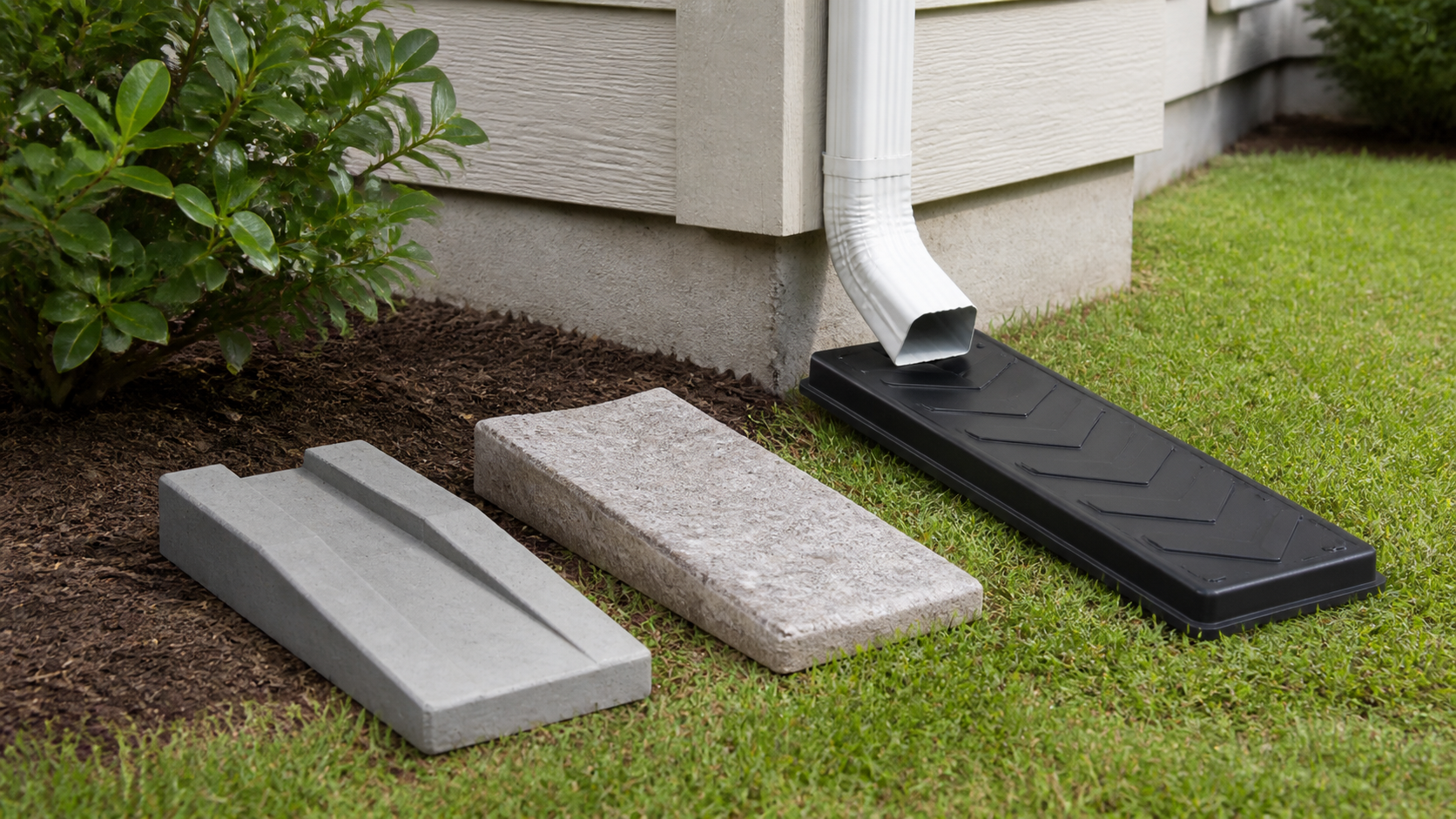
Molded Plastic Splash Blocks
Plastic is light, easy to reposition, and commonly shaped with raised sides or ribs. Low weight also makes it easier for wind, flowing water, pets, lawn equipment, or settling soil to move it.
Compare: exterior-use guidance, UV resistance, wall thickness, base width, channel depth, anchoring provisions, and whether the shape can be cleaned without trapping leaves.
Concrete Splash Blocks
Concrete resists casual movement and can suit a permanent-looking landscape edge. It is heavy to carry, may settle into soft soil, and can chip in handling or freeze-thaw exposure.
Compare: weight, dimensions, molded slope, finish, edge condition, freeze suitability, supporting base, and how it will be lifted for cleaning.
Composite and Stone-Look Blocks
Composite formats aim for a heavier feel or landscaped appearance without full concrete weight. Material descriptions vary, so do not infer durability from appearance alone.
Compare: stated material, temperature and UV guidance, impact resistance, weight, underside contact area, color fade, and cleaning directions.
Must-Have Selection Criteria
- Useful length: The outlet reaches a surface that continues away from the home rather than stopping in a low spot.
- Correct orientation: The high receiving end sits beneath the downspout and the lower end points away.
- Outlet coverage: The channel catches routine discharge without blocking or supporting the downspout.
- Stable base: The block rests evenly and will not rock, sink quickly, or reverse its intended slope.
- Weather-suitable material: Product instructions match the site's sun, temperature, and freeze exposure.
- Visible, cleanable route: Leaves, sediment, nests, and ice can be spotted and removed without unsafe access.
Setup and Maintenance
Prepare only the shallow surface area the product instructions call for; do not excavate beside the foundation or alter drainage structures without qualified guidance. Place the block with its receiving end under the downspout and its channel falling away from the wall. Keep the far end clear of paths, steps, driveways, basement openings, utility equipment, and places where discharged water could freeze.
Inspect after installation and periodically after rain, storms, mowing, and freeze-thaw cycles. Remove leaves and sediment, reset small shifts, and look for cracks, curling, buried ends, washed-out soil, disconnected downspouts, overflowing gutters, and standing water. Edging, mulch, and turf should not form a dam at the block's outlet.
Nice-to-Have Features
- Raised sides: Helpful for keeping ordinary discharge in the channel when alignment is correct.
- Textured underside: May reduce sliding on a compatible stable surface.
- Anchor points: Useful only with manufacturer-approved hardware and where staking will not hit buried utilities or irrigation.
- High-contrast edge: Easier to see around grass and landscaping.
- Liftable weight: Heavy enough to stay put but practical for the household to clean and reset safely.
Who Should Skip a Splash Block
- Skip it as the only response to basement water, wall cracks, soil movement, major erosion, recurring foundation-side pooling, or interior dampness.
- Skip it when the ground slopes toward the house or it would send water to a neighbor, public path, window well, or other problem area.
- Skip a loose surface block where fast flow repeatedly displaces it; the gutter and discharge plan need evaluation.
- Skip concrete if lifting and periodic cleaning would be unsafe for the household.
- Skip any setup that requires digging where utilities, irrigation, cables, or drainage components may be present.
Bottom Line
The best downspout splash block matches the outlet, spans the useful surface distance, points downhill away from the wall, stays stable through ordinary weather, and remains easy to inspect. Plastic is light and adaptable, concrete is steady but heavy, and composites vary by specification. If the site does not already provide a safe onward path—or water keeps pooling, eroding soil, or reaching the building—a different drainage plan needs qualified evaluation.