Best Drawer Organizers for Small Kitchen Utensils
The best drawer organizer for small kitchen utensils is the one that fits the drawer you actually have, keeps daily tools visible, and does not waste half the space with fixed compartments that are the wrong size. In a small kitchen, drawer depth, utensil mix, cleaning, and non-slip fit matter more than a pretty tray photo.
As an Amazon Associate, The Good Home Doc may earn from qualifying purchases.
Product-first guide
Shop the products in this guide
Use these affiliate product routes as shopping starting points, then check the measurements, compartment layout, cleanup needs, and skip criteria below before choosing.
This is a best-fit buying framework, not a ranked product review. Use it to compare expandable utensil trays, modular bins, bamboo organizers, plastic inserts, low-profile dividers, and drawer liner pairings. If the whole kitchen needs a storage reset, start with the small-home organization systems guide first. If drawer items slide because the drawer bottom is slick, pair this guide with the kitchen shelf and drawer liner guide.
Quick Picks by Situation
- Best for most small utensil drawers: a low-profile expandable tray with non-slip feet and compartments that match flatware, serving tools, and everyday prep tools.
- Best for shallow drawers: a thin plastic or bamboo tray under 2 inches tall, with no raised handles or tall dividers that catch when the drawer closes.
- Best for odd utensil mixes: modular bins or adjustable dividers that can separate measuring spoons, peelers, clips, straws, and short prep tools.
- Best for renters: removable bins, tension dividers, or non-adhesive trays that do not require screws, glue, or permanent drawer changes.
- Best for easy cleaning: smooth plastic bins or trays with rounded corners that lift out quickly when crumbs collect.
What a Drawer Organizer Should Solve
A good utensil organizer reduces digging. It should make the spoon, peeler, measuring cup, or can opener easier to grab without turning the drawer into a puzzle. The problem is that many small kitchens have narrow, shallow, or older drawers that do not match standard organizer photos.
Before buying, empty the drawer and group the tools into daily, weekly, and rarely used items. The organizer should earn space for daily tools first. If every slot is filled with gadgets you barely use, the drawer will still feel crowded after you organize it.
Comparison Framework
Expandable Utensil Trays
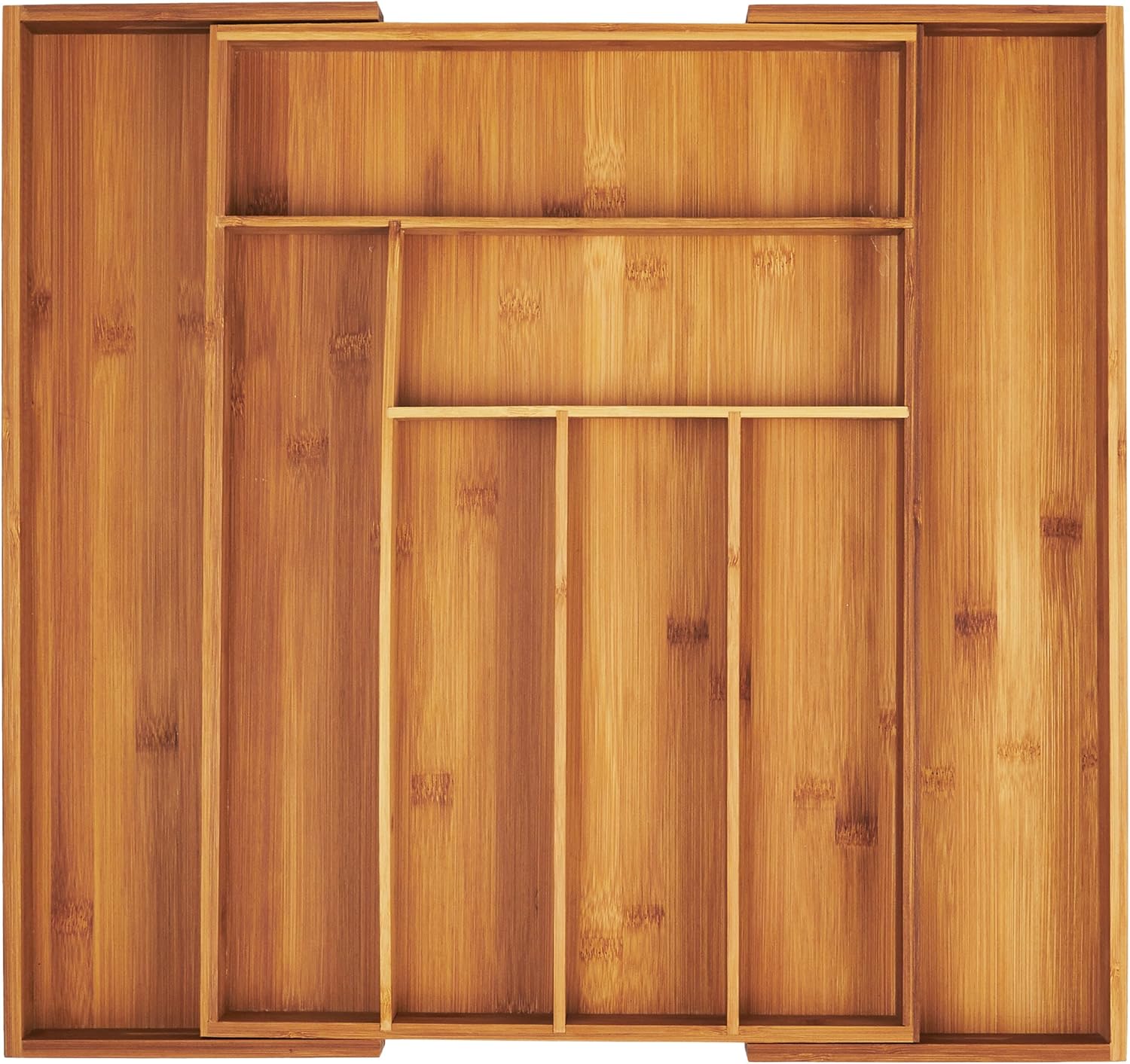
Expandable trays are the safest starting point when a drawer is wider than a basic flatware tray but not wide enough for several separate bins. They usually have a fixed center and side wings that slide open.
Choose this type if: you need one tidy tray for flatware plus a few prep tools and your drawer has enough width for the expandable sides.
Watch out for: side wings that create skinny, awkward compartments, rails that collect crumbs, and trays that expand so far they block drawer movement.
Modular Drawer Bins
Modular bins are small rectangles, squares, or long trays that can be rearranged. They work well for renters, older drawers, and utensil mixes that do not fit a fixed flatware layout.
Choose this type if: you have measuring spoons, bag clips, peelers, thermometers, bottle openers, or kid utensils that need separate zones.
Watch out for: loose bins that slide unless paired with a liner, too many tiny bins, and layouts that leave unusable gaps.
Bamboo or Wood Organizers
Bamboo organizers can look better than plastic and often feel sturdy, but they need a dry drawer and occasional wiping. They are less forgiving if the drawer catches moisture, crumbs, or sticky residue.
Choose this type if: the drawer is dry, the dimensions are a close match, and you want a heavier tray that feels stable.
Watch out for: swelling, rough edges, seams that trap crumbs, and compartments that cannot be adjusted later.
Plastic Inserts and Trays
Plastic trays are practical for busy kitchens because they are light, affordable, and easy to rinse. They are especially useful when kids, shared housing, or frequent cooking makes the drawer messy.
Choose this type if: easy cleanup matters more than appearance and you want an organizer that can be lifted out often.
Watch out for: flimsy trays, sharp interior corners, slick bottoms, and molded compartments that are too short for your utensils.
Adjustable Dividers
Adjustable dividers create custom lanes inside the drawer instead of adding bins. They are helpful for long tools, but they depend on drawer walls that can hold tension or mounting pressure.
Choose this type if: you have spatulas, tongs, whisks, and longer tools that do not belong in a flatware tray.
Watch out for: weak tension, drawer walls that are too thin, lost small items, and dividers that shift when the drawer is opened quickly.
Must-Have Features
- Correct drawer measurements: Measure inside width, depth, and usable height. Include any drawer stop, rounded corner, or face-frame lip that reduces usable space.
- Low enough profile: The organizer should clear the drawer above it and the tallest utensil inside it.
- Compartments that match your tools: Long slots for spatulas, narrow slots for flatware, and small bins for clips or measuring spoons are different jobs.
- Easy lift-out cleaning: Kitchen drawers collect crumbs. A good organizer should come out without unloading the whole drawer.
- Non-slip behavior: Rubber feet, a grippy base, or a removable drawer liner helps prevent the organizer from shifting.
- No permanent installation: For renters and uncertain layouts, avoid glue, screws, or adhesive dividers unless you accept the removal risk.
Nice-to-Have Features
- Expandable sides: Useful when the drawer width is slightly unusual, as long as the expanded space is still usable.
- Rounded corners: Easier to wipe than deep square corners where crumbs collect.
- Labels or visual zones: Helpful in family kitchens where people put items away quickly.
- Stackable small bins: Useful only for very shallow tools; avoid stacking if it makes daily utensils harder to reach.
- Matched drawer liner: A removable non-adhesive liner can help modular bins stay put and quiet rattly tools.
Measure Before You Buy
Measure the inside drawer box, not the drawer front. Write down width, front-to-back depth, and the usable height from the drawer bottom to the lowest obstruction above it. Then measure your longest tool and tallest handle. A tray can technically fit the drawer and still fail if the ladle, whisk, or pizza cutter keeps the drawer from closing.
If the drawer is shallow, favor low dividers and fewer layers. If the drawer is narrow, avoid wide flatware trays that leave a thin strip of wasted space on one side. If the drawer is deep front-to-back, think about which items belong in the back. Daily tools should not be hidden behind rarely used gadgets.
Match the Organizer to the Utensil Mix
Flatware plus a few tools: choose an expandable tray with clear flatware lanes and one or two wider compartments.
Cooking tools: use adjustable dividers or long modular bins for spatulas, tongs, whisks, and serving spoons.
Small prep items: use small bins for measuring spoons, peelers, corn holders, clips, and bottle openers so they do not disappear under larger tools.
Kid or shared kitchens: choose washable plastic and simple zones. If the layout is too fussy, it will not stay organized.
Very crowded drawers: remove duplicates first. No organizer can make six spatulas, three can openers, and unused specialty tools feel spacious.
Who Should Skip a Drawer Organizer
Skip a new organizer if the real issue is too many utensils. Decluttering duplicates, moving rarely used tools to a bin, or hanging long tools may solve more than buying another insert. Also skip fixed trays if your drawer dimensions are odd or your utensil mix changes often.
If a drawer is damp, sticky, swollen, or hard to open, fix the drawer condition before covering it with bins. An organizer should make a clean drawer work better, not hide crumbs, moisture, or damage.
Best Setup for a Small Kitchen Drawer
- Keep daily tools in the front half. Put forks, spoons, knives, peelers, and measuring spoons where hands naturally reach.
- Use one main tray plus a few small bins. Too many separate pieces can make the drawer harder to reset.
- Put long tools together. Tongs, spatulas, whisks, and serving spoons need long lanes, not short flatware compartments.
- Add a removable liner if bins slide. Use non-adhesive liner first, especially in rentals.
- Recheck after one week. If items keep landing outside the organizer, the layout does not match the routine.
Bottom Line
For most small kitchen utensil drawers, start with a low-profile expandable tray or a simple modular bin layout that matches your actual tools. Measure first, keep the daily items easiest to reach, choose washable materials, and skip permanent inserts unless you are sure the drawer layout will not need to change.