Best Extendable Dusters for High Ceilings and Fans
Dust on a ceiling fan, tall ledge, or upper corner is easy to ignore because the wrong tool makes the job awkward. The best extendable duster gives you enough reach from the floor, a head shaped for the surface, and a pole you can still control when fully extended.
As an Amazon Associate, The Good Home Doc may earn from qualifying purchases.
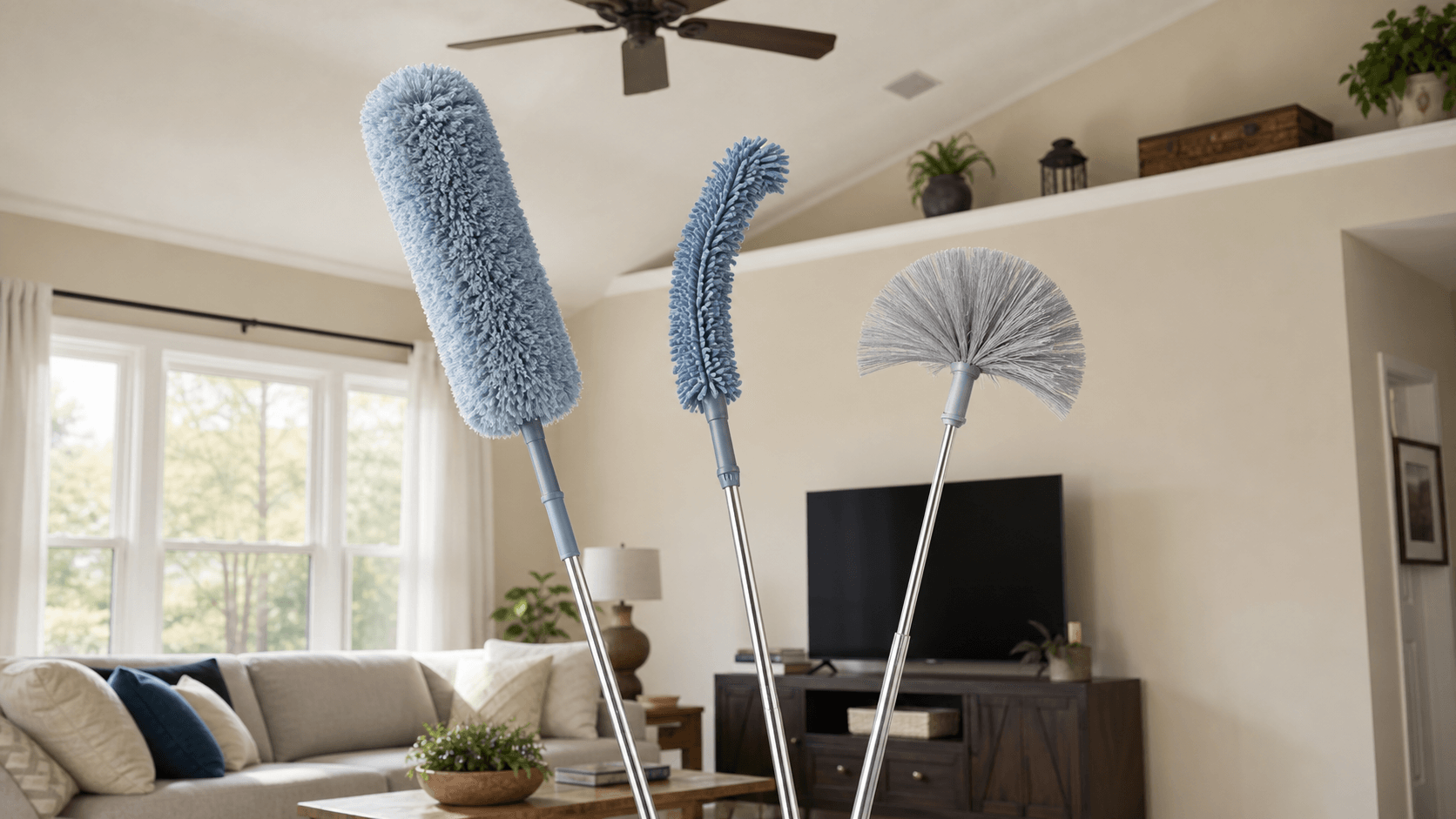
Product-category guide
Compare extendable duster types
Start with the highest surface you can reach while standing securely on the floor, then match the head to fan blades, flat ledges, corners, or vents.
This is a best-fit category comparison, not a tested ranking of brands. Reach figures, pole locks, replacement heads, and care directions vary by model. Confirm the current manufacturer specifications before buying, and use an extendable duster only where you can remain balanced on a clear, dry floor.
Quick Picks by Job
- Best all-around type: a washable microfiber head on a locking telescoping pole for ledges, corners, and broad hard surfaces.
- Best for ceiling fans: a split, forked, or sleeve-style head that contacts both sides of a stationary blade without heavy pressure.
- Best for crown molding and narrow ledges: a slim bendable microfiber head that can hold a shallow angle.
- Best for cobwebs in corners: a round, soft-bristle head that reaches wall-to-ceiling joints without scraping paint.
- Best for several head types: an interchangeable system with a secure standard connector and a storage plan for loose attachments.
Measure Reach From the Floor
Do not buy by ceiling height alone. Measure from your comfortable hand position to the target surface while both feet remain flat on the floor. Add the pole's usable extension and head length, but leave room to hold the lower grip with two hands. A pole advertised with a generous total reach may include the user's height or may become too flexible to control at maximum extension.
Also measure the collapsed length and the storage spot. A pole that fits the ceiling but not the closet often ends up leaning behind a door, where it can fall or bend. If the target still cannot be reached from the floor, an extendable duster is not a substitute for suitable access equipment or professional help.
Comparison Framework
Fluffy Microfiber Heads
Dense microfiber heads collect loose dust from broad ledges, wall tops, vents, and smooth fan housings. Washable covers reduce disposable refill use.
Choose this type when: you want one general-purpose head for light, routine dust on compatible hard surfaces.
Watch for: oversized heads that snag around trim, covers that slide off, and care instructions that require hand washing or air drying. Microfiber can catch on rough wood, textured ceilings, or damaged paint.
Bendable Flat Heads
A slim head with a flexible internal spine can be shaped for the top of a fan blade, cabinet, or ledge. It reaches into narrower gaps than a round plume.
Choose this type when: surface angle and narrow clearance matter more than maximum dust capacity.
Watch for: a spine that slowly loses its shape, exposed wire at the tip, or a head that rotates when it should stay fixed. Bend only as the maker directs.
Ceiling-Fan Sleeve or Forked Heads
These surround part of a stationary fan blade so dust is less likely to scatter. Check the opening, head depth, and blade clearance rather than assuming every fan shape fits.
Choose this type when: fan blades are the main job and the head can slide on without forcing or flexing them.
Watch for: thick or sculpted blades, nearby lights, loose blade hardware, and fabric that bunches at the leading edge. Turn the fan off and wait for it to stop completely before starting.
Round Cobweb Heads
Soft radial bristles reach into high corners, stairwell edges, and around simple trim. They are good for web removal but less precise on flat blade tops.
Choose this type when: corners and irregular outlines are the recurring problem.
Watch for: stiff bristles on delicate paint, rough textures that trap fibers, and wide heads that bump fixtures or framed items.
Must-Have Features
- A positive pole lock: Twist locks or flip locks should hold without collapsing or slowly rotating under light cleaning pressure.
- Control at useful extension: A slightly shorter, stiffer pole is often more practical than a very long pole that bows and wobbles.
- A secure head connection: Threaded or locking attachments should not loosen overhead.
- A washable or replaceable head: Confirm how it detaches, how it is cleaned, and whether replacements are actually offered.
- A comfortable lower grip: Two-handed control is easier when the pole has a non-slip section and no sharp lock edges.
Nice-to-Have Features
- Interchangeable heads: Useful when the same pole serves fan blades, corners, and ledges without storing several handles.
- A hanging hole: Keeps the pole off the floor if the storage hook can safely hold it.
- A removable washable sleeve: Easier to clean than taking a bulky head to the sink.
- A compact collapsed length: Helpful for apartments and small utility closets, provided extra joints do not add wobble.
How to Dust a Ceiling Fan Without Spreading the Mess
- Turn the fan off at its normal control and wait until the blades stop completely.
- Clear people, pets, furniture, and loose objects from your working path; protect the floor or furniture below if needed.
- Inspect from below. Do not use the duster if the fan looks loose, damaged, wet, or otherwise in need of service.
- Extend and lock the pole before lifting it. Keep both feet on the floor and use light, controlled strokes from the blade's attachment area toward its outer end.
- Lower the tool before turning or adjusting the head. Clean the fallen dust and wash or empty the head according to its directions.
Do not dust a moving fan, reach near exposed wiring, spray cleaner overhead, or use a metal pole near live electrical parts. Cleaning a sound exterior surface is different from servicing a fan or fixture; leave repair, disassembly, and electrical concerns to a qualified professional.
Surface and Room Cautions
Textured ceilings: use minimal contact. A duster can snag loose texture or damaged material; stop if the surface flakes or crumbles.
High shelves and displays: remove fragile objects from below and avoid pushing behind items you cannot see. Dusting is not worth knocking down a vase or framed object.
Vents and fixtures: clean only exterior surfaces allowed by the manufacturer. Do not insert a duster into vents, recessed housings, or equipment openings.
Stairwells and landings: long poles can shift your balance. If you cannot stand on a level, unobstructed surface, stop and choose a safer approach.
Cleaning and Storage
Take the head outdoors or over a trash container before shaking loose dust. Wash removable microfiber only as directed; fabric softener and high heat can affect some fibers. Let every washable part dry fully before reassembly so moisture is not trapped around a connector.
Collapse the pole, release unnecessary tension from bendable heads, and store attachments where their fibers will not be crushed. Before the next use, check locks, threads, and the head connection. Replace damaged poles, exposed wires, split grips, or attachments that no longer stay secure.
Who Should Skip an Extendable Duster
Skip a long manual pole if overhead work strains your shoulders, neck, hands, balance, or breathing, or if you cannot keep clear sight of the head. A vacuum extension approved for the surface may be easier for some reachable jobs, while a cleaning professional may be the better answer for very high, awkward, or stairwell locations.
Also skip routine dusting when the surface, fan, fixture, or ceiling appears loose, damaged, wet, moldy, electrically unsafe, or contaminated by an unknown material. A duster removes ordinary loose dust; it does not diagnose or repair the cause of staining, debris, or damage.
Bottom Line
For most homes, start with a washable microfiber head, a positive-lock telescoping pole, and enough practical reach to work with both feet on the floor. Choose a fan-specific sleeve when blades are the main problem, a bendable flat head for ledges, or a round brush for corners. Maximum advertised length matters less than control, a secure head, easy washing, and knowing when the target is beyond a duster's safe limits.