Best Stackable Shoe Boxes for Dust-Free Closet Storage
Occasional-use shoes are easy to lose at the back of a closet and quick to coat in dust. The best stackable shoe boxes keep pairs visible and individually reachable without turning the shelf into an unstable plastic wall.
As an Amazon Associate, The Good Home Doc may earn from qualifying purchases.
Product-category guide
Compare rigid front-opening shoe boxes
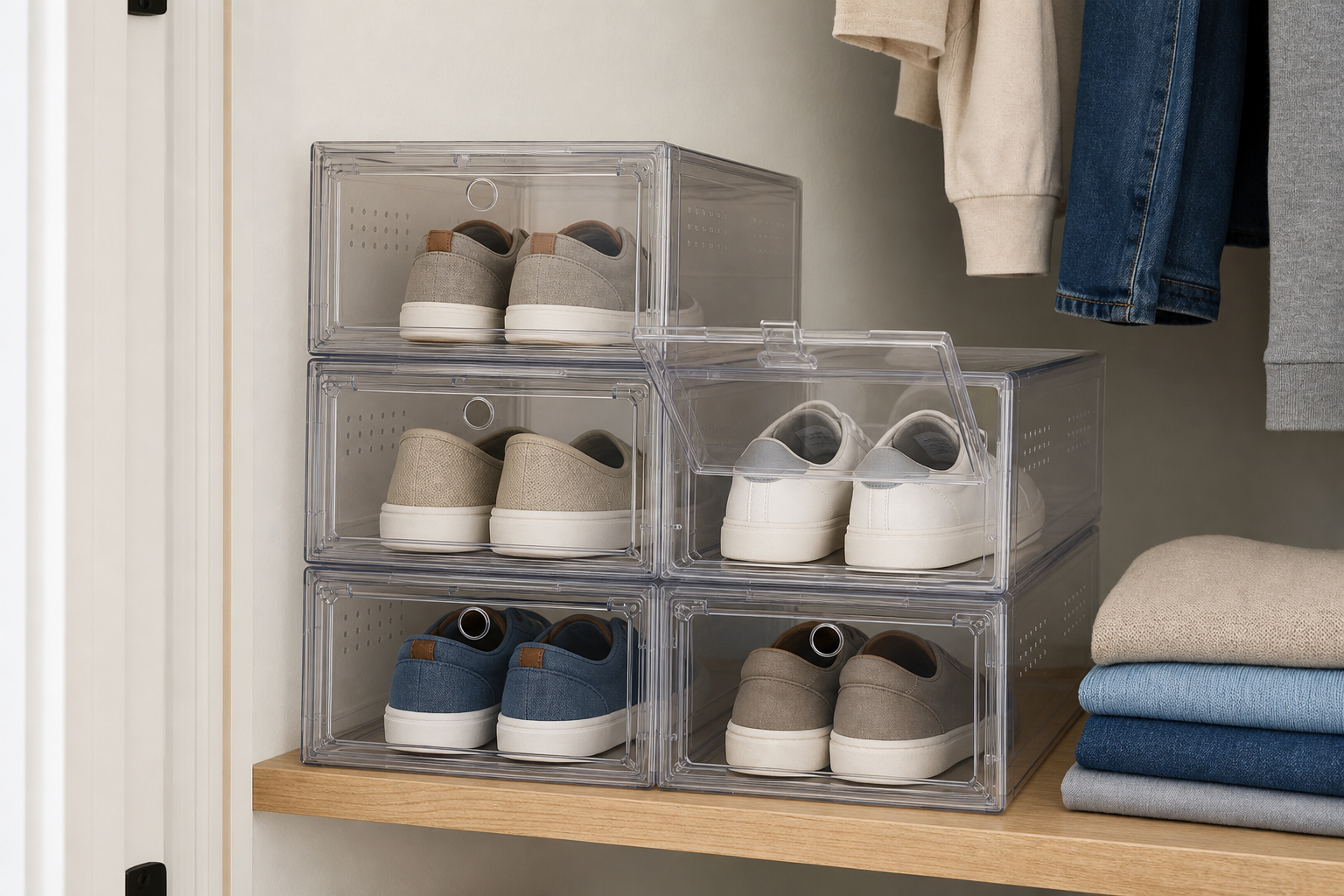
Front-opening boxes usually make the lower pairs easier to reach. Confirm internal dimensions, door clearance, ventilation, stack connection, and assembly before buying.
This is a selection framework, not a tested product ranking. It covers rigid boxes for low-frequency closet storage, not daily-use racks or entryway cabinets. For shoes by the front door, start with the entryway shoe-storage guide.
Quick Picks by Closet Problem
- Best for reaching lower pairs: rigid front-opening boxes with doors that clear the shelf edge.
- Best for seeing every pair: clear-sided boxes with minimal cloudy framing and a visible front panel.
- Best for a short shelf: lift-off rigid boxes in a single layer, where unstacking is not required.
- Best for larger shoes: an oversized box chosen by usable internal length and height, not outside dimensions.
- Best for easy cleaning: smooth plastic panels with few deep seams and doors that can remain open while drying.
Measure the Shoes and the Closet
Measure the longest pair from heel to toe, the widest point across the soles, and the height at the tallest part. Add finger room so shoes do not need to be forced through the opening. Product listings often lead with exterior measurements; the internal dimensions and door opening decide whether a pair fits.
Then measure usable shelf width, depth, and height. Include the closet door, sliding track, trim, hanging clothes, and room for a front flap to open. For a planned stack, add the assembled height of every box and leave clearance at the top. Do not assume ten boxes will stay stable simply because a listing shows a tall tower.
Comparison Framework
Rigid Front-Opening Boxes
These are the most practical fit for a multi-level stack because one pair can be removed without lifting the boxes above it. A positive latch helps the door stay closed, while clear sides make labels less necessary.
Check: whether the front opening is as large as the interior, whether the door remains attached when open, and whether boxes connect top to bottom rather than merely resting together.
Lift-Off Lidded Boxes
A simple lidded box can reduce dust and may feel sturdier than a folding design. It works best for one layer or pairs used only a few times a year.
Check: how much of the stack must be moved to reach a lower pair. If the answer is “all of it,” use that position only for genuine long-term storage.
Collapsible Plastic Boxes
Flat-pack boxes are easier to ship and store before assembly. Their real quality depends on the panel joints, door frame, and how firmly each corner locks.
Check: assembly steps, panel flex, replacement-part availability, and whether the maker gives a stack or load limit.
Must-Have Features
- Usable internal dimensions: Include room for the shoe and your hand, not just the outside shell.
- Stable stack connection: Interlocking rims, clips, or feet should resist ordinary sliding when a door opens.
- Independent access: The lower pair should be reachable without dismantling a frequently used stack.
- Some ventilation: Small vents help stored shoes release ordinary residual moisture; they do not make damp shoes safe to pack away.
- Cleanable panels: Smooth surfaces are easier to wipe and dry than fabric windows or deep textures.
- A realistic height limit: Follow the manufacturer's assembly, stacking, and load guidance.
Nice-to-Have Features
Magnetic or positive-latch doors can make repeated access tidier, but a complicated latch is not useful if it breaks or pinches. Label pockets help with opaque boxes. Carry handles are convenient for one box but do not prove that a loaded stack can be moved as a unit.
Dust Control, Ventilation, and Care
Closed boxes reduce settling dust; they are not airtight protection. Brush off dry dirt and let footwear dry fully before storage. Trapping damp shoes can hold odor and moisture near the materials. If a closet has recurring condensation, a musty smell, staining, or visible growth, do not seal the symptom behind more boxes—address the moisture source.
Wipe the empty box according to its care instructions and let every panel dry before returning the shoes. Leave enough space around the stack to inspect the shelf and clean nearby surfaces.
Who Should Skip Stackable Shoe Boxes
Skip this format for shoes worn every day; an open rack, tray, or ventilated cabinet near the normal take-off point is usually less work. Also skip a tall stack where children may climb, the shelf bows, boxes block a closet track, or the assembly cannot remain square and secure.
Tall boots, high-top footwear, very large sizes, or delicate materials may need purpose-sized containers. If you cannot confirm internal fit, buy one box first or choose an easier-to-return option instead of committing to a large set.
A Practical Closet Setup
- Keep daily shoes outside this system and group occasional pairs by use.
- Measure the largest pair in each size group and the usable closet space.
- Mock up the planned stack with tape or cardboard, including door-opening room.
- Place heavier pairs in the lowest boxes and lighter pairs above.
- Stop below the manufacturer's stack limit and below any height that feels unstable.
- Leave some empty capacity so a new pair does not turn the system into clutter.
Bottom Line
For most low-frequency closet storage, a rigid clear front-opening box is the most useful starting point because it balances dust reduction, visibility, and access. Internal measurements and a secure stack matter more than a large advertised capacity. Keep the tower modest, store only dry shoes, and use the entryway for pairs that need daily airflow and access.