Best Tiered Can Organizers for Shallow Pantries
A can organizer should make labels visible without stealing the shelf depth you are trying to save. The best type depends on the pantry opening, the cans you actually keep, how you rotate food, and whether the organizer stays stable as the shelf empties.
As an Amazon Associate, The Good Home Doc may earn from qualifying purchases.
Product-category guide
Choose the organizer around shelf depth and rotation habits
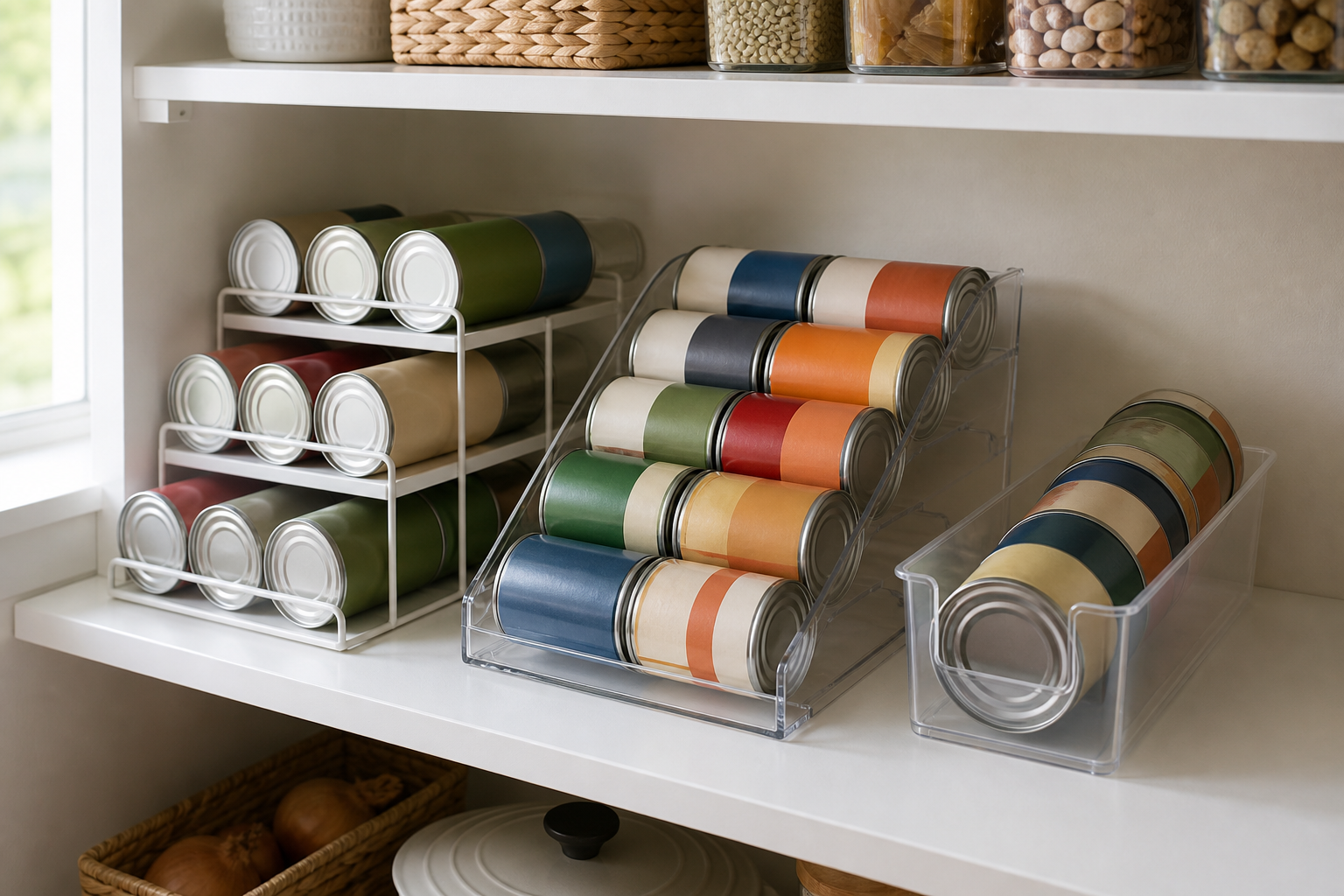
Stepped risers maximize label visibility, gravity-feed racks support first-in-first-out rotation, and open bins keep one can type together with the least complicated setup.
This is a category comparison, not a tested ranking of current models. Confirm the current dimensions, compatible can sizes, materials, assembly, care instructions, and return terms before buying.
Quick Picks by Pantry Problem
- Best for seeing many labels: a stepped riser that fits fully behind the shelf lip and below the shelf above.
- Best for rotating duplicates: a gravity-feed rack with lanes sized for the cans you regularly buy.
- Best for several can diameters: an adjustable or open tiered shelf without fixed dispensing lanes.
- Best for simple cleanup: a low open bin that lifts out with room to grasp it safely.
- Best for a changing pantry: separate freestanding risers that can move as categories change.
Measure Before You Compare
- Measure usable shelf width and depth, excluding the door frame, hinges, shelf lip, and anything stored in front.
- Measure clear height to the shelf above. Add the organizer height to the tallest can on its highest tier.
- Measure the diameter and height of the largest, smallest, and most frequently purchased cans.
- Leave finger room to remove cans without dragging the rack forward.
- Check the closed door path and confirm cans cannot roll toward the shelf edge.
A product labeled compact can still be too deep for an older pantry or too tall once a can sits on the back tier. Make a cardboard footprint and stack an empty can to the proposed height before ordering.
Selection Criteria That Matter
- Usable footprint: Compare the full assembled dimensions, including feet, handles, rails, and rear stops—not only the space that holds cans.
- Can compatibility: Fixed lanes may fit standard soup cans but not wider tomatoes, short tuna cans, or tall specialty cans. Use current stated dimensions rather than category labels.
- Label visibility: A riser should lift the back rows enough to identify them without hiding cans under the shelf above.
- Loading order: Gravity-feed designs work best when each lane holds one consistent size and the household actually reloads from the back.
- Stability: The organizer should sit flat, keep cans contained, and remain steady when a can is removed from one side.
- Cleaning access: Pantry spills and dust collect around feet and rails. Prefer a design you can unload and lift without taking apart the shelf.
- Assembly and adjustment: Adjustable rails are useful only if they lock securely and remain aligned through normal loading.
Comparison Framework
Stepped Shelf Risers
Stepped risers place rows at different heights, so they are the clearest option when the main problem is forgotten cans. They accept more size variation than fixed lanes, but the back tier needs extra vertical clearance.
Choose one if: you keep several can types and want to scan labels at a glance.
Watch for: deep steps that waste the front edge, narrow platforms, missing rear stops, and a top row that collides with the shelf above.
Gravity-Feed Can Racks
Sloped lanes bring the next can forward after one is removed. They can make rotation easier for households that stock duplicates, but fixed lane widths reduce flexibility.
Choose one if: you repeatedly buy the same can sizes and will load newer cans behind older ones.
Watch for: cans that bridge across rails, uncontrolled rolling, difficult rear loading, and a rack that extends past a shallow shelf.
Stackable or Modular Racks
Modular racks can add capacity without using the full pantry width. They need verified connectors and enough headroom to load each level without awkward reaching.
Choose one if: shelf height is generous and the pantry layout may change.
Watch for: flexing joints, top-heavy layouts, unclear stacking limits, and sections that must be dismantled for cleaning.
Open Pantry Bins
A low bin is not truly tiered, but it can be the more practical answer for one can type or a shelf with very limited height. It contains cans and lifts out for inventory checks.
Choose one if: simplicity, mixed sizes, and easy shelf cleaning matter more than seeing every label.
Watch for: handles that consume depth, bins too heavy to lift when full, and tall sides that hide labels.
Must-Haves vs Nice-to-Haves
Must-Haves
- Full fit within the shelf opening and closed-door path.
- Compatibility with the actual cans you keep.
- A flat, stable base and effective front or rear stops where needed.
- Enough hand access for loading and removal.
- A design that can be unloaded and cleaned safely.
Nice-to-Haves
- Adjustable step width or lane spacing.
- Nonslip feet suitable for the shelf surface.
- Tool-free assembly with securely locking parts.
- Open sides that make low stock easy to notice.
Setup, Rotation, and Cleaning
Assemble the organizer according to its current instructions, place it on a clean dry shelf, and load it evenly. Do not stack cans above the rack's rails or in a way that lets them roll or fall from the shelf. Put heavier and larger cans where the design supports them, and avoid forcing a can into a lane that is too narrow.
Use a simple rotation habit: check dates when unloading groceries, move older food forward, and place newer cans behind it only when the rack permits safe rear loading. Periodically empty the organizer, wipe it according to its care directions, clean the shelf, and inspect rails, connectors, feet, and stops.
Who Should Skip a Tiered Can Organizer
Skip this category if the shelf is so low that the back tier cannot be reached, if your pantry stock changes sizes constantly, or if the rack would make a full shelf too heavy or awkward to unload. A labeled single-row bin or fewer cans stored at eye level may work better.
Also skip a gravity-feed rack if you do not buy duplicates or cannot load newer cans from the rear. If shelving bows, shifts, or has unknown support, unload it and address the shelf condition before adding dense canned goods or another storage layer.
Bottom Line
For mixed cans on a shallow shelf, a stable stepped riser is usually the most flexible starting point because it improves visibility without requiring fixed lanes. Choose a gravity-feed rack only when can sizes and rotation habits are consistent. In every case, measure the assembled footprint and loaded height, keep cans contained, and favor a layout you can empty and clean without a struggle.