Is an Under-Sink Drip Tray Worth It?
An under-sink drip tray is usually worth it when you want inexpensive protection from bottle spills, damp sponges, and very small drips that you will notice and address quickly. It is not a repair, and it is the wrong purchase when water is already active, recurring, or reaching the cabinet, wall, or floor.
As an Amazon Associate, The Good Home Doc may earn from qualifying purchases.
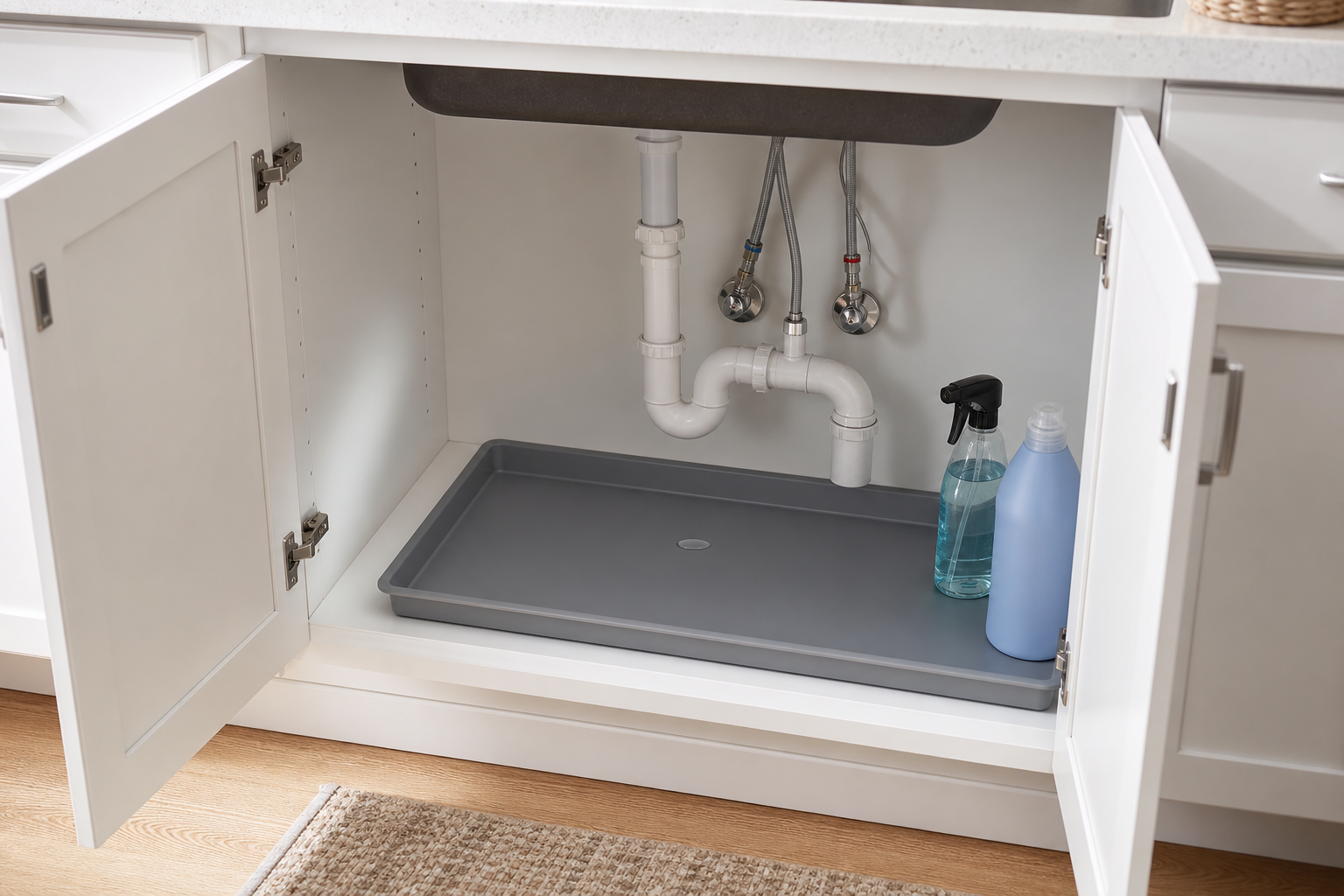
Compare the category after measuring: Browse category: Shop under-sink drip trays on Amazon.
This is a shopping starting point, not a tested ranking. Confirm the tray's outside dimensions, pipe clearance, lip height, material, return policy, and cleaning instructions before buying.
This page answers whether a tray is worth buying at all. For the broader prevention plan, start with the home leaks and moisture prevention guide. If you already know you need a tray, use the under-sink drip tray fitting guide for measurement and material details.
Quick Decision: Buy, Skip, Delay, or Escalate
- Buy: the cabinet is currently dry, ordinary spills are your main concern, a stock tray fits around the plumbing, and you will inspect and clean it.
- Skip: you open the cabinet daily, keep liquids in a removable bin already, or no tray fits without blocking valves, filters, disposal access, or pull-out storage.
- Delay: the cabinet needs decluttering or careful measurements first. A badly fitted tray can make storage and inspection harder.
- Choose an alternative: use a washable bin for leaking bottles, a cabinet liner for splash and scuff protection, or a leak alarm when early warning matters more than containment.
- Escalate: visible dripping, swollen panels, staining, soft material, musty odor, recurring dampness, or water spreading beyond the tray calls for a repair request or qualified evaluation—not more containment.
When a Drip Tray Earns Its Space
A tray is useful because it creates a removable, washable boundary between small amounts of water and the cabinet floor. That is especially practical in a crowded cabinet where cleaner bottles tip, spray heads seep, wet sponges get stored, or a water filter is changed periodically.
The strongest case is prevention in a dry cabinet. The tray can make a small mess easier to see and lift out before it reaches unfinished seams or stored paper goods. Its value increases when the cabinet base is awkward to wipe, the household stores several liquids there, or a minor spill would otherwise disappear behind bins.
It can also pair sensibly with an alarm. The tray offers limited containment; the alarm supplies an audible warning. Read under-sink drip tray vs leak alarm before assuming one product replaces the other.
What a Tray Cannot Do
A drip tray does not stop a supply-line leak, repair a drain connection, diagnose the source of moisture, or guarantee protection from a large or fast leak. A shallow tray can overflow. Water can also run down a cabinet wall, pipe, or hose and miss the tray entirely.
Do not use the tray as permission to ignore water. If moisture returns after cleanup, treat recurrence as information that the source still needs attention. Renters should document the condition and contact the landlord or property manager. Homeowners should call a plumber or other qualified professional when the source is unclear, inaccessible, or beyond a simple product spill.
Cost, Setup, and Maintenance Tradeoffs
The purchase price is only one part of the decision. A stock molded tray is usually the simplest option when it fits, but unusual plumbing layouts may require a segmented tray or a different containment approach. Custom cutting can reduce the raised edge that makes a tray useful, and a cutout may leave a path for water to reach the cabinet.
- Setup: empty the cabinet and measure usable width, depth, door-opening clearance, pipe locations, disposal clearance, and access to shutoff valves.
- Storage: the lip may interfere with sliding bins or make tall bottles harder to remove. Do not pack items so tightly that you cannot see the tray.
- Cleaning: choose a tray you can lift out without disconnecting plumbing. Wipe spills promptly and let the tray and cabinet dry before restocking.
- Inspection: check below and around the tray periodically. Containment is less helpful if it hides stains or damp seams.
- Replacement: warped, cracked, brittle, or permanently stained trays become harder to inspect and may no longer contain small spills reliably.
Fit Criteria That Matter Before Buying
Measure the actual cabinet floor, not the outside cabinet width. Hinges, face frames, center stiles, pipes, garbage disposals, filters, and shelf supports can reduce usable space. Also check whether a wide rigid tray can pass through the door opening even if it would fit once inside.
A modest raised edge helps contain small spills, but a taller lip is not automatically better. It can block pull-outs and make valves harder to reach. Favor a waterproof, nonabsorbent material with smooth corners that are easy to wipe. If you need to bend, force, or permanently alter the tray around plumbing, reconsider the size or product format.
Red Flags: Stop Shopping and Address the Source
- Water appears while the faucet, dishwasher, disposal, filter, or drain is in use.
- The cabinet base is swollen, soft, peeling, stained, or damp at a seam.
- A musty odor or moisture returns after the area has been dried.
- Water is near an electrical outlet, wiring, appliance connection, wall cavity, floor edge, or the unit below.
- You cannot identify whether the moisture is a product spill, condensation, supply leak, or drain leak.
Avoid touching wet electrical components. If water is near electricity, a major leak is active, or the safe shutoff procedure is uncertain, keep clear and contact the property manager, utility, emergency maintenance, or an appropriately qualified professional as the situation requires.
Who Should Skip a Drip Tray
Skip it if the cabinet already has an active or recurring water problem, because containment can delay the repair decision. Also skip it when the only available tray blocks necessary access, cannot be removed for cleaning, or encourages you to cram more products into an already crowded space.
A tray may be redundant if every liquid already sits in a removable waterproof bin and the cabinet gets inspected frequently. If your real concern is a hidden leak while you are away or asleep, an under-sink leak alarm may be the more useful first purchase.
Bottom Line
An under-sink drip tray is worth it as low-effort containment in a dry cabinet when it fits cleanly, remains visible, and can be removed for cleaning. Buy one for small everyday spills and early evidence of a minor drip. Skip or delay it when fit is poor or your current bins already do the job. Most importantly, escalate active, recurring, spreading, or unexplained moisture instead of asking a tray to solve a repair problem.