Best Cordless Reading Lamps for Rooms Without Outlets
A cordless reading lamp can put focused light beside a chair, bed, or temporary work spot without running a cable across the room. The useful choice is not the lamp with the boldest runtime claim; it is the format you can aim, recharge, control, and place securely every day.
As an Amazon Associate, The Good Home Doc may earn from qualifying purchases.
Product-category guide
Choose the format around the reading spot and charging routine
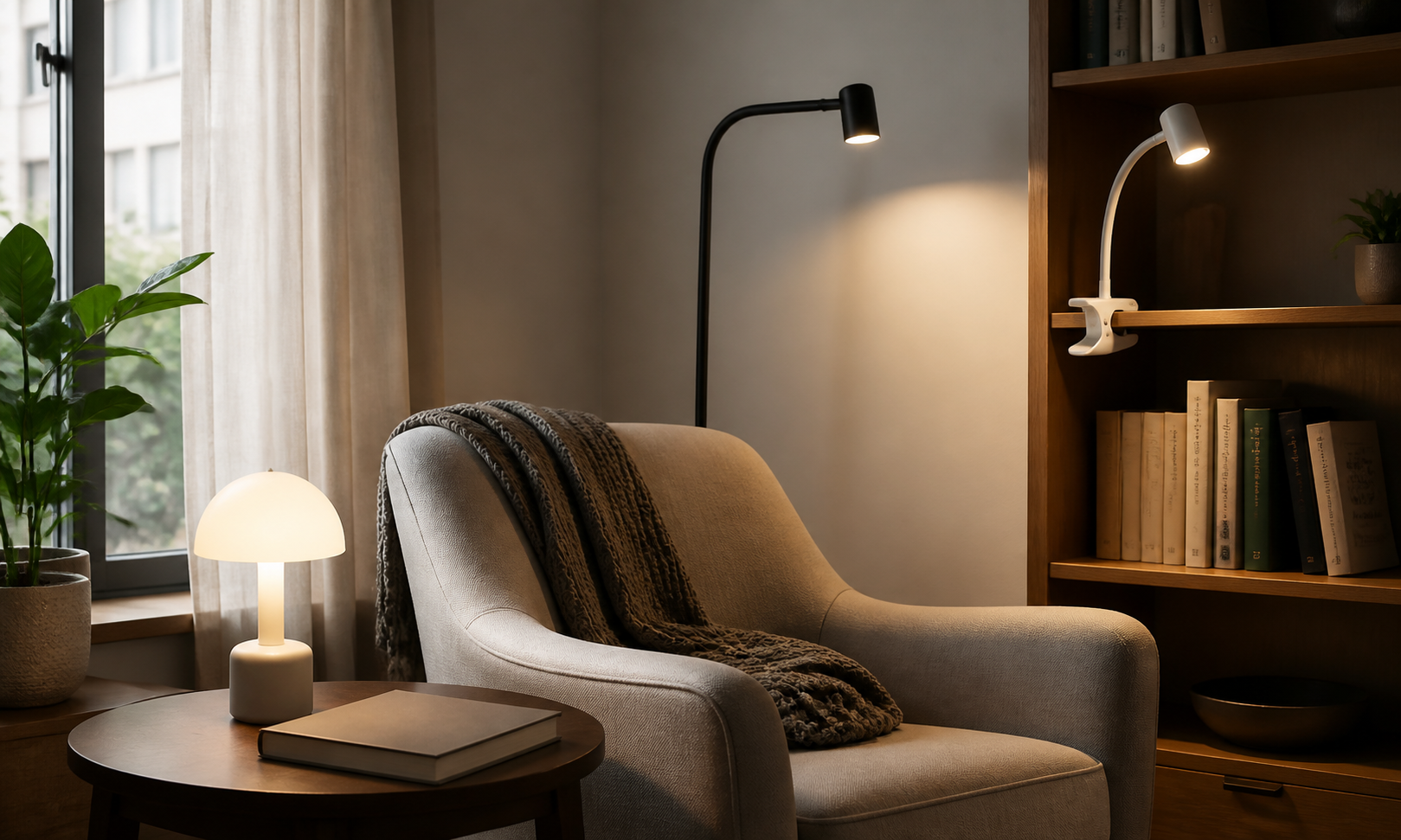
Compare where the lamp will stand or clamp, how its beam reaches the page, and where it will recharge before deciding between tabletop, clip-on, and floor-standing designs.
This is a category comparison, not a hands-on ranking. Runtime, charge time, battery construction, brightness, and charging accessories vary by model and setting. Verify those details in the current manufacturer documentation before buying.
Quick Picks by Reading Setup
- Best for a side table: a stable rechargeable tabletop lamp with a shielded head, reachable controls, and enough adjustment to keep glare below eye level.
- Best when floor and table space are tight: a clip-on lamp only when a strong, compatible shelf or headboard edge is available.
- Best beside a freestanding chair: a cordless floor lamp with a broad, weighted base and an arm that positions the light above the reader's shoulder.
- Best for moving between rooms: a light tabletop lamp with an easy grip and a charging station you will actually use.
- Best to skip: any lamp that wobbles, exposes a harsh LED at seated eye level, or depends on charging in an inconvenient location.
Comparison Framework
Rechargeable Tabletop Lamps
Tabletop models are easy to move and recharge, and their low center of gravity can make them the simplest option for an existing side table. Many decorative cordless lamps spread ambient light rather than directing enough light onto a page.
Compare: full base diameter, shade coverage, beam direction, control location, lowest useful setting, charge indicator, charging-port access, and whether the lamp can operate while charging.
Skip when: the table is narrow or unstable, the lamp blocks drinks or books, or its unshielded light source sits in the reader's direct sightline.
Rechargeable Clip-On Lamps
A clip-on lamp preserves floor and table space, but the clamp and support surface do most of the safety and stability work. A flexible neck also creates leverage that can rotate a weak clamp.
Compare: clamp opening, pad material, stated surface requirements, neck reach, head weight, joint drift, control access, and whether the clamp blocks a shelf or headboard function.
Skip when: the only edge is glass, fragile veneer, rounded, upholstered, too thick, or part of furniture the maker says not to clamp.
Rechargeable Floor Reading Lamps
A cordless floor lamp can serve a chair with no nearby table and avoids a cord across a walkway. It is the largest format to store and carry to a charging point, and a tall stem increases the importance of base stability.
Compare: base diameter and weight, total height, arm reach, joint security, carrying point, charging-port position, and whether the charging cable can connect without tipping or straining the lamp.
Skip when: the base narrows a walking route, the lamp must be carried up stairs to charge, or children and pets make a tall portable lamp a poor fit.
Measure the Reading Zone First
- Mark the page position when the reader is seated normally, not leaning toward an imaginary lamp.
- Measure available table area, clamp thickness, or floor footprint, including furniture feet and the route used to sit down.
- Estimate the distance from lamp head to page and check the maker's dimensions and adjustment range.
- Choose a permanent charging location and confirm that the supplied charging method fits it without adapters or stretched cables.
- Map how the lamp will travel to that charger and where it will sit safely while connected.
Must-Have Selection Criteria
- Controllable beam: the head, arm, or shade should direct light at the page while shielding the reader's eyes and nearby people.
- Stable support: the base must sit fully on one level surface, or the clamp must fit the documented edge without damaging it.
- Clear battery information: look for documented charge indicators, charging requirements, and runtime conditions tied to brightness settings.
- Reachable physical controls: basic brightness and power should not require an app, account, or awkward reach.
- Practical charging access: the port and supplied cable should be easy to connect without laying the lamp down or loading a joint.
- Useful low setting: several well-spaced levels are more helpful than a single bright mode in a shared or nighttime room.
Nice-to-Have Features
A remembered brightness setting reduces repeated tapping. A battery-level indicator is more useful than a single low-battery warning. A replaceable light source or serviceable battery can extend useful life when supported by the manufacturer, while a common charging connector may simplify cable replacement. Warm-to-neutral color adjustment can help a lamp work for both relaxed evening reading and detail-focused tasks, but it does not compensate for poor beam placement.
How to Read Runtime Claims
Battery runtime changes with brightness, light color, battery age, temperature, and charging history. Compare claims only when the maker states the setting or test condition. A long maximum-runtime number may describe the dimmest mode, not the setting needed to illuminate a book.
Plan around the lamp's charging routine rather than treating the longest advertised figure as a promise. If you read for an hour most evenings, decide how often you are willing to move or connect the lamp, then look for documentation that makes that routine plausible. Follow the supplied charging instructions and stop using a battery-powered lamp that swells, leaks, overheats, smells unusual, or has damaged wiring or a damaged enclosure.
Light Quality and Placement
Place the lamp above and slightly behind the reading shoulder so the page is lit without the LED shining directly into the eyes. Right-handed readers often prefer light from the left, and left-handed readers from the right, to reduce hand shadows. Recheck glare from every normal seat in a shared room.
A narrow task beam helps one reader without lighting the whole room, while a wider shielded beam works better for a large book or shared activity. If the page has glossy illustrations or a tablet is part of the routine, an adjustable head matters more because reflections change with angle.
Who Should Skip a Cordless Reading Lamp
- Skip cordless entirely if the lamp will stay beside a safe, convenient outlet; a corded lamp avoids battery aging and repeated charging.
- Skip clip-on formats if no compatible structural edge is available or the clamp could mark rented or delicate furniture.
- Skip tall floor formats where the base would enter a walking route or the lamp could be pulled over.
- Skip app-dependent controls when guests or household members need straightforward physical operation.
- Skip small portable lamps when the goal is to light an entire room rather than one page or activity.
Charging and Battery Care
Use the charging equipment and power specifications stated by the manufacturer. Charge on a firm, dry, ventilated surface away from bedding, upholstered furniture, heat, and water, and keep the cable where it cannot be pinched or tripped over. Do not cover the lamp or charger while connected.
Battery-powered lighting is not emergency lighting unless it is specifically designed, documented, and maintained for that use. Keep normal emergency plans and approved lights separate. For damaged outlets, warm plugs, flickering fixed lighting, or insufficient electrical service, stop improvising and ask a qualified electrician to assess the issue.
Selection Checklist
- Choose tabletop, clip-on, or floor-standing support based on the actual reading spot.
- Measure the base, clamp edge, head reach, and all nearby walking clearance.
- Verify the beam can reach the page without direct glare.
- Read the current runtime conditions, charge method, controls, battery indicator, and care instructions.
- Set a safe, convenient charging location before buying.
- Confirm return terms in case the lowest useful setting, stability, or beam pattern does not fit the room.
Bottom Line
A rechargeable tabletop lamp is the simplest fit when a stable surface is available, a clip-on lamp saves the most space when there is a compatible edge, and a cordless floor lamp reaches a freestanding chair without a cable across the room. Choose by support, beam position, and charging routine first. Battery claims and extra modes matter only after the lamp fits the reading spot safely and comfortably.