Best Floor Lamps for Small Living Rooms
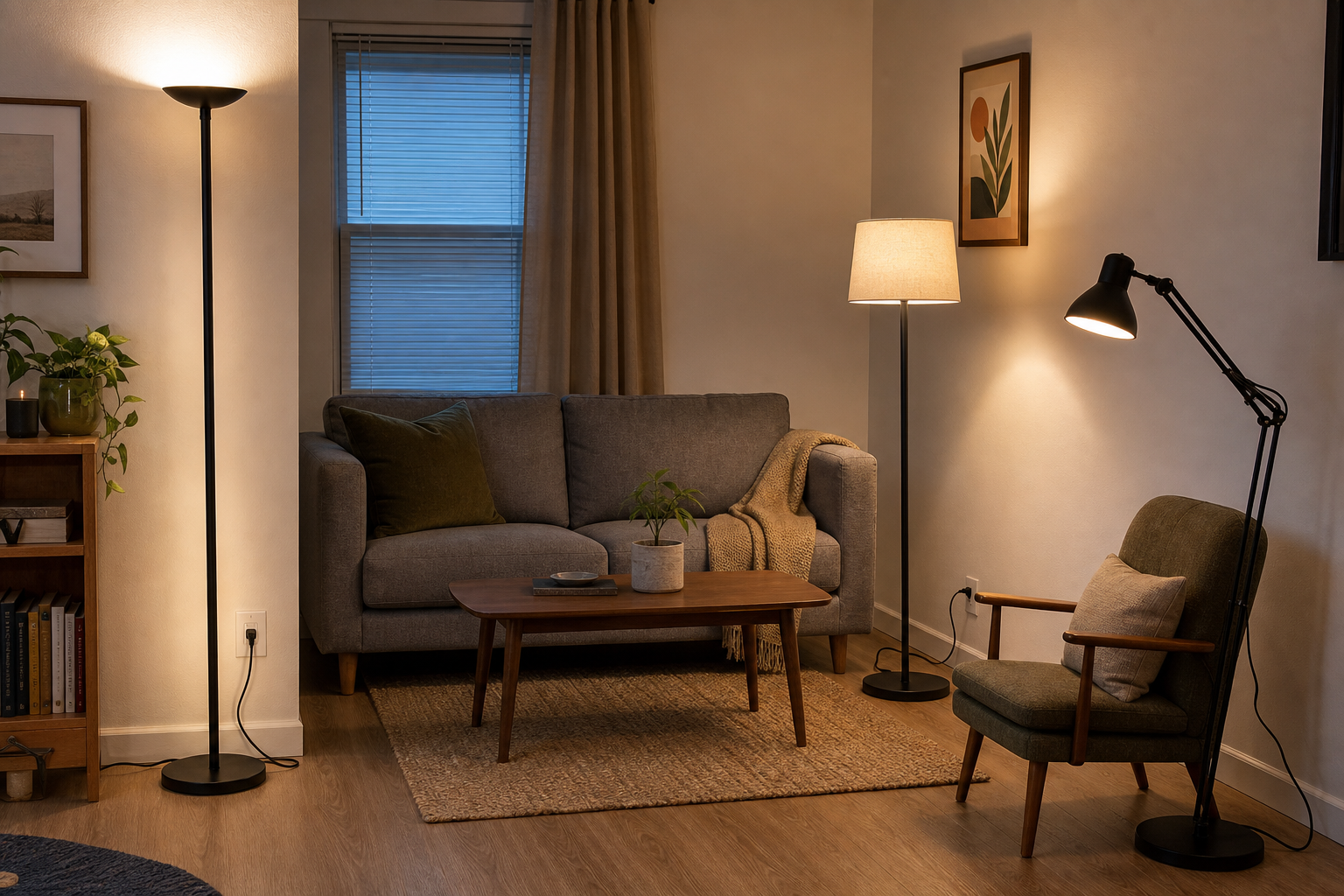
The best floor lamp for a small living room fits a real gap beside your furniture, sends light where the room needs it, and keeps its base and cord out of the walking path. A slim shaded lamp is the safest all-around starting point; choose an uplight for broader ambient light or an adjustable task lamp when reading is the main job.
As an Amazon Associate, The Good Home Doc may earn from qualifying purchases.
Start with the light pattern your room is missing: These affiliate category links are shopping starting points, not tested rankings.
- Browse category: Slim shaded floor lampsA practical all-purpose choice for soft light beside a sofa or chair.
- Browse category: Dimmable torchiere lampsUseful when a dark room needs broader light bounced from the ceiling.
- Browse category: Adjustable task floor lampsBest when one seat needs focused reading or craft light.
Confirm the base diameter, total height, shade or arm clearance, listed bulb limits, switch location, cord length, assembly, return policy, and manufacturer instructions before buying.
This is a best-fit category framework, not a brand ranking or hands-on test. It belongs to the home comfort and setup upgrades guide. If you have a surface available and need localized light instead, compare the table lamp guide for dark apartments.
Quick Picks by Room Problem
- Best for most small living rooms: a slim shaded lamp with a weighted base, replaceable bulb, and switch you can reach from the main seat.
- Best for a room with no ceiling light: a dimmable torchiere that throws light upward onto a light-colored ceiling.
- Best beside a reading chair: an adjustable task lamp whose shade can sit above and slightly behind the reader's shoulder.
- Best behind a sectional: an arc lamp only when its heavy base can sit fully under or beside furniture and the arm clears heads and traffic.
- Best to skip: any lamp whose base narrows the walkway, whose shade creates eye-level glare, or whose cord must cross open floor.
Comparison Framework
Slim Shaded Floor Lamps
A straight pole, compact base, and fabric or opaque shade make this the easiest format to fit beside a sofa. The shade spreads light at seated eye level, so its height and opacity matter as much as the lamp's width.
Choose one if: you want flexible ambient light and can place the shade above seated sightlines. Skip it if: the only available spot leaves the bulb visible from the sofa or puts the base in a doorway.
Torchiere Uplights
A torchiere directs most of its light toward the ceiling. It can make a small room feel evenly lit without consuming a table, especially when the ceiling is low, light-colored, and unobstructed.
Choose one if: the room feels dim overall and you want broad ambient light. Skip it if: the ceiling is very dark or high, the top will sit near curtains, shelving, or other materials, or upward glare is uncomfortable.
Adjustable Task Lamps
Task lamps use a pivoting shade, gooseneck, or jointed arm to aim light at a book, puzzle, desk, or craft. Their focused beam can leave the rest of the room dark, so they often work best as one layer rather than the only lamp.
Choose one if: one seat has a clear activity and the controls are easy to reach. Skip it if: the arm swings into a walkway, the joints drift, or the narrow beam will be harsh for other people in the room.
Arc Lamps
Arc lamps can bring light over a coffee table or sectional without a ceiling fixture, but they are not automatically small-space lamps. The long arm, large shade, and counterweighted base demand careful measuring.
Choose one if: the base can stay protected by furniture and the arc clears standing and seated heads. Skip it if: the room is frequently rearranged, children or pets may pull the lamp, or the base would create a trip point.
Measure the Lamp Zone Before Shopping
- Measure the open floor rectangle where the base will sit, including baseboards and furniture feet.
- Keep the normal walking route clear; do not count space people use to enter, sit down, open a recliner, or reach a balcony door.
- Measure from the floor to seated eye level and to the top of nearby furniture. Compare those numbers with the shade and switch height.
- Locate the outlet and measure a route along the wall. Do not plan on stretching a cord across a doorway or under a loose rug.
- For adjustable or arc lamps, map the full arm and shade sweep, not just the base.
Must-Have Selection Criteria
- A base that fits completely: all feet or the full base should rest flat on one stable surface, not half on a rug edge.
- Useful light direction: choose upward light for room ambience, shaded sideways light for conversation areas, and focused light for reading.
- Stable proportions: a taller or longer-reaching lamp needs a base designed for that leverage. Do not hide wobble with furniture.
- Reachable controls: a switch at hand height or a simple foot switch placed outside the walking path makes daily use realistic.
- Clear bulb guidance: follow the maker's socket type, maximum wattage, enclosed-fixture limits, and dimmer compatibility.
- Safe cord routing: the supplied cord must reach the outlet without tension, pinching, or crossing an open path.
Nice-to-Have Features
- Dimming: helpful in a multipurpose room, provided the included or chosen bulb is compatible with the lamp's dimmer.
- Replaceable bulb: gives more choice over brightness and color temperature than a permanently integrated light source.
- Multiple light levels: useful when the same lamp supports conversation, television, and reading.
- Opaque lower shade: can reduce seated glare while still spreading light around the room.
- Simple assembly: fewer threaded pole sections and a clear shade attachment can make the lamp easier to tighten and maintain.
Brightness, Bulbs, and Glare
Brightness claims are useful only when paired with the room and light direction. An uplight may need more output than a reading lamp because it bounces light before it reaches the room. A bare or clear bulb can feel harsh even when its output number looks modest.
For a calmer living room, choose a shielded shade and a color appearance that works with your other lamps. If a lamp includes an integrated LED, check whether the light source is replaceable, how dimming works, and what happens if the LED or driver fails. Never install a bulb that exceeds the lamp maker's limit.
Placement Around Children, Pets, and Busy Paths
No freestanding lamp is impossible to tip. Put the base on a flat, firm surface and keep it away from play zones, pet zoom paths, door swings, and furniture people use for support. Route the cord where it will not invite pulling or chewing, and follow the manufacturer's placement instructions.
If the only available location is unstable, blocks egress, crowds a heater, or requires unsafe cord routing, skip the floor lamp. A table lamp on stable furniture, an approved plug-in wall light, or landlord-approved fixed lighting may suit the room better.
Who Should Skip Each Type
- Skip a torchiere if the ceiling and upper wall surfaces will not reflect light well or the lamp top cannot maintain the maker's required clearance.
- Skip a task lamp if several people need even room light or the movable arm will be bumped repeatedly.
- Skip an arc lamp if you cannot protect its base and overhead sweep with a stable furniture layout.
- Skip integrated LEDs if long-term bulb replacement matters more than a slim, built-in design.
- Skip smart-only controls if guests or household members need the lamp to work without an app, account, or network.
A Practical Two-Lamp Setup
One floor lamp rarely does every job well. In a small room without a ceiling fixture, use one broad ambient source near the room edge and one lower-output task or table lamp near the seat used for reading. Separate controls let you use only the light you need, and two moderate sources often feel more comfortable than one glaring lamp.
If outlets are scarce, do not improvise with hidden daisy-chained extensions. Follow the lamp and power-device instructions, keep plugs accessible, and ask a qualified electrician to assess damaged, warm, loose, or insufficient outlets.
Bottom Line
For most small living rooms, start with a slim shaded floor lamp that has a weighted base, reachable controls, replaceable bulb, and a cord that reaches the wall without crossing the room. Choose a torchiere when the whole room needs ambient light, a task lamp for one focused seat, and an arc lamp only after measuring its full footprint and sweep. The best choice is the lamp that improves the room without becoming another obstacle.