Best Countertop Mug Racks for Small Kitchens
A countertop mug rack earns its space only when it frees a crowded cabinet without making the worktop harder to use. The best format fits your actual mugs, stays steady during one-handed removal, and leaves enough clear counter for cooking and cleanup.
As an Amazon Associate, The Good Home Doc may earn from qualifying purchases.
Compare the format that fits your mugs and counter:
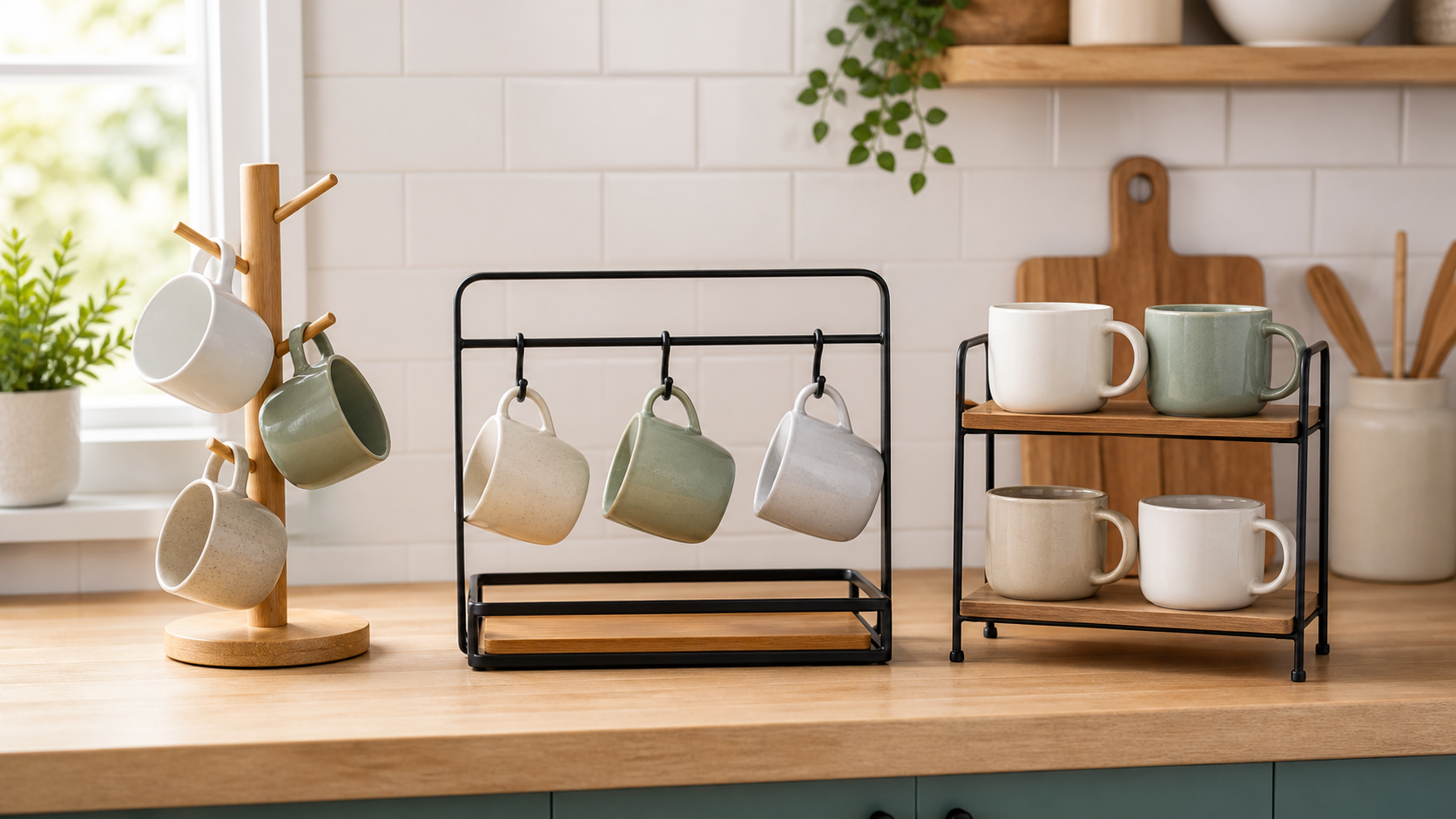
- Browse category: Compare countertop mug treesA small base can save surface area, but arm spacing and balance matter with large or uneven mugs.
- Browse category: Compare horizontal countertop mug racksA wider footprint can make handles easier to reach and keep mugs from colliding.
- Browse category: Compare shelf-style mug standsUseful for handle-heavy mugs when shelf height, depth, and edge protection all fit.
These are category searches, not tested rankings. Confirm current dimensions, mug capacity, spacing, materials, care instructions, stability guidance, and return terms before buying.
This guide compares freestanding countertop formats, not under-cabinet hooks or wall-mounted rails. It does not name product winners or claim hands-on testing. Use the measurements and failure points below to narrow the category before checking a current listing.
Quick Best-Fit Guide
- Best for the smallest surface footprint: a compact mug tree, provided its base and arm layout remain stable with your mug mix.
- Best for easy handle access: a horizontal hook rack with enough space between hanging points.
- Best for awkward handles: an open shelf-style stand that does not depend on handle openings.
- Best for a coffee station: a low rack that clears upper cabinets, appliance lids, water tanks, and cords.
- Best when every inch of counter is used: skip the category and improve cabinet storage instead.
Measure the Mugs Before the Rack
Measure your widest mug body, overall height, handle opening, and how far the handle projects. For a hanging design, the hook must enter the handle without forcing it, while the space below keeps the mug off the base or counter. Check whether neighboring mugs touch when you remove one.
Outline the listed width and depth on the counter with removable tape. Include feet and mug overhang, then open nearby drawers, cabinet doors, appliance lids, and the dishwasher. Measure upward too; a tall tree can fit while leaving too little clearance to lift off the top mug.
Comparison Framework
Mug Trees
A central post with radiating arms uses a compact base. The tradeoff is balance: loading one side first, mixing heavy and light mugs, or pulling outward can make a narrow tree less settled.
Choose one when: counter width is the main constraint, handles fit the arms, and you can load opposite sides evenly.
Horizontal Hook Racks
A framed rack spreads hanging points across a wider base. This provides separation and predictable removal, but consumes more linear space and wide mugs reduce usable capacity.
Choose one when: you have a narrow strip of counter, want handles facing forward, and have measured mug spacing and frame height.
Shelf-Style Stands
Small freestanding shelves hold mugs by their bases. They accept more mug shapes, but stacked mugs can chip and open edges need enough containment to prevent sliding during a bump.
Choose one when: mugs do not hang well, openings fit their height, and each mug comes out without moving several others.
Must-Have Buying Checks
- Verified footprint: Use the widest and deepest dimensions, including feet and mug overhang.
- Mug compatibility: Check diameter, height, handle opening, and projection against usable spacing.
- Stable loading: Favor a broad, flat base and follow maker placement, capacity, and loading guidance.
- Clean removal: One mug should lift out without striking the backsplash, cabinet, or neighbors.
- Counter-safe contact: Feet should suit the counter, sit flat, and avoid trapping scratch-causing grit.
- Maintainable material: Follow cleaning and drying instructions for painted metal, wood, or mixed materials.
Nice-to-Have Features
- Padded feet: Helpful when securely attached and easy to clean around.
- Replaceable caps: Useful when contact points wear, if replacements are available.
- An open frame: Fewer crevices make splashes and dust easier to wipe.
- Mixed storage: A filter tray helps only if it does not crowd mug removal.
What to Avoid
Avoid choosing by advertised mug count alone. Capacity can assume small, uniform cups and falls with wide bodies or oversized handles. Skip sharp contact points, rocking bases, and tall designs that require tilting mugs into an upper cabinet.
Keep the rack away from sink splashes, a hot cooktop, and appliance vents. It is storage, not a drying rack: dry mugs fully first and follow material-care instructions.
Who Should Skip a Countertop Mug Rack
- Skip one if it reduces your only safe food-preparation area or blocks an appliance.
- Skip hanging formats for unusually small, thick, fragile, or inconsistent handles.
- Skip a tall tree when cabinet clearance makes the top arms awkward.
- Skip open storage where grease, dust, or splashes make mugs harder to keep clean.
- Skip freestanding storage where children, pets, cords, or traffic make tipping likely.
Buying Checklist
- Measure the widest and tallest mugs you use.
- Measure handle openings and projection.
- Mark rack footprint and mug overhang on the counter.
- Check cabinet height, appliances, drawers, and cleaning access.
- Compare stability, spacing, material care, feet, and stated capacity.
- Plan loading, unloading, wiping, and drying.
- Keep cabinet storage if the rack creates more crowding than it solves.
Bottom Line
A mug tree is the starting format when footprint matters most, a horizontal rack suits clear handle access, and a shelf stand handles more mug shapes. The useful choice is not the highest claimed capacity; it is the rack that fits your mugs, clears the cabinets, stays settled, and leaves the kitchen easier to use.