Best Countertop Produce Baskets for Small Kitchens
A produce basket is useful only when it keeps room-temperature food visible and reachable without swallowing the prep area. The right format fits the counter, leaves air around the contents, separates easily bruised items, and is simple enough to empty and clean.
As an Amazon Associate, The Good Home Doc may earn from qualifying purchases.
Compare the storage format that fits your counter and routine:
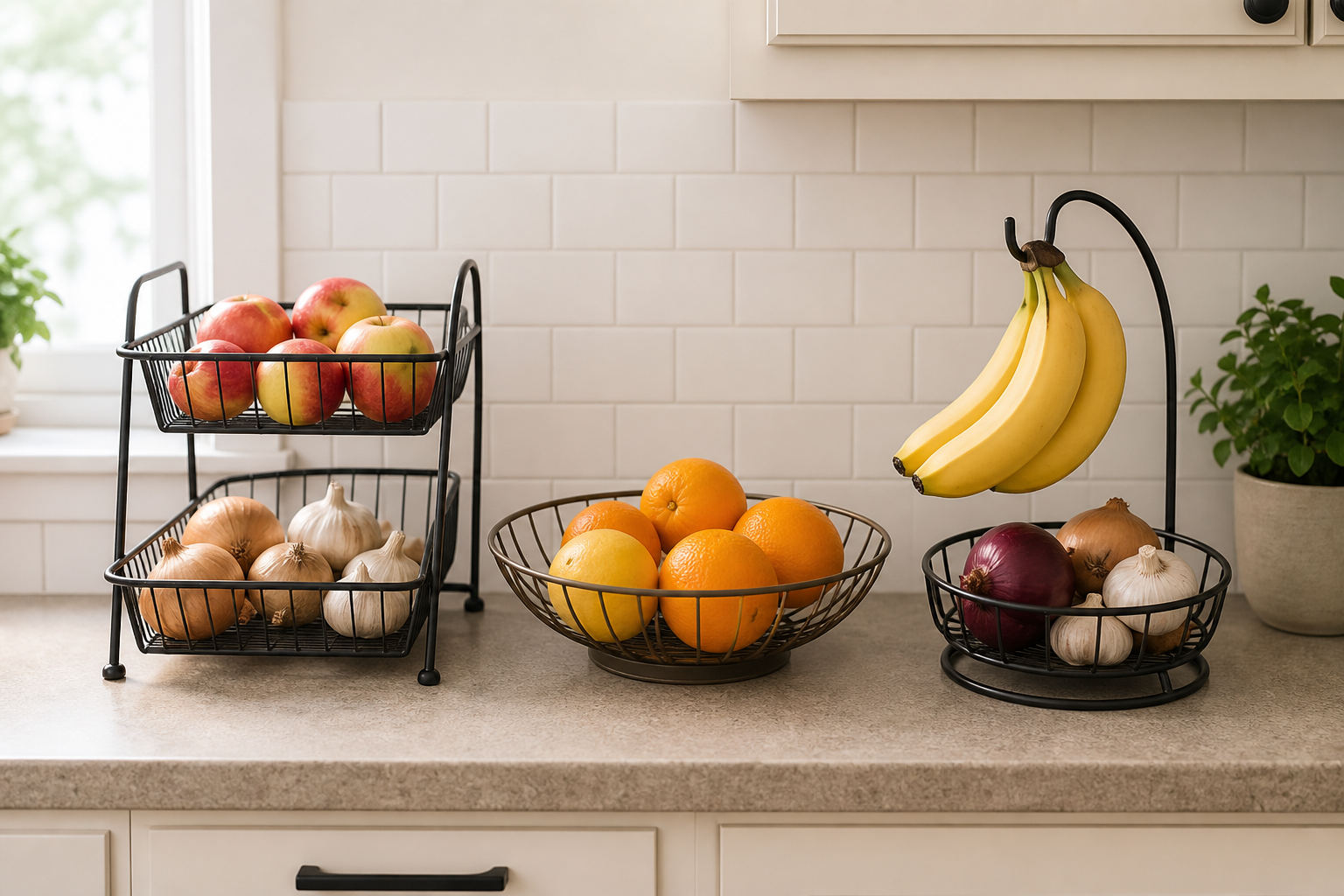
- Browse category: Compare two-tier countertop produce basketsVertical storage saves width, but useful tier spacing and a stable loaded base matter.
- Browse category: Compare open countertop fruit bowlsA low bowl keeps contents visible and easy to rotate, but offers little separation.
- Browse category: Compare banana hangers with produce basketsA hanging arm separates bananas when the overall height, balance, and bowl capacity fit.
These are category searches, not tested rankings. Confirm current dimensions, materials, care instructions, assembly, stability guidance, and return terms before buying.
This is a category comparison, not a list of named winners. It covers open storage for produce that you already keep at room temperature; follow storage directions for each food and do not use a basket as a reason to leave refrigerated items out.
Quick Best-Fit Guide
- Best when counter width is tight: a two-tier basket with enough vertical clearance to reach the lower tier.
- Best for visibility and quick rotation: a shallow open bowl that keeps the bottom layer easy to inspect.
- Best for separating bananas: a hanger-and-basket combination with a broad, stable base.
- Best for carrying produce elsewhere: removable bowls or baskets with comfortable, firmly attached handles.
- Best when prep space is already scarce: skip countertop storage and use a ventilated cart, pantry shelf, or another suitable location.
Measure the Working Footprint
Use the product's widest and deepest dimensions, including feet, handles, and any outward curve. Mark that footprint with removable tape, then check the space left for a cutting board, small appliances, drawers, and cabinet doors. A basket that technically fits can still make the kitchen harder to use.
Measure upward to the cabinet or shelf above. For tiered designs, check the clear opening above the lower basket—not just the total frame height—so you can place and remove produce without scraping it against the tier above.
Comparison Framework
Two-Tier Baskets
Tiered baskets use height instead of spreading produce across the counter. They can separate categories, but a cramped lower tier hides food and a top-heavy load can make a narrow frame less settled.
Choose one when: vertical clearance is generous, both tiers remain visible, and the base stays flat under the way you expect to load it.
Open Bowls and Low Baskets
A single open container is the easiest format to see, reach, and wipe. The tradeoff is mixing: piling firm, heavy produce over delicate items increases pressure and makes the bottom harder to inspect.
Choose one when: you buy modest quantities, rotate them often, and can keep the layer shallow.
Hanging Stands with a Basket
A banana arm adds separation without a second container. It also adds height and leverage, so hook clearance, bunch size, and base stability matter more than claimed total capacity.
Choose one when: you regularly store bananas, have clear space above, and the stand remains balanced as items are removed.
Removable or Nesting Baskets
Removable bowls make carrying and cleaning easier, while nesting designs can adapt as quantities change. Extra joints and contact points can trap debris, so inspect how each part lifts out and goes back securely.
Choose one when: cleaning access and flexible separation matter more than the smallest possible frame.
Must-Have Buying Checks
- Honest footprint: Include handles, feet, hanger arms, and produce overhang in the measurement.
- Open airflow: Favor spacing that does not press produce against a solid, damp, or hard-to-clean bottom.
- Useful tier clearance: Your hand and typical produce should pass through the lower opening comfortably.
- Stable loading: A flat, broad base should remain settled when one side or tier is emptied first.
- Produce separation: The format should let you keep easily bruised items away from heavier ones.
- Complete cleaning access: Crumbs, skins, and moisture should be reachable without complicated disassembly.
- Suitable material care: Follow the maker's washing, drying, coating, and food-contact instructions.
Nice-to-Have Features
- Removable bowls: Helpful for carrying and cleaning when they lock back into the frame securely.
- Wide openings: Easier to load without pressing produce against an upper rim.
- Protective feet: Useful if they sit flat, remain attached, and do not trap grit or water.
- Simple construction: Fewer tight seams and decorative crevices usually mean easier wiping.
What to Avoid
Avoid choosing by advertised piece count. Apples, onions, squash, citrus, and bananas differ too much in size and weight for that number to predict a useful load. Skip a tiered frame if the bottom contents disappear from view or require unloading the top to reach.
Do not crowd produce against a sunny window, cooktop, sink splash zone, or appliance exhaust. Inspect items regularly and clean the basket when spills, skins, or soft produce leave residue. Storage needs vary by food, so use appropriate guidance rather than assuming every item belongs together.
Who Should Skip a Countertop Produce Basket
- Skip one if it takes away the only practical food-preparation surface.
- Skip open storage if direct sun, heat, grease, or frequent sink spray reaches the spot.
- Skip deep bowls if you tend to forget what is underneath the top layer.
- Skip tall or hanging formats beneath low cabinets or where a loaded arm could be bumped.
- Skip mixed storage when your usual produce needs different conditions or bruises easily.
- Skip freestanding countertop storage where children, pets, appliance cords, or a busy edge make tipping likely.
Buying Checklist
- List the room-temperature produce you actually buy in a normal week.
- Measure the full counter footprint and overhead clearance.
- Check lower-tier access with your hand and typical produce sizes.
- Plan which items need separation and how you will avoid deep piling.
- Compare base stability, removable parts, openings, and material care.
- Confirm you can lift, empty, wipe, and dry every surface.
- Keep the counter clear if the basket creates more crowding than order.
Bottom Line
A two-tier basket is the practical starting point when width is scarce, a shallow bowl works for modest quantities you inspect often, and a hanger combination helps separate bananas when height and balance allow it. The best fit is the format that preserves prep space, keeps contents visible, and makes rotation and cleaning easier.